January 8, 1925
The Heart of a DogJanuary 8, 1925 marks the turning point in Doctor Bormenthal’s clinical record: the experiment has not rejuvenated a dog but transformed it into a human-like organism. The date gathers the experiment’s consequences into view—physical change, contested naming, public rumor, and the competing documents through which the transformed creature’s identity is recognized or denied.
Diagnosis and First Steps
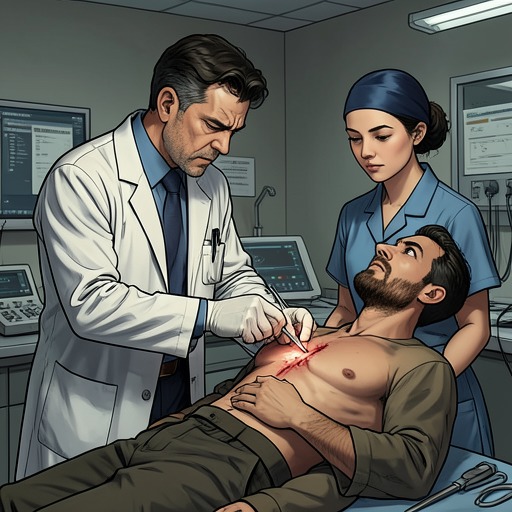
In an entry dated January 8, Doctor Bormenthal records that he and Professor Preobrazhensky have finally agreed on the diagnosis. With what the notes describe as scholarly impartiality, the professor acknowledges his error: transplantation of the pituitary induces “total humanisation,” not rejuvenation. The correction revises the experiment’s central premise without diminishing, in the professor’s assessment, the value of the discovery.
The same entry records the creature walking around the flat for the first time. It laughs after looking at an electric light, then enters the study with Professor Preobrazhensky and Doctor Bormenthal. The notes describe it as standing on two legs and giving the impression of a short, ill-knit human male. Its laughter and changed posture make the diagnosis visible in ordinary movement: the transformation is no longer confined to an operation or a hypothesis.
From Dog’s Name to Human Name
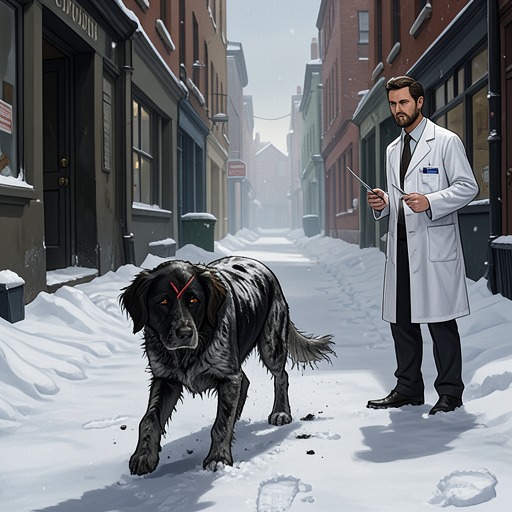
The records preserve the name’s earlier beginning. When Professor Preobrazhensky first calls the dog Sharik, the animal accepts the name in exchange for the food that has revived it. The name initially belongs to a dog addressed by its benefactor; it carries no documented claim to legal or family status.
After the transformation, the man supplies a human name. Asked what he proposes to call himself, he replies, “Tолigraph Poligraphovich.” The notes render this as “Tолigraph,” but the canonical name he later asserts is Poligraph Poligraphovich Sharikov. When asked what surname he will take, he says he will use his real name. The change from Sharik to a full personal name marks a shift from a name bestowed on an animal to an identity the transformed man claims for himself.
That claim immediately meets institutional resistance and negotiation. Shvonder proposes a certificate identifying the bearer as Poligraph Poligraphovich Sharikov and describing him as born in the flat. Professor Preobrazhensky rejects the formulation as absurd, insisting that Sharikov was not born there. The dispute exposes the gap between biological creation in the apartment and the administrative language needed to establish a person’s identity.
Public Attention and Documentary Record
The experiment’s consequences escape the household before its meaning is settled. Rumors draw crowds to the street, with onlookers and old women gathering outside and dogs clustering beneath the windows. Newspapers circulate incompatible fabrications: one dismisses a supposed Martian in Obukhov Street as a rumor, while another claims a child has been born able to play the violin. Telephone calls make consultations impossible, and the telephone is cut off. The public story grows faster than the researchers’ ability to control or explain it.
Doctor Bormenthal’s notes make the dated diagnosis part of a larger documentary sequence. He records that Professor Preobrazhensky remains unwell and that he himself is carrying out most observations, including pictures and recordings. The case record concludes that there is now a new organism to be studied as such, with speech reports, recordings, and photographs listed as appendices. The date therefore marks not only a conclusion about the operation but a change in the object of inquiry: the experimental dog is now treated as a distinct organism.
Identity Put on Trial
The name later becomes part of a formal accusation. In a document signed by Sharikov as a controller in the City Cleansing Department and countersigned by Shvonder, Sharikov accuses Professor Preobrazhensky of threatening the house committee chairman, making counter-revolutionary speeches, ordering Zinaida Bunina to burn Engels, and concealing Doctor Bormenthal’s unregistered residence. The allegations show the new identity operating in public and political life, while the supporting document ties Sharikov to the very committee whose representative had helped arrange his certificate.
In the final investigation, the authorities read an accusation that Professor Preobrazhensky, Doctor Bormenthal, Zinaida Bunina, and Darya Ivanova murdered Poligraph Poligraphovich Sharikov. Professor Preobrazhensky responds by denying that this named person is present, then identifying him as the dog he operated on. The date’s clinical recognition of humanization thus stands in sharp contrast with the ending’s strategic reclassification: the name first claimed by the transformed creature is invoked in an official charge, while the professor answers by recalling the animal origin the paperwork cannot settle.