Philip Preobrazhensky and Sharikov relationship
The Heart of a DogProfessor Preobrazhensky and Sharikov’s relationship changes from a guarded encounter between a stray dog and a potential benefactor into a creator-and-creation conflict. The professor first approaches Sharik with food and a searching but gentle gesture; after the operation, he calls the transformed man his father and takes the name Poligraph Poligraphovich Sharikov. Yet the professor ultimately distances himself from that identity, calling the returned dog his own animal and denying that Sharikov is someone he recognizes. The relationship exposes the unstable boundary between care for an animal, responsibility for an experiment, and acceptance of the person that experiment produces.
First Encounter and Early Attachment
Before the operation, Sharik interprets passersby through their eyes, which he takes as signs of character and fear. When the well-dressed gentleman approaches, he calls the dog by name and offers food. The exchange gives the professor an early role in Sharik’s life not merely as an observer but as someone who feeds and addresses him. Sharik’s attention to the gentleman’s appearance and manner also establishes the unevenness of their first relationship: the dog watches and judges the human before the human takes him in hand.
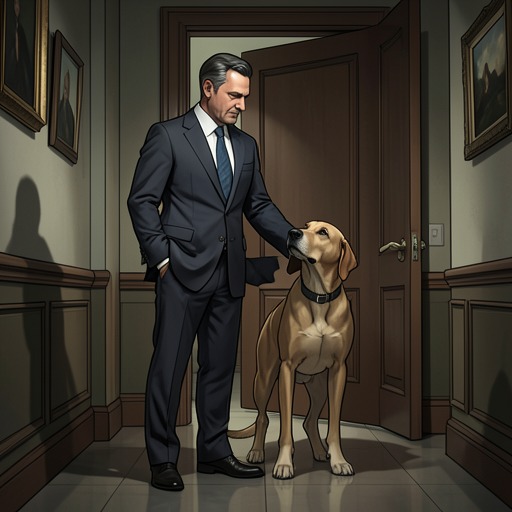
The professor’s contact is unexpectedly gentle. He bends over Sharik, looks closely into his eyes, and strokes his stomach through a glove. The gesture follows his command and inspection, joining an air of authority to a moment of intimacy. It foreshadows the relationship’s recurring combination of care and control: Sharik is treated as a living being to whom the professor has grown attached, but also as the subject of a medical intervention directed by the professor.
That attachment is explicit on the eve of the operation. Explaining to Doctor Bormenthal that the crucial moment will come when he enters the Turkish saddle and that the gland must then be passed to him immediately, the professor acknowledges the grave risk to the dog. He pauses over Sharik’s half-closed eye and admits that he feels sorry for him and has grown used to having him around. His concern does not stop the procedure, but it makes clear that the operation is not emotionally indifferent to him: the dog’s life and their established companionship remain present even as he proceeds with the experiment.
A New Name and Claimed Kinship
After the transformation, the man asks the professor not to be so hard on him and calls him Dad. The address proposes a familial bond, but the evidence does not show the professor accepting it as an uncomplicated relationship. Instead, the new identity is also negotiated through a name. Asked what surname he will take, the man identifies himself as Poligraph Poligraphovich; Shvonder then suggests preparing a certificate that would formally identify him as Poligraph Poligraphovich Sharikov, born in the flat.
The naming process gives their conflict a public and administrative dimension. The professor’s role in producing the new being is part of the background to the claimed father-child relationship, while Shvonder’s proposed certificate would make the name legible to an institution. The evidence thus distinguishes personal address from official recognition: the man calls the professor Dad, but his surname and registration are discussed as matters to be documented. The professor’s creative authority does not by itself settle who Sharikov is or how others must recognize him.
Rejection of the Experiment’s Result
Later, the professor describes the outcome of his discovery as a burden that will remain attached to him. He recalls years spent studying cerebral appendages and contrasts that research with the result: a dog transformed into a human specimen he finds repellent. His words make the creation-and-creator relation explicit, but not in the reassuring terms of paternal pride. The experiment’s result is instead a consequence he believes he must live with, and the transformation that began as scientific work has become a personal and professional reckoning.
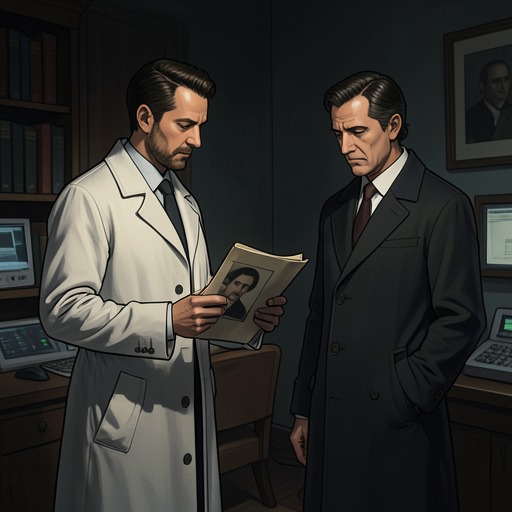
The relationship reaches its sharpest break after Sharikov returns by lorry and is called into the consulting room. He enters surprised and vaguely frightened, first looking at Bormenthal and then at the professor, whose hand rests on the handle of the obstetrical chair. The scene places the two men together again under the shadow of the medical setting where their altered relationship took shape. The evidence does not disclose the crime’s details in this passage, but it records the charged encounter that precedes the official accusation.
The Moscow Cleansing Department subsequently charges Preobrazhensky, Bormenthal, Zinaida Bunina, and Darya Ivanova with the murder of Poligraph Poligraphovich Sharikov, identified as a sub-department controller. In response, the professor asks who Sharikov is and says that the questioner must mean his dog, the one he operated on. The denial sharply reverses the earlier claim of kinship: where Sharikov had called him Dad, the professor now recognizes him as a dog and disavows the official human identity named in the charge.
The Restored Dog and the Relationship’s Irony
The professor later states that science has not yet found a means of turning animals into people and acknowledges that he tried. This retrospective formulation frames the experiment as a failed attempt rather than a successful creation of a lasting human identity. In the relationship’s final terms, the professor’s connection to Sharik is renewed through the dog, while his connection to Sharikov is rejected. The distinction preserves the professor’s attachment to the animal even as it denies the transformed person’s claim to a place in that bond.
The relationship’s central irony is therefore not simply that a scientific creator loses control of his creation. The professor’s affection predates the experiment, and he recognizes his attachment even while proceeding despite the risk. But care for Sharik does not translate into acceptance of Sharikov. The changing names—from Sharik, to Poligraph Poligraphovich Sharikov, and finally to the professor’s dog—mark competing claims about identity and belonging. The relationship ends with a deliberate separation between the animal the professor says he operated on and the human being the authorities name as a victim, leaving the experiment’s responsibility entangled with the professor’s refusal to acknowledge its human result.