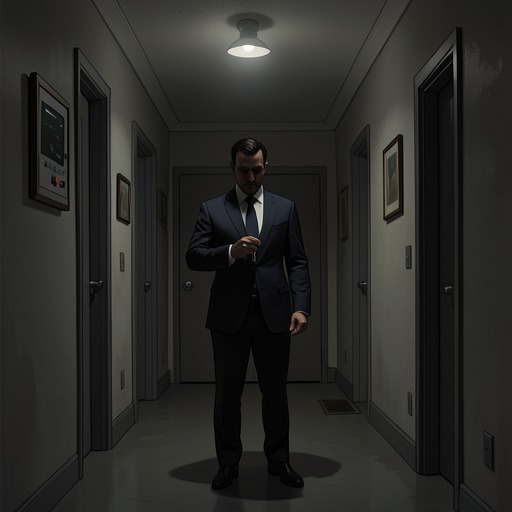
Preobrazhensky’s apartment
The Heart of a DogPreobrazhensky’s apartment is a seven-room home whose rooms are also the infrastructure of Professor Preobrazhensky’s medical practice. When the building’s management committee demands that he surrender space, the flat becomes the scene of a struggle over who can define its proper use: the committee invokes collective occupancy, while the professor insists that domestic rooms, clinical work, and professional independence cannot simply be rearranged by decree. Later, Sharikov invokes his status as a residential-association member to demand a room allocation, carrying the dispute from committee pressure into the apartment itself.
Layout and Use
The apartment’s seven rooms are not presented as surplus space detached from work. Preobrazhensky names them by their functions: a waiting room that must also serve as his library, a dining room, a study, a consulting room, an operating theatre, his bedroom, and the servant’s room. He argues that this arrangement is already insufficient and says he could use an eighth room for a library. The detail matters because the committee’s arithmetic—one man occupying seven rooms—counts rooms while discounting the different activities they accommodate. The distinctions between rooms are practical, not merely matters of comfort. The waiting room doubles as a library; the consulting room and operating theatre are separate parts of the medical practice; the dining room is where the household eats. In defending the arrangement, Preobrazhensky treats the apartment as a connected working environment, not a collection of interchangeable spaces. His insistence that he must examine patients and operate in designated rooms makes the consequences of the proposed redistribution concrete.
The Occupancy Dispute
The management committee arrives saying it has been charged with increasing occupancy. Its members acknowledge that they know the regulation of August 12 exempts the professor’s apartment from an increase, but answer that a general meeting has judged his use of space excessive. They focus especially on the dining room and consulting room, asking him voluntarily to give up the former in the name of labour discipline and asserting that no one in Moscow has a dining room. The exemption therefore does not end the confrontation: the committee substitutes its collective judgment about how much space is appropriate for the regulation’s protection. Preobrazhensky responds by laying out the apartment’s uses and declaring the conversation at an end. When the committee proposes that he eat in the bedroom, he follows the logic of their demand to its absurd conclusion: he would eat in one room, read in another, dress in the hall, operate in the servant’s room, and examine patients in the dining room. He rejects this rearrangement, insisting that he will eat in the dining room and operate in the operating theatre. The room-by-room counterproposal exposes what is at stake: not simply possession of square footage, but the ability to preserve the functions that make the apartment a home and a place of medical work. The professor’s protest also reveals how readily an abstract claim to redistribution collides with the material organization of daily life. The committee speaks in terms of occupancy and collective discipline; Preobrazhensky answers with meals, reading, dressing, examinations, and operations. His appeal to rooms’ actual uses does not make the conflict disappear. Shvonder threatens to complain to higher authority after the professor refuses, and the professor’s sudden, suspicious politeness signals that the visit has become a contest over power as well as space.
From Protected Home to Claimed Entitlement
The later dispute involving Sharikov gives the apartment’s contested status a new form. Sharikov produces three pieces of paper—green, yellow, and white—and says that he is now a member of the residential association. He identifies Preobrazhensky as the tenant in charge of flat No. 5 and claims an entitlement of thirty-seven square feet. The demand converts the earlier argument about the professor’s seven rooms into a direct claim on the space from within the household: a formally stated measure and membership status are brought against the existing arrangement of rooms and work. The two confrontations are linked but not identical. The committee had pressed Preobrazhensky to surrender his dining room despite the occupancy exemption; Sharikov now presents papers and invokes a specific area he says he is owed. In both cases, the apartment is treated as space that can be assessed and apportioned through institutional claims. Yet the later demand makes the pressure more intimate: the dispute is no longer only a committee’s visit but a claim addressed to the tenant from inside the apartment’s daily life.
Narrative Significance
The flat’s layout gives an otherwise broad political argument a physical scale. Seven rooms can be counted as an apparent excess, but their named functions disclose a different reality: the same home contains a waiting area, library, study, consulting room, operating theatre, bedroom, and servant’s room. The conflict turns on whether those distinctions are recognized or flattened into a total number of rooms available for redistribution. The apartment consequently serves as more than a backdrop. It is where competing accounts of order become tangible: professional work depends on one arrangement, while the committee’s policy and Sharikov’s later entitlement claim treat the same interior as divisible space. The dining room is especially revealing, since the committee targets it as a privilege and Preobrazhensky defends it as the ordinary place to eat. The struggle over the flat thus joins domestic routine, medical practice, and administrative authority in a single contested setting.