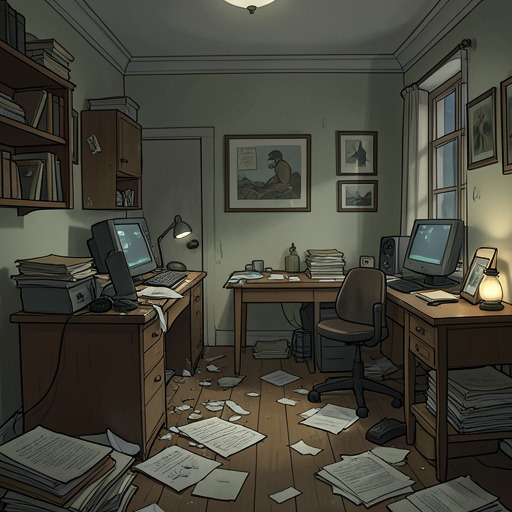
Ruin (social disorder)
The Heart of a DogRuin (social disorder) names the deterioration of ordinary collective life in the apartment building, but Professor Preobrazhensky rejects it as an independent, almost supernatural calamity. For him, disorder has human causes: neglect of work, misuse of shared spaces, and the displacement of practical responsibilities by political talk. His argument runs from stolen galoshes and a bare staircase to the deeper claim that ruin begins in people’s minds—and that domestic order depends on what people actually do.
The House as Evidence
When Shvonder and the other representatives of the house management arrive after a tenants’ meeting about increasing occupancy, Professor Preobrazhensky reacts not chiefly to their presence but to what he imagines their plans may do to the building. His despair turns immediately to the central heating. The scene makes ruin tangible as a threatened domestic system: a dispute over communal housing is already, in his view, a danger to the infrastructure that keeps the house functioning.
The alarm recurs when another general meeting can be heard. Professor Preobrazhensky predicts a sequence of consequences: evening community singing, frozen lavatory pipes, and eventually a boiler explosion. He concludes that the house is finished and says he will have to leave, though he cannot see where he could go. Zina answers that he worries himself to death; his fear is not a general abstraction but a recurring response to signs that the building’s routines and maintenance are being displaced.
His evidence reaches back to his long residence in the house. He says he has lived there since 1903 and that, until March 1917, not a single pair of galoshes disappeared from the rack, even though the front door stood open and patients continually came to his consulting rooms in the twelve-flat building. One day in March 1917, every pair of galoshes vanished, including two of his own; three walking sticks, an overcoat, and the porter’s samovar disappeared as well. Afterward, the rack itself ceased to exist. The before-and-after contrast makes the missing objects a record of a wider change in how residents treat shared property.
The physical alterations of the building extend the same argument. The carpet has been removed from the front staircase, the front entrance of No. 2 Kalabukhov House in Prechistenka Street has been boarded up, and residents must use the back door. Flowers have disappeared from the landing; electricity, which Professor Preobrazhensky recalls failing only twice in twenty years, now goes out regularly once a month. He also complains that people clump up the marble staircase in dirty galoshes and felt boots, while galoshes must be kept under lock and key with a soldier guarding them against theft. The details form a chain: disorder is visible not only in what disappears, but in the defensive arrangements and dirt that replace ordinary care.
What Ruin Means
Professor Preobrazhensky refuses Doctor Bormenthal’s description of the place as going to ruin. He calls ruin a mirage, a vapour, and a fiction, then challenges the idea that it exists as an external agent—a witch with a broomstick smashing windows and putting out lights. His denial does not mean that the damage is imaginary. Rather, he disputes the habit of naming the consequences while leaving their causes vague.
He defines the problem through conduct. If he stopped operating every evening in order to run a glee club in his apartment, that would put him on the road to ruin. If he and the women who work in the household used the floor rather than the lavatory bowl, the lavatory would be ruined. In this formulation, a shared space deteriorates when the people responsible for using it cease to observe basic practices. The building is not damaged by an invisible power called ruin; its condition follows from the habits of those who live and work in it.
The argument turns on a distinction between a thing and the acts that produce its condition. Lavatories are not, by themselves, the cause of ruin; the human behavior that makes them unusable is. Likewise, the vanished rack, stripped carpet, and failing electricity are not merely signs of an abstract historical force. They are evidence of altered habits, neglected work, and a weakened sense of responsibility for spaces shared with others. The concrete domestic examples give Professor Preobrazhensky’s definition its force: what seems like a large social calamity is made and maintained through repeated, ordinary actions.
Work, Speech, and Responsibility
For Professor Preobrazhensky, the remedy begins with a return to practical work. He mocks those who shout about stopping ruin while failing to do the jobs he considers theirs, including sweeping the backyards. His examples widen from the apartment to the tram tracks and public affairs: people cannot, he insists, clean the tracks and settle the fate of Spanish beggars at the same time. The point is not simply that one task is more important than another; it is that proclaiming concern for broad causes cannot substitute for competently performing immediate duties.
Speech itself becomes part of the diagnosis. Professor Preobrazhensky argues that the house, and other houses, will not improve until people stop talking what he regards as claptrap. He imagines a policeman stationed beside every person to moderate outbursts, then insists that the situation will change once the “mad chorus” falls silent. The proposed policing is deliberately severe, but it exposes his conviction that public language has become detached from useful action. In his account, repetitive political slogans do not repair a boiler, restore a staircase, or keep common spaces clean.
The argument also shows the limits and tensions of his position. He speaks with confidence drawn from his own professional work and years in the house, and he treats discipline and competence as indispensable conditions of order. Yet his proposal to restrain speech with police sits uneasily beside his claim that people must correct themselves and get on with their work. The tension sharpens the passage’s portrait of ruin: Professor Preobrazhensky sees disorder as preventable through personal responsibility, but his exasperation leads him to imagine coercion as a way to silence the very public behavior he condemns.
Historical and Narrative Significance
The March 1917 disappearance of the household goods supplies the passage with a historical hinge. Professor Preobrazhensky contrasts a remembered period of order with the losses and deteriorations that followed, then connects that change to the condition of the house in the present. His account is grounded in specific objects and routines rather than a detached political explanation: two pairs of his galoshes, the porter’s samovar, a carpet, a door, flowers, heating, and electricity all become measures of how social change is experienced at home.
Ruin therefore works both as a contested word and as a material condition. Professor Preobrazhensky rejects the word when it obscures agency, but his own catalogue confirms the reality of damaged property, degraded shared spaces, and failing services. The passage’s central contrast is between naming a crisis and accepting responsibility for its causes. By making disorder legible through a lavatory, a staircase, and a heating boiler, it gives a public argument the scale of everyday life: social order is neither an abstraction nor a speech, but a pattern of work, use, and care that can be sustained—or allowed to collapse.