Russian Revolution of 1917
The Heart of a DogThe Russian Revolution of 1917 is invoked as a historical rupture whose consequences are measured in the novel through domestic disorder, contested property, and unstable official authority. Recalling the change in a Moscow apartment building, Professor Preobrazhensky links the revolution’s aftermath to missing possessions and the deterioration of common spaces; later, the transformation of Sharik into Poligraph Poligraphovich Sharikov unfolds amid rumor, paperwork, and accusations that turn private events into public cases.
The Revolution as a Before-and-After
Professor Preobrazhensky dates the breakdown of the building’s former order to March 1917. He says that since moving in in 1903, he had known no instance of galoshes disappearing from the rack, even though the front door stood open and visitors regularly came to his consulting rooms. In March 1917, he recalls, the galoshes vanished along with two of his own pairs, three walking sticks, an overcoat, and the porter’s samovar. The rack itself subsequently ceased to exist. His account makes the revolution legible not through a description of political events, but through a sharp change in what happens to ordinary things.
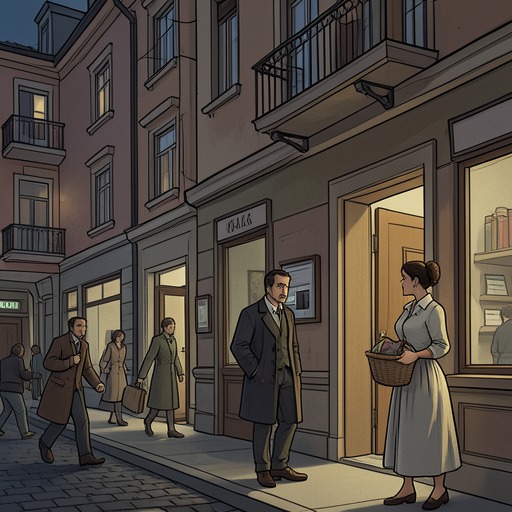
That remembered loss expands into a catalogue of altered communal life. The staircase carpet has been removed; flowers have disappeared from the landing; electricity, which Preobrazhensky recalls failing only twice in twenty years, now goes out regularly; and residents track dirt through the building. The front entrance to Kalabukhov House has been boarded up, forcing people to use the back door, while galoshes are kept under lock and key and guarded against theft. These details present a shared domestic environment in which everyday objects and routines have ceased to be dependable.
Property, Blame, and Social Disorder
Preobrazhensky disputes the suggestion that proletarians do not own galoshes: he insists that they now have the very pairs that disappeared from the rack, and that the missing property was his. The exchange gives the remembered revolution a continuing material consequence, while leaving the original removal unresolved. His speculations about possible culprits are not evidence of who took the galoshes; they dramatize his frustration at a social order in which the loss has not been remedied and ownership has become contentious.
His complaint also challenges the assumption that political change itself explains every practical failure. He objects to the removal of the staircase carpet and asks why Marx would have required a boarded-up front door or dirty boots on the stairs. When he is told that the place is going to ruin, he rejects the word as a misleading abstraction and instead defines disorder through specific failures of work and daily practice. The contrast is significant: the revolution is named as a temporal watershed, but the argument about its consequences turns on conduct, maintenance, and the treatment of shared property.
From Private Experiment to Public Records
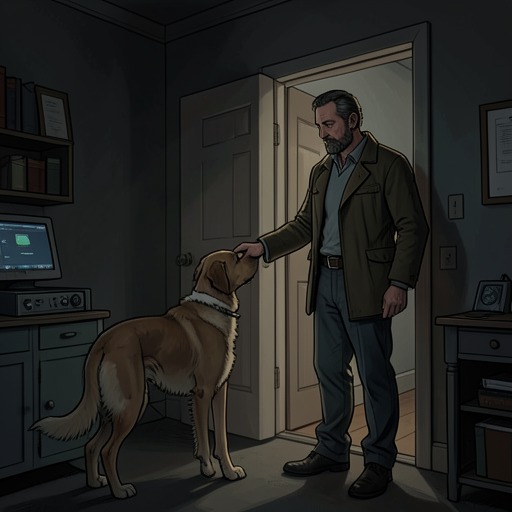
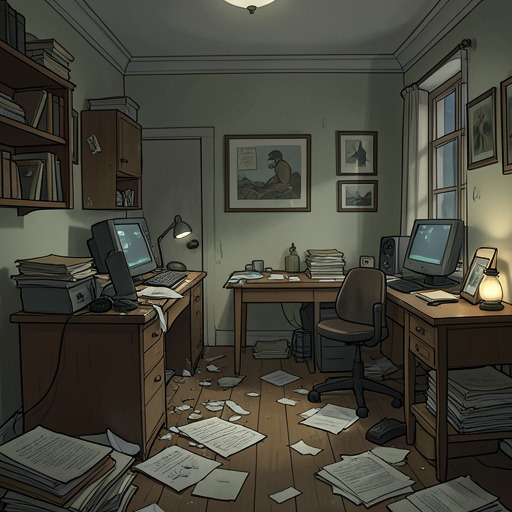
The later plot places this remembered social rupture beside a more extraordinary transformation. A case record identifies the experimental subject as Sharik, a male mongrel approximately two years old. After the experiment, Doctor Bormenthal concludes that a new organism exists and must be studied as such; his signed notes are accompanied by speech reports, recordings, and photographs. The transition from a named dog to a documented organism makes the experiment both a scientific event and an archival one: its progress is recorded through forms that claim to preserve evidence.
That record-keeping does not settle public understanding. Rumors spread through the town, crowds gather in the street, and dogs collect beneath the windows. Newspapers circulate false or sensational accounts, including a report about a child able to play the violin from birth and a photograph captioned as though Professor Preobrazhensky had performed a Caesarean operation. The gulf between the recorded experiment and its public retellings shows how quickly an unusual private event can be recast as rumor and spectacle.
Paperwork later becomes a weapon in the conflict over the transformed Sharik. In a letter countersigned by Shvonder, Sharikov accuses Preobrazhensky of threatening the house committee chairman, making counter-revolutionary speeches, ordering Zinaida Bunina to burn Engels, and concealing Doctor Bormenthal in the flat without registration. These charges transform household disputes into ideological and administrative allegations. At the final confrontation, an official reads out a charge accusing Preobrazhensky, Bormenthal, Zinaida Bunina, and Darya Ivanova of murdering Sharikov. Preobrazhensky responds by treating Sharikov as the dog on whom he operated, refusing the accusation’s premise that the named human being has been murdered.
Narrative Significance
The revolution’s remembered effects and the later documentary conflict are linked by a recurring question: who has the authority to name a change and make that description stick? Preobrazhensky interprets the post-1917 household through lost objects and failed routines; Bormenthal’s notes classify the experiment as a new organism; newspapers and rumors distort it; and Sharikov’s signed complaint recasts domestic conflict as political misconduct. The novel places these competing accounts beside one another rather than allowing any single document to resolve responsibility.
The galoshes, staircase carpet, and samovar give historical upheaval a concrete domestic scale, while the case notes and accusation show official language attempting to fix the meaning of a transformation. The revolution is therefore both a date in Preobrazhensky’s recollection and a framework for the novel’s satire of disorder, property, and bureaucratic power. Its significance lies less in a narrated account of the revolution itself than in the altered routines and contested descriptions through which its aftermath is perceived.