Sharik's restored canine state
The Heart of a DogSharik’s restored canine state is the quiet but decisive ending of Heart of a Dog: after being treated as a human being named Poligraph Poligraphovich Sharikov, he is again a dog in Professor Preobrazhensky’s flat. His comfort is real, but the scar on his skull and the earlier dispute over his name preserve the history of the transformation. The closing contrast between domestic ease and an official murder charge leaves the boundary between dog, created human, and legally recognized person unresolved in public, even as Sharik himself settles back into canine life.
Identity and Return
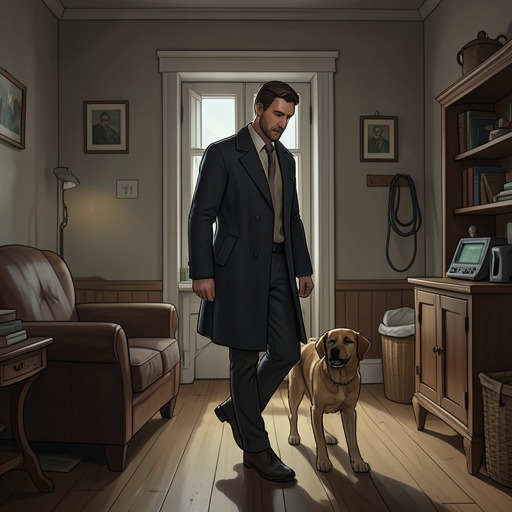
At the close, Sharik lies on the carpet beside the leather couch while Professor Preobrazhensky sits nearby. The dog’s thoughts are contented and practical: he considers himself fortunate, feels settled in the flat, and is uncertain only about his pedigree. He rejects the idea that he has Labrador blood, but treats the matter as unimportant. The former subject of an experiment has returned to an animal’s ordinary domestic perspective, concerned with his place in the household rather than with human status.
The return does not erase the operation. Sharik’s head still bears a circular scar, which aches during the March fog; by evening, the warmth eases the pain. The scar makes the earlier bodily alteration legible within the restored state: he is once again recognizably a dog, but not a dog untouched by what was done to him. The narrative makes recovery a change in condition, not a return to an entirely unmarked past.
Naming and Administrative Identity
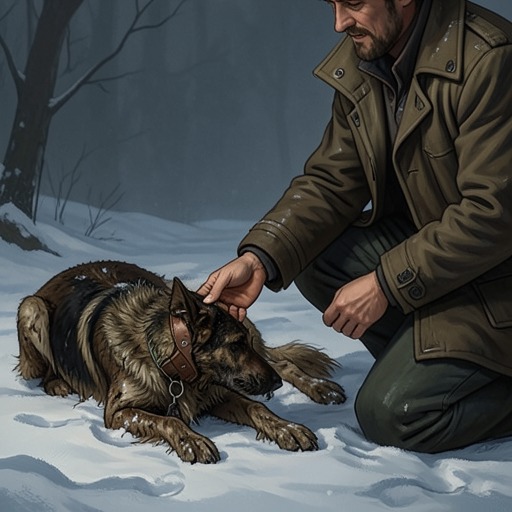
The story’s naming sequence underscores how unstable Sharik’s human identity had been. When addressed as Sharik, the dog accepts the name because it comes with food and rescue; after transformation, the man declares his name to be Toligraph Poligraphovich. Later, when asked what surname he will take, he insists on using his real name. Shvonder then proposes a certificate identifying him as Poligraph Poligraphovich Sharikov and describing him as born in the flat. The certificate would give documentary form to an origin that the professor contests: Sharikov was made through an operation, not born there.
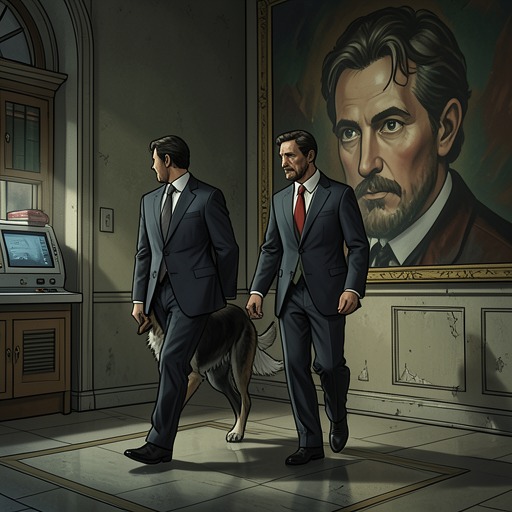
That administrative identity persists even after Sharik has returned to dog form. In the final confrontation, an official reads an accusation charging Professor Preobrazhensky, Doctor Bormenthal, Zinaida Bunina, and Darya Ivanova with the murder of Poligraph Poligraphovich Sharikov, described as a sub-department controller in the Moscow Cleansing Department. The charge treats Sharikov as a person whose death must be investigated; the professor answers by asking who Sharikov is and identifying him instead as the dog on whom he operated. The scene turns the naming dispute into a conflict over what the state recognizes and what the household sees.
The Final Scene and Its Contrast
After the accusation and the professor’s denial, the narrative returns to the flat. The grey accordion-shaped radiators hiss, the blinds shut out the night sky over Prechistenka Street, and Sharik rests beside the leather couch. The domestic setting is calm and familiar, sharply unlike the official scene in which the people in the flat are named as criminal suspects. Sharik’s ease does not resolve that public conflict; rather, it places the charge beside the lived fact of a dog once more at home.
The last image also links the ending to the beginning. The professor, remembered as a benefactor of dogs, sits while Sharik sleeps nearby, and the dog’s earlier gratitude to the gentleman who fed and rescued him is echoed in his conviction that he has been lucky and has found a settled home. The final return therefore restores the original relation between dog and household without pretending that the intervening transformation never occurred. The scar, the remembered human name, and the accusation remain as marks of a history that Sharik himself now regards as largely beyond his concern.
Significance
Sharik’s restored state gives the plot a material ending while withholding a simple social resolution. In the flat, the transformation has been reversed: Sharik is again a dog, comfortable beside the professor. Outside that intimate setting, the name Poligraph Poligraphovich Sharikov continues to carry institutional force, enough to prompt a murder charge. The contrast shows that bodily state, personal naming, and official identity do not coincide automatically.
The ending also shifts the measure of a successful life away from the human status pursued for Sharikov. Sharik values warmth, safety, and belonging in the flat; questions of pedigree and the circumstances of his altered body recede behind that contentment. Yet the story keeps the scar and the accusation in view, so his peace is not presented as proof that the experiment had no consequences. The restored dog is at home, but the human identity created and then lost remains embedded in the world around him.