Sharik’s human-transplant operation
The Heart of a DogSharik’s human-transplant operation is the decisive experiment at the center of the novel: Professor Preobrazhensky and Doctor Bormenthal alter a dog’s body with human organs, and the intended study of rejuvenation produces a humanized creature instead. The operation begins with the dog Sharik, whom the professor has just drawn into his care by offering him sausage and calling him by name. Its outcome reaches beyond the laboratory: Sharik becomes a short, ill-knit human male, is given a personal name and surname, and is eventually identified in an official accusation as a city employee. The procedure thus makes biological transformation inseparable from disputes over identity and recognition.
Purpose and Preparation
The operation is recorded as beginning at 8:05 p.m. on December 23, under anaesthesia. Its stated purpose was to observe the effects of combining pituitary and testicular transplantation, both to study whether the transplanted organs remained functional in a host and to investigate their role in cellular rejuvenation. It was described as the first operation of its kind to be performed in Europe.
Preobrazhensky operated with Bormenthal assisting. The human organs came from a 28-year-old man who had died four hours and four minutes before the operation; the organs had been kept in sterilised physiological fluid. The record specifies chloroform, camphor, and two cardiac injections of adrenalin among the drugs used. These details establish the procedure as a planned experiment, not an emergency treatment: the dog’s body is made the site of an inquiry into transplantation and rejuvenation.
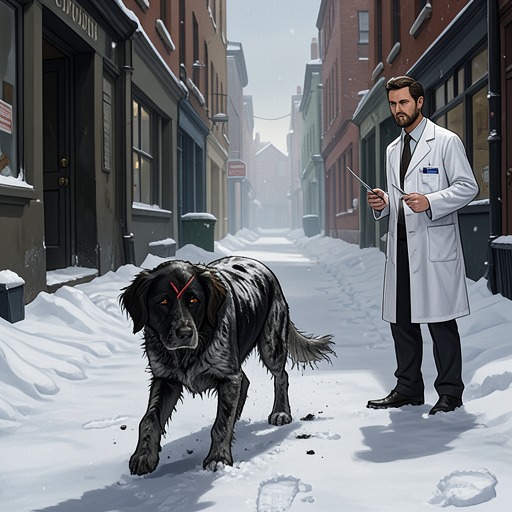
The opening of the experiment follows an encounter in which the professor offers the hungry dog a piece of sausage labelled “Special Cracower” and calls him Sharik. The name first marks a relationship formed through feeding and rescue. It will later be displaced by a human name, so the operation’s identity-changing effects begin within a story that has already made naming part of the bond between the dog and his benefactor.
The Procedure
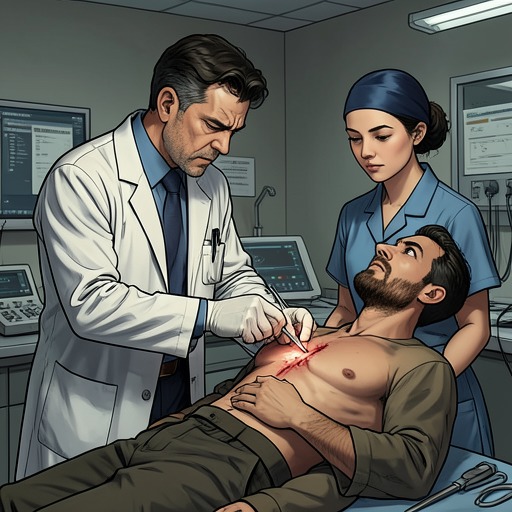
The operation proceeds in two linked stages. First, Preobrazhensky removes Sharik’s testes and replaces them with human testes and associated structures, while Bormenthal manages the surgical work. The operation record confirms that the replacement organs came from the same recently deceased man whose pituitary gland was used in the second stage.
The surgeons then perform a trepanning operation on the skull to reach the pituitary gland. Preobrazhensky removes Sharik’s gland and inserts the human one, securing it with thread before the brain and skull are put back in place. During this part of the procedure, Bormenthal reports that Sharik’s pulse is falling sharply and gives injections as the dog’s condition worsens. The sequence makes the operation’s stakes explicit: the experiment is undertaken to study transplantation, but its subject’s survival is uncertain while the work is still in progress.
The scene’s division of labor is clear. Preobrazhensky directs and performs the crucial interventions; Bormenthal assists, responds to the changing pulse, and administers the injections. Their cooperation enables the experiment, while the clinical record later preserves its aim and materials in a more measured form than the urgent action of the operating room.
Results and Diagnosis
In the days after the operation, the household observes the creature’s emergence into human form. On January 8, the diagnosis is finally settled: Preobrazhensky acknowledges that transplantation of the pituitary has induced total humanization, not rejuvenation. He regards the mistaken prediction as no reason to deny the discovery’s importance. The diagnosis therefore marks a reversal in the experiment’s meaning: the procedure has not achieved its stated line of inquiry as expected, but it has produced a result the professor considers momentous.
That result appears first through movement and speech. The creature walks around the flat, laughs after looking at an electric light, and is described as standing firmly on his legs with the appearance of a short, ill-knit human male. He registers the word “Bourgeois” and swears in a manner the observer describes as mechanical. The transformation is consequently not presented as an instant passage to a fully formed human identity. Physical change is accompanied by speech and human behavior, but the observations also stress their uneven, unsettling quality.
The operation record and the later diagnosis frame the same event from different angles. The record sets out a controlled experimental purpose; the household’s observations document an unexpected result that changes the terms of the inquiry. What was intended to investigate rejuvenation instead gives rise to a humanized being whose behavior and status cannot be resolved by the surgical report alone.
Naming and Public Identity
After the transformation, the creature chooses the given name Poligraph Poligraphovich. Asked what surname he will take, he says he will use his real name. The subsequent request for a certificate turns that private claim into an administrative problem: Shvonder proposes documenting him as Poligraph Poligraphovich Sharikov and describes him as having been born in the flat. The proposed wording makes the operation’s consequence visible in bureaucratic terms—the creature needs a recognized identity, but the circumstances that produced him do not fit ordinary ideas of birth or family origin.
The sequence changes the force of the original name. Sharik was the name by which the professor addressed the rescued dog; Sharikov is the surname attached to the transformed creature in the proposed certificate. The intervening operation helps explain why the change is possible, but it does not itself settle who has the authority to name him or what social standing that name confers. His transformation is therefore biological and administrative at once: a new body prompts a new claim to personhood, while recognition depends on other people and institutions.
The official consequences persist into the novel’s final accusation. A man reading from a paper charges Preobrazhensky, Bormenthal, Zinaida Bunina, and Darya Ivanova with the murder of Poligraph Poligraphovich Sharikov, identified there as a sub-department controller in the Moscow Cleansing Department. Preobrazhensky answers by treating Sharikov as his operated-on dog. The contrast brings the operation’s unresolved identity question back into view: the same being can be described as a human official in an accusation and as a dog by the professor who created the transformation.
Significance
The operation joins scientific intention to an outcome its operators did not predict. Preobrazhensky sought to study whether transplanted organs could function and how they might relate to cellular rejuvenation; his January diagnosis instead names total humanization. That reversal gives the experiment its decisive narrative function: it produces not a restored or rejuvenated dog, but a new, unstable identity whose conduct, name, and legal recognition become matters of conflict.
The novel’s changing names trace that instability with particular clarity. The professor’s affectionate naming of Sharik precedes the humanized creature’s choice of Poligraph Poligraphovich and the proposed registration as Sharikov. Finally, the accusation uses the full name in a legal charge, while the professor refuses its implication by calling the accused his dog. The operation makes this chain of competing descriptions possible, but the chain shows that surgical alteration alone cannot settle the creature’s place in human society.