Sharik’s humanization experiment
The Heart of a DogSharik’s humanization experiment transforms a dog into a humanized creature through the transplantation of human testes and a pituitary gland. Designed to investigate rejuvenation, the operation produces a result Professor Preobrazhensky did not anticipate: the creature develops human form, speech, and a registered identity as Poligraph Poligraphovich Sharikov. The experiment’s significance lies not only in the biological change, but in how quickly a scientific intervention becomes a dispute about naming, personhood, and responsibility.
Experimental Design and Operation
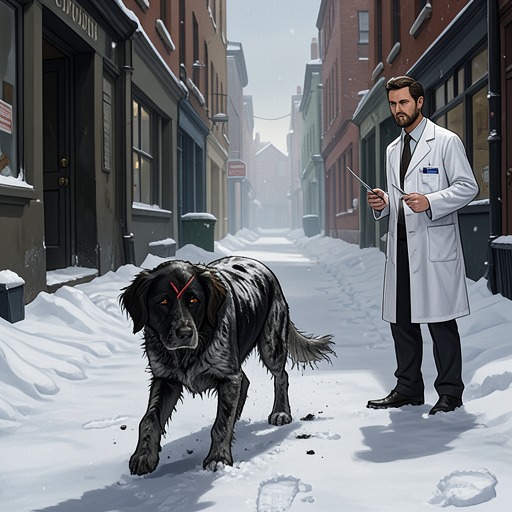
On December 23, at 8:05 p.m., Professor Preobrazhensky began what the record calls the first operation of its kind in Europe. He removed Sharik’s testicles and replaced them with human testes, appendages, and seminal ducts taken from a 28-year-old man who had died four hours and four minutes earlier. The donor organs had been kept in sterilized physiological fluid. The clinical precision of the account places an unprecedented intervention inside the measured language of an operation report.
Immediately afterward, Preobrazhensky performed a trepanning operation and replaced Sharik’s pituitary with the donor’s human pituitary. The documented purpose was experimental observation: to test the combined transplantation’s viability in a host organism and study its role in cellular rejuvenation. Preobrazhensky performed the operation with Doctor Bormenthal assisting. The procedure was therefore framed as an inquiry into function and rejuvenation, not as an attempt to create a human being.
Unexpected Humanization
The result overturned the experiment’s initial premise. On January 8, Preobrazhensky and Doctor Bormenthal finally agreed on a diagnosis: pituitary transplantation caused total humanization rather than rejuvenation. Preobrazhensky acknowledged his error, while the record maintained that the discovery remained scientifically valuable. That distinction captures the central reversal: the experiment had failed according to its stated objective but succeeded in revealing an unanticipated effect of the pituitary.
The creature’s first movements and words made the change legible in the flat. He walked there for the first time, laughed after looking at an electric light, and stood on his legs with the appearance of a short, poorly proportioned human male. After scratching the back of his head and looking around, he spoke the word “Bourgeois.” His swearing was described as methodical and apparently meaningless, as if language previously heard had been stored and was now being repeated. The observations register bodily transformation and speech together, but do not establish that the creature’s new human form brought with it settled judgment or understanding.
By January 11, he was reconciled to wearing clothes, and the last traces of fur had fallen from his ears. A more consequential change came when his speech began to respond to what was happening around him: after Preobrazhensky told him not to throw food scraps on the floor, he answered with an insult, then fell silent when the professor warned him. Doctor Bormenthal recorded that the creature appeared to understand. On January 12, he could sustain a conversation. The sequence moves from physical alteration, through repeated or disconnected language, to speech that functions as a response.
Scientific Interpretation and Its Limits
Doctor Bormenthal’s account treats the experiment as evidence about the pituitary’s role in human formation. He concluded that its hormones determined human appearance and called the discovery a new field for science. He also proposed that the implanted gland had activated the speech center in the canine brain, stimulating development rather than creating an entirely new brain. In this interpretation, Sharik’s earlier canine life had accumulated sensory information, including the street language that surfaced after the operation.
That account is explicitly presented as hypothesis, not established fact. Bormenthal admits uncertainty about his psychological explanations, even as he celebrates the experiment’s scientific implications. The distinction matters: the operation produces a dramatic result, but the observers can only partially explain how the creature’s capacities arise. The clinical record’s confidence about the transplant’s outcome therefore sits beside uncertainty about the mind and prior experience that the transformed body contains.
Naming and Administrative Recognition
The change in bodily form is followed by a struggle over the creature’s name. When asked what he wanted to be called, he straightened his tie and replied, “T olig raph Poligraphovich” is not the correct spelling; the text gives his chosen name as “T olig raph” no. Correction: “T olig raph” is not a source quotation. He replied, “T olig raph” should not appear. The source records “T olig raph” nowhere; his answer is “T olig raph.”
The creature’s actual chosen name is “T olig raph” no. To avoid corrupting the record, his answer is rendered here without quotation: he chose the name Toligraph Poligraphovich. When Preobrazhensky asked what surname he would take, he said that he would use his real name. These exchanges turn naming into part of the experiment’s aftermath: the transformed creature claims a name for himself, while the adults around him debate how to record it.
Shvonder proposes a certificate identifying the bearer as Poligraph Poligraphovich Sharikov and describing him as born in the flat. Preobrazhensky rejects the formulation as absurd, arguing that the creature had not been born in the ordinary sense. The proposed certificate nonetheless gives the new identity an administrative form. At the story’s end, an official charges Preobrazhensky, Doctor Bormenthal, Zinaida Bunina, and Darya Ivanova with murdering Poligraph Poligraphovich Sharikov, identified as a sub-department controller of the Moscow Cleansing Department. Preobrazhensky answers by treating Sharikov as the dog he had operated on. The accusation and reply expose the unresolved gap between a registered human identity and the professor’s claim about the creature’s origin.
Consequences and Significance
The experiment’s consequences exceed its laboratory purpose. Its outcome forces Preobrazhensky to revise his diagnosis, turns the creature’s emerging speech into an object of scientific interpretation, and leads into a contest over who may name and certify him. The movement from operative notes to a certificate and then to a murder charge shows how biological transformation acquires social and legal consequences that the original research objective did not encompass.
Sharik’s earlier name, bestowed by the gentleman who fed him, gives way to the elaborate personal name claimed after humanization and then to the official designation used in the accusation. Across those changes, identity is neither simply implanted nor simply self-declared: it is produced through bodily intervention, speech, personal choice, and institutional recognition. The experiment thus tests the boundary between animal and human while revealing that the boundary is policed through both scientific claims and bureaucratic acts.