Sharikov and Shvonder relationship
The Heart of a DogSharikov and Shvonder relationship is a political alliance built through documents, official recognition, and shared opposition to Professor Preobrazhensky’s authority. Shvonder helps Sharikov secure a name, registration, housing rights, and employment; Sharikov in turn becomes an instrument through whom the house committee’s pressure reaches the professor’s private household. Their cooperation makes the identity of an experimental creation consequential in the public world, while exposing how administrative recognition can confer power without resolving the conflict between a person’s official status and the circumstances of his creation.
The house committee and the occupancy dispute
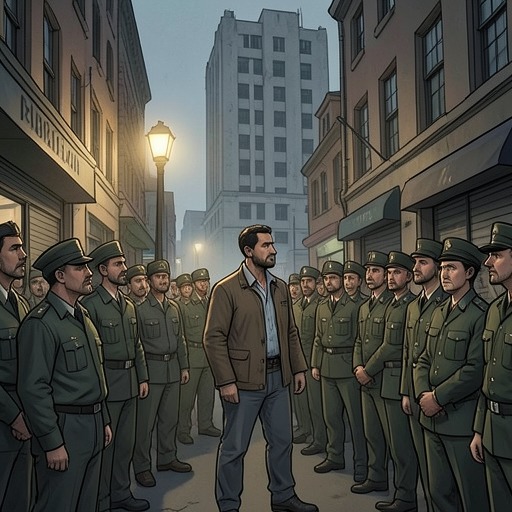
Shvonder enters the relationship as chairman of the house committee, representing a general meeting of tenants charged with increasing occupancy in the building. He presents the committee’s demand to Preobrazhensky as an official matter, while the professor reacts with alarm at the prospect of changes to the household and its central heating. The clash establishes the institutional setting for Shvonder’s later support of Sharikov: the committee is not merely an intermediary but an organized source of pressure on the professor’s control of his apartment.
Sharikov’s claim to committee support rests on the everyday requirements of residence. He argues that he must be registered in Moscow and obtain an identity card, saying he does not want to be arrested as a deserter. Preobrazhensky counters that Sharikov is an unnatural phenomenon and an artefact, not an ordinary person whose status can readily be entered into official records. Shvonder’s later interventions answer that practical vulnerability by treating Sharikov as a citizen whose claims must be heard.
Naming and official recognition
The alliance becomes explicit in the dispute over Sharikov’s identity papers. When asked what name he will use, Sharikov first proposes Poligraph Poligraphovich, a choice the professor dismisses as unserious. Asked for his surname, Sharikov gives Sharikov as his real name. Shvonder stands at the professor’s desk and proposes a certificate identifying its bearer as Poligraph Poligraphovich Sharikov, even suggesting that he was born in the apartment. The proposed wording turns an uncertain origin into an administratively legible identity.
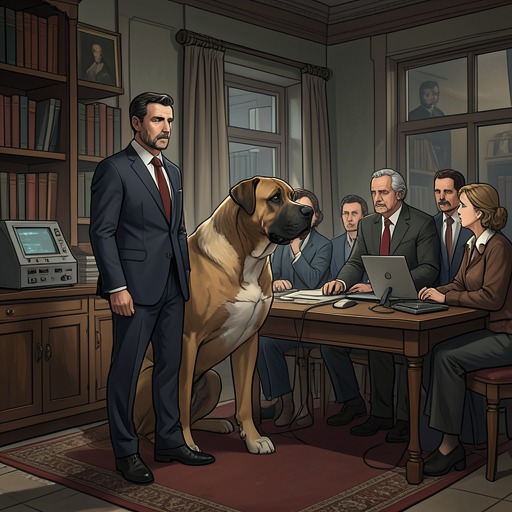
Preobrazhensky objects that Sharikov was not born in the ordinary sense; Shvonder replies that the experiment was the professor’s responsibility and that he brought citizen Sharikov into the world. This exchange gives the alliance its central argument. The professor treats Sharikov’s origin as a biological and scientific problem that complicates his status; Shvonder recasts that origin as a matter of responsibility and civic recognition. He supports Sharikov’s right to participate in the discussion of his own documents, insisting that the identity paper is of the greatest importance. The document does more than record a name: it gives Sharikov a recognized position from which to make claims against the household that produced him.
Housing rights and political education
Shvonder’s assistance has concrete consequences when Sharikov receives papers from a young woman associated with the house committee. He calls for Doctor Bormenthal and presents three sheets, green, yellow, and white, as proof that he has become a member of the residential association. He claims the entitlement of thirty-seven square feet as the tenant in charge of apartment No. 5, occupied by Preobrazhensky. His new status translates the committee’s general campaign for increased occupancy into a specific demand on the professor’s space.
The papers also sharpen the personal conflict. Sharikov’s claim is not simply that he belongs in Moscow; he asserts a measurable share of the apartment, backed by his membership in the residential association. Preobrazhensky responds with a threat against Shvonder, making clear that the chairman is regarded as the political force behind the claim. The alliance thus moves from the abstract language of registration and rights to a direct contest over who may occupy the professor’s home.
Shvonder also supplies Sharikov with Kautsky, which the professor associates with the direction of Sharikov’s education. When challenged about the book, Sharikov says that Shvonder gave it to him so that he could be educated, adding that Shvonder was not a fool. The exchange indicates that the chairman’s influence extends beyond paperwork: he provides material that Sharikov presents as a route into political and intellectual life. Yet the professor sees the result not as sound education but as another source of conflict, linking Sharikov’s new reading to an incident in the household.
From residential status to public office
The alliance acquires a further institutional dimension when Sharikov announces that he has taken a job. The typewritten appointment names him as a sub-department controller in the Moscow Cleansing Department, responsible for eliminating vagrant quadrupeds, including cats. Preobrazhensky immediately asks who arranged it and says he can guess; Sharikov confirms that it was Shvonder. A relationship that began with the house committee’s intervention in residence has now helped place Sharikov in a government department, with an official position and a stated responsibility.
This appointment extends the same pattern of identity-making. Committee papers first establish Sharikov as a resident with an entitlement; the appointment then names him as a worker with authority in a public institution. In each case, written recognition makes his status operational. The narrative presents these advances alongside the unresolved disparity between his official roles and the disorder surrounding his dealings in the apartment, rather than suggesting that documentation has brought about personal or domestic reconciliation.
Allegiance turned against the household
The alliance ultimately carries the conflict beyond housing and employment. A report signed by Sharikov as a controller in the city cleansing department is countersigned by Shvonder as chairman of the house committee. It accuses Preobrazhensky of threatening to murder Shvonder, alleges that he keeps a firearm and makes counter-revolutionary speeches, and describes Doctor Bormenthal as secretly living in the apartment without registration. It also accuses the professor of ordering Zinaida Bunina to burn Engels and labels both doctors Mensheviks. The accusations recast disputes within the household as political and administrative offenses, using the same institutions and classifications through which Shvonder had earlier secured recognition for Sharikov.
In a later scene, an official reads a charge naming Preobrazhensky, Bormenthal, Zinaida Bunina, and Darya Ivanova as defendants in the alleged murder of Poligraph Poligraphovich Sharikov, identified as a sub-department controller in the city cleansing department. Preobrazhensky answers that he does not understand who Sharikov is, then identifies him as the dog on whom he operated. The contrast condenses the relationship’s central irony: the name and public position secured through Shvonder’s support have become the basis of a formal accusation, while the professor’s reply refuses the official identity by returning Sharikov to the history of the experiment. Shvonder’s alliance with Sharikov has therefore helped produce not only a tenant and employee, but also a political adversary of the household and a figure in an accusation against its members.