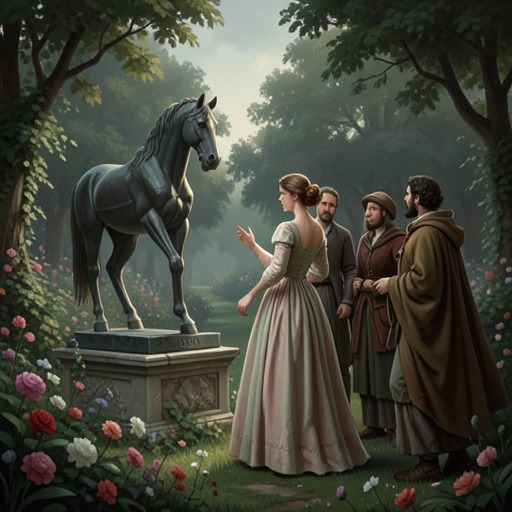
Aravis escapes Tashbaan
The Horse and His BoyAravis escapes Tashbaan by improvising with the help of Lasaraleen, an old acquaintance whose privileged palace access provides a route out of the city. Their attempt to reach the river takes them unexpectedly into the presence of the Tisroc, Rabadash, and Ahoshta Tarkaan; hiding beneath a sofa, Aravis hears Rabadash’s plan to pursue Queen Susan and the Tisroc’s permission for a secret military expedition. Once free, she reunites with Bree, Hwin, and Shasta and immediately reports the danger, making her escape the link between a private flight from an arranged marriage and the effort to warn others of Rabadash’s attack.
Flight and an Unexpected Ally
Aravis’s escape takes an unforeseen turn when she recognizes Lasaraleen in a litter. The two girls know one another from houses they have visited and parties they have attended, and Aravis looks up at her former acquaintance before remembering the danger of being seen. Their eyes meet; Lasaraleen calls out her name and begins to mention her father. Aravis reacts at once, letting go of the horses, climbing into the litter beside her, and urgently asking Lasaraleen to hide her. When the curtains are drawn, Aravis makes the stakes explicit: her father does not know she is in Tashbaan, and she is running away.
Lasaraleen initially treats the disclosure as thrilling news and is more concerned with her dress than with the escape. Aravis has to press her to take the danger seriously and ask where her father is. Their different temperaments shape the plan: Aravis is focused on getting away, while Lasaraleen’s chatter, distractions, and uncertainty repeatedly slow the practical discussion. Still, their familiarity gives Aravis a potential ally who can move within the social world of the palace.
The horses can be sent out through the North Gate without attracting attention: grooms in fine clothes could lead a war horse and a lady’s saddle horse down to the river without being stopped. Aravis herself cannot simply follow in the litter. Lasaraleen explains that litters are used inside the city, so one leaving through the gate would prompt questions. Her alternative is the Tisroc’s garden, which descends to the water and has a small water-door reserved for palace people. Lasaraleen proposes that they enter the palace after dark and use it to reach boats tied outside.
In the Palace and Under the Sofa
The route Lasaraleen knows leads them into a dangerous encounter. She is unsure which passage to take, then confidently recognizes a flight of steps. Ahead, two men come into view walking backward with tall candles, a custom that signals the presence of royalty. Lasaraleen grips Aravis’s arm in sudden fear and hurries her back up the steps, feeling along the wall for a door. They slip inside and draw it shut, finding themselves in darkness.
The hiding place offers little security. Aravis and Lasaraleen squeeze into the narrow space between a sofa and a curtained wall. Lasaraleen gets the better position and is completely covered; part of Aravis’s face remains exposed, though her veil makes it less immediately recognizable. They lie still, aware that their own breathing seems loud. When the door opens and light enters, Aravis cannot move her head farther behind the sofa and sees the people who have come into the room.
Two deaf and mute slaves carry candles and stand at either end of the sofa. Behind them is the Tisroc, whom Aravis recognizes by his pointed cap, followed by a tall, excited young man armed with an ivory-sheathed scimitar, and Ahoshta Tarkaan, the new Grand Vizier to whom Aravis has been betrothed. The secret council transforms the purpose of the hiding place: the girls are no longer merely concealed in a royal residence but are within hearing of a political and military decision.
The Council Aravis Overhears
The young man is Rabadash, and he is furious that Queen Susan has left. He complains that the Tisroc delayed him by insisting that the ship’s departure be checked before pursuit began; the lost time, he says, has put her beyond his reach. He declares that he wants Susan and intends to have her. His anger makes the pursuit personal, but the conversation soon reveals its wider political consequence: Rabadash means to march against Anvard.
Ahoshta judges that Anvard may fall into Rabadash’s hands and that such a success would put Narnia in danger. The Tisroc authorizes his son to go, but with explicit limits and without any promise of rescue or retaliation if he is killed or captured. He warns that unnecessary bloodshed among Narnian nobles, if it brings about open war, will cost Rabadash his favor and position in Calormen. Rabadash accepts his father’s command, kneels to kiss his hands, and rushes out. Aravis, still cramped in her hiding place, has heard enough to understand that the escape must now serve an urgent purpose: Rabadash’s expedition is a threat to be carried beyond the palace.
Out Through the Water-Gate
After the council disperses, Lasaraleen is too frightened to move quickly. Aravis urges her to take them to the water-gate, but Lasaraleen wants to remain hidden until her nerves settle. Aravis insists, and her friend eventually leads her back down the steps, along another corridor, and into the palace garden. Terraces descend toward the city wall. Although Aravis would later remember the lawns, fountains, and cypress shadows, the immediate need to escape leaves her with only a vague impression of the setting.
At the bottom of the garden, Lasaraleen is shaking too much to unbolt the gate, so Aravis opens it herself. Beyond it are the river, a landing stage, and several pleasure boats. Aravis thanks Lasaraleen and explains that she is fleeing from a situation that cannot suit her. Lasaraleen urges her to reconsider, praising Ahoshta as a great man and insisting that the Tisroc’s decision must be right. Aravis refuses to accept her friend’s deference to palace authority as a reason to stay. She says goodbye, compliments Lasaraleen’s dresses and house, and recognizes that the life her friend prefers would not suit her.
Aravis steps into a punt, casts off, and crosses the river alone. She has always lived in the country and has hated her time in Tashbaan; reaching the farther bank marks her return to the journey she had been trying to resume. In the dark beyond the river, she finds the road Shasta had taken, reaches the boundary between grass and sand, and sees the Tombs. Uncertainty about whether her companions are there does not stop her from going toward them.
Warning and Consequence
Before Aravis reaches the Tombs, she sees Bree, Hwin, and the groom. The groom sets off toward the city, while Aravis greets the horses with affectionate pats and kisses. Bree then spots Shasta emerging from hiding as the groom leaves. The reunion is brief in its relief and immediate in its purpose: Aravis says there is no time to lose and gives the others a hasty account of Rabadash’s expedition.
Bree understands the military stakes as a violation of peacetime expectations, objecting that an attack has been launched without a challenge being sent. He declares that they will reach the threatened place before Rabadash does. Aravis mounts Hwin as she asks whether they can do so. Her flight has therefore changed from an effort to evade her father and the marriage arranged for her to a race against Rabadash’s forces. The escape matters not only because it gets Aravis out of Tashbaan, but because the information she carries enables the companions to respond to the danger beyond the city.