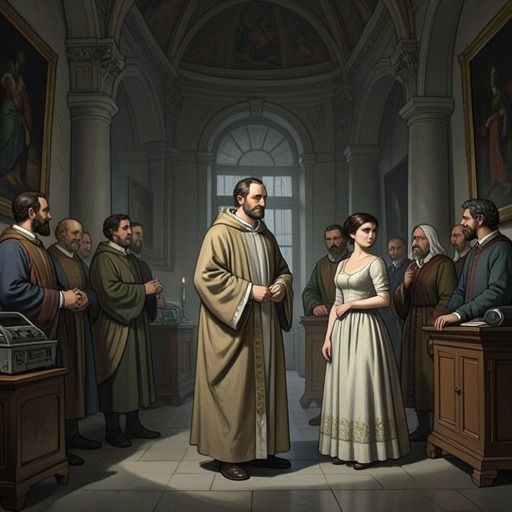
Aravis—Ahoshta Tarkaan
The Horse and His BoyAravis—Ahoshta Tarkaan is a relationship created by family arrangement rather than mutual attachment: Aravis’s stepmother persuades her father to promise her to Ahoshta, an older and politically powerful courtier. Aravis rejects the match and escapes rather than accept it. Their betrothal therefore sets her journey in motion, while the later revelation that Aslan wounded her because of the punishment inflicted on her stepmother’s slave connects the consequences of her flight to a separate moral reckoning.
Origins of the Betrothal
Aravis introduces herself as the only daughter of Kidrash Tarkaan, lord of Calavar, and explains that her mother is dead, one brother has fallen in battle against rebels in the far west, and the other is still a child. Her stepmother hates her and persuades her father to arrange a marriage with Ahoshta Tarkaan. The decision is made by Aravis’s father under the influence of his wife and in consideration of Ahoshta’s wealth and power, not through Aravis’s consent.
Ahoshta’s position has advanced despite what Aravis regards as his low birth. He has won the Tisroc’s favor through flattery and harmful counsel, become a Tarkaan and lord of many cities, and seemed likely to succeed the existing Grand Vizier. The marriage offer is accepted, with the wedding expected at high summer that same year. This combination of family authority, political ambition, and an announced timetable leaves Aravis facing a decision made for her and already set in motion.
Aravis’s Refusal and Flight
When she learns that the marriage has been arranged, Aravis is overwhelmed by the prospect. After a day of grief, she gets up, washes her face, has her mare Hwin saddled, and takes a sharp dagger once carried by her brother in the western wars. She rides out alone. In a wood, once her father’s house is out of sight, she considers taking her own life rather than entering the marriage. Hwin speaks to her and persuades her not to die, urging her to stay alive in case her fortunes improve. The scene makes clear that the betrothal is not a merely unwelcome prospect: Aravis sees escape as necessary, though she has not yet found a safe way forward.
Her refusal remains firm even after she reaches Tashbaan and meets Lasaraleen. Lasaraleen argues for the match on the grounds of Ahoshta’s new rank, his possessions, and the pleasures his wealth could offer, including palaces, pearls, and luxurious baths. Aravis answers that she does not care and cannot stand the sight of him. The contrast exposes the different values shaping their responses: Lasaraleen treats the marriage as a route to comfort and social advantage, while Aravis rejects it because she cannot accept the proposed husband.
Ahoshta’s Rise and the Palace Scene
By the time Aravis hides in the palace, Ahoshta has become Grand Vizier after the former officeholder, Axartha, dies. Aravis recognizes him when he enters with the Tisroc and a young man. He is still the hunched, wizened figure she had been promised to marry. The private betrothal has thus become entangled with public power: the man whose status helped secure the arrangement now occupies one of the highest offices in Calormen.
The palace episode does not show a meeting or reconciliation between the betrothed pair. Instead, Aravis observes Ahoshta as part of a political gathering while concealed nearby. Her account and her presence in the palace place the personal consequences of the marriage arrangement beside the court’s display of authority, but they do not change her refusal or make the match voluntary.
Consequences and Moral Reckoning
Ahoshta remains part of the history Aravis recounts when she meets Shasta: among the dangers and hardships of their escape, she explains why she had fled her father’s house. The betrothal is the precipitating cause of her departure, not a relationship that develops through courtship. Her subsequent journey carries her far beyond the domestic decision that began it, even as the proposed marriage remains a measure of the choice she refused to surrender.
Later, Aslan tells Aravis that he was the lion who wounded her during the journey. He explains that the wounds answered, one for one, the stripes laid on her stepmother’s slave because Aravis had drugged the woman into sleep. This consequence is not attributed to Ahoshta or to the betrothal itself: it concerns Aravis’s treatment of the slave while escaping her family’s control. The distinction matters to the relationship’s overall significance. Aravis’s rejection of an imposed marriage is treated as her own decision, while her separate wrongdoing receives its own reckoning. The book thus leaves the betrothal as the force that drove her into flight, without treating that cause as an excuse for every action she took along the way.