Aravis—Hwin
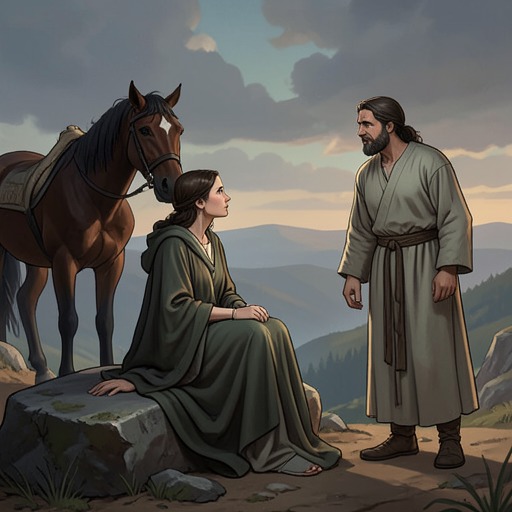
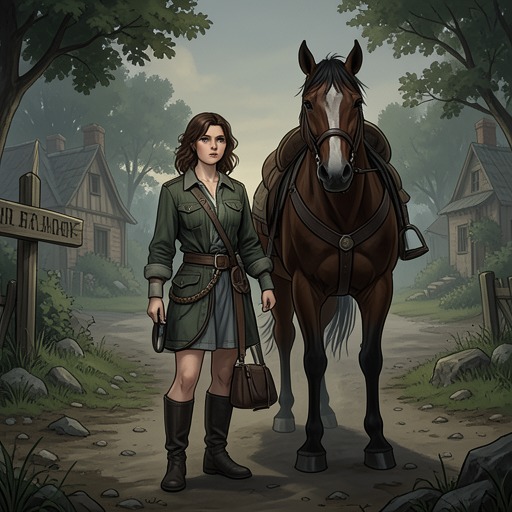
The Horse and His BoyAravis—Hwin is a relationship formed under Calormene control and tested by a shared escape toward Narnia. Its decisive change comes when Hwin claims the journey as her own: the flight is no longer simply Aravis’s plan with a horse in tow, but a partnership that challenges the assumption that a human may own a free, talking horse. Their later reunion at the Hermit’s enclosure gives that companionship an intimate, physical expression in Hwin’s horse-kiss.
Captivity and the Journey North
Hwin’s escape is rooted in the same coercive world that governs Aravis’s flight. Bree explains that he was stolen as a foal and spent years enslaved by humans, concealing his ability to speak so he would not be displayed at fairs or more closely guarded. The account establishes that a talking horse’s captivity is not merely a matter of being ridden: it involves constrained movement, concealment of identity, and the continuing risk that discovery would make escape harder. Hwin, too, is part of the effort to flee Calormen and reach Narnia, though the evidence does not give a separate account of how her captivity began.
The two meet while both are trying to escape. When Bree proposes that the travelers go together, he addresses Hwin directly and offers her his assistance and protection for the journey. His gesture treats her as a participant whose consent matters, rather than as a mount belonging to Aravis. That distinction makes the group’s proposed cooperation more than a practical arrangement: it begins to recast the relation between the girl and the mare.
Hwin Claims Her Escape
Aravis initially tells Hwin to stay out of the conversation, but Hwin refuses. She says that the escape is hers just as much as Aravis’s, identifies Narnia as their destination, and expresses confidence that Bree will not betray them. Her intervention establishes both her agency and her judgment: she speaks for herself and takes part in assessing whom the travelers can trust.
Bree makes the underlying conflict explicit when Aravis asks why he speaks to Hwin instead of to her. He calls that expectation Calormene talk and points out that, as free Narnians, Hwin is not Aravis’s horse; the relation could just as readily be described in reverse, with Aravis as Hwin’s human. Aravis pauses, having apparently not considered the matter in that light. Hwin’s declaration and Bree’s reframing together unsettle the habitual hierarchy between rider and horse, even as the fugitives still have to decide how to travel safely through enemy country.
Care and Companionship at the Hermit’s Enclosure
After the difficult events that leave Aravis with a sore back, she recovers at the Hermit’s enclosure. The next day, once she feels well enough to rise after breakfast, she goes out to see the horses. The setting has turned from the previous evening’s threatening weather into sunlight filling the green enclosure, a peaceful and quiet place for the reunion.
Hwin trots straight across to Aravis and gives her a horse-kiss. The small, affectionate greeting presents their bond through reciprocal concern: each has asked after the other’s health and sleep before Aravis turns to find Bree. In contrast to the earlier dispute over whether Hwin is a possession, the gesture shows a relationship sustained by attachment and mutual attention.
Freedom and the Limits of the Evidence
The relationship’s significance lies in how the flight puts companionship beside the structures of enslavement. Bree’s remembered concealment shows one cost of captivity; Hwin’s insistence that the escape belongs to her shows that Aravis’s companion has a will and a stake of her own. Aravis’s moment of reconsideration marks a shift in how she understands the human–horse bond, while her return to Hwin at the enclosure supplies evidence of continued closeness.
The account does not specify a later decision by Aravis to formally redefine their relationship or describe what becomes of Hwin after these scenes. What it does establish is more concrete: Hwin speaks for herself, joins the shared attempt to reach Narnia, and greets Aravis affectionately after their separation. Their relationship is thus both an intimate bond and a small but consequential challenge to treating a free, talking companion as property.