Archenland
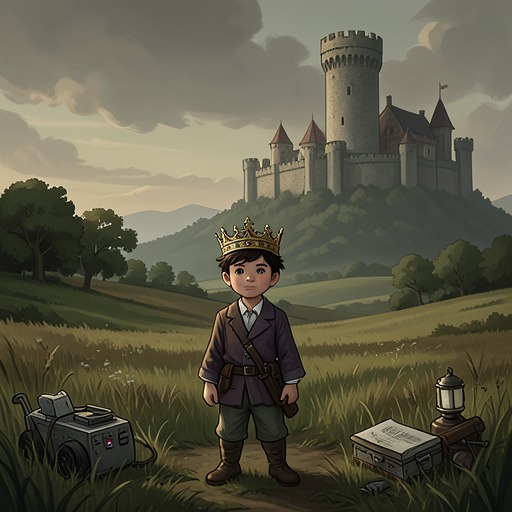
The Horse and His BoyArchenland is the kingdom between Calormen and Narnia whose terrain determines both the fugitives’ passage north and the course of Rabadash’s invasion. Its capital, Anvard, is the immediate target of the attack; the kingdom’s defended castle and alliance with Narnia make it the setting for the decisive battle that ends the invasion.
Setting and Geography
Archenland lies north of Calormen and south of Narnia. The landscape at its northern edge opens into greener hills and a network of rivers beneath the Northern Mountains. A mountain pass leads from Archenland into Narnia, connecting the two kingdoms by a route important to both travel and military movement.
The route from the desert into Archenland depends on a concealed stony valley. Sallowpad explains that a traveler starting from the Tombs of the Ancient Kings and riding northwest with Mount Pire’s double peak straight ahead can reach the valley in a day or a little more. Though nearly impossible to spot from nearby, the valley leads to a river that runs into Archenland. Its narrowness and hidden entrance make the geography a practical alternative to the desert route through the Great Oasis, whose springs could not supply a large army.
After the fugitives follow the valley for several hours, it widens at the meeting of two rivers. The river they have been tracking joins a broader, turbulent stream flowing east from the higher mountains. Beyond it, low hills rise toward the Northern Mountains; rocky pinnacles mark one side of the view, while pine slopes, cliffs, gorges, and distant peaks stretch away on the other. The wooded saddle ahead is the pass into Narnia. The travelers find a shallow place to wade across the swift, broken river, reaching the country that had seemed an improbable northern refuge.
Anward and the Invasion Plan
Anvard, King Lune’s castle, is the first objective in Rabadash’s proposed surprise campaign. He plans to leave secretly at night with two hundred horsemen, cross the desert, and reach the castle on the second morning, expecting to seize it before its defenders are prepared. From there, he intends to pass through the mountains into Narnia and continue to Cair Paravel. His plan makes Archenland the gateway to a larger invasion, rather than merely a border territory.
Rabadash’s proposal rests on the assumption that Archenland is at peace with Calormen and therefore unready for attack. In his account, capturing Anvard quickly would give him a route onward and let him wait at Cair Paravel for Queen Susan’s ship. His father, the Tisroc, questions the danger that the plan entails, but Rabadash describes the small force and rapid assault as a way to attempt conquest while limiting the consequences for Calormen if it fails.
Warning and Battle at Anvard
Shasta reaches King Lune with news of the approaching attack. He identifies Rabadash and the two hundred horsemen as the threat, insists that the warning comes from his own sight, and says he has raced them all the way from Tashbaan. His arrival gives the defenders notice that Rabadash’s surprise depends on their being caught unprepared.
When the Narnian relief force approaches, Anvard’s gate is shut and its portcullis lowered. About fifty Calormenes are using a tree trunk as a battering ram while the rest of Rabadash’s men are positioned to assault the gate. Seeing the Narnians descend from a ridge, the attackers remount and turn to meet them. The battle therefore develops on two fronts: the Calormenes have been striking at the castle entrance, but now must face the arriving relief force as well.
The fighting ends with the defenders emerging from the castle. King Lune leads a sortie with his men, while King Edmund fights in the engagement; the Calormene line is pressed from several directions and breaks. Some of the attackers surrender and others flee toward the woods. The battle is over with the Calormenes decisively defeated, and the castle gates stand open as King Lune and King Edmund meet across the battering ram.
Political and Narrative Significance
Archenland’s position gives it significance beyond its size: control of Anvard would provide Rabadash with a route through the pass into Narnia. Its rivers and mountain approaches also make the kingdom part of the fugitives’ passage from desert danger toward the northern lands. Geography thus serves two contrasting purposes in the story, offering concealment and passage to travelers while presenting an invasion route that can be countered by a timely warning and allied defense.
The battle at Anvard brings Archenland and Narnia together in action. King Lune’s forces defend their castle, and the Narnian relief force helps defeat the attack before Rabadash can use Archenland as a bridge to further conquest. Anvard’s open gates at the end mark the reversal of the siege: the attackers have been repelled, and the threatened kingdom is no longer isolated.