Arsheesh
The Horse and His BoyArsheesh is a poor fisherman in southern Calormen whose household gives Shasta his first experience of work and dependence. Though he presents himself as the boy’s father, he later acknowledges that he found Shasta as an infant and kept him as a laboring member of the household; when a Tarkaan comes seeking to buy the boy, the story of Shasta’s origins begins to emerge.
Identity and Household
Arsheesh lives beside a small creek of the sea, where he fishes in the morning and takes his catch by donkey cart to a nearby village in the afternoon. His livelihood is precarious: when the fish sell well, he returns in a tolerable mood, but a poor sale makes him fault-finding and liable to punish Shasta. The boy is responsible for mending and washing the nets, preparing supper, and cleaning their cottage.
The household is defined by unequal dependence. Shasta calls Arsheesh Father, yet the fisherman’s treatment of him is shaped less by parental care than by the work the boy can provide. When Arsheesh entertains a guest, Shasta is given bread and sent out of the cottage, usually to sleep in the donkey’s small thatched stable. Arsheesh’s domestic authority also restricts the boy’s curiosity: questions about the land to the north may be dismissed as distractions from work.
The Tarkaan’s Offer
A richly equipped stranger arrives from the south, and Arsheesh recognizes him as a Tarkaan, a great lord. The guest demands hospitality, which the fisherman cannot refuse. After supper, Shasta is put outside as usual; from a crack in the wooden wall, he overhears the Tarkaan say that he wants to buy him.
Arsheesh first answers with an elaborate claim of paternal attachment, describing Shasta as his only child and invoking a poet’s maxim about natural affection. The Tarkaan rejects the performance: the difference in their complexions makes the claimed fatherhood implausible, and he points out that Arsheesh has profited from the boy’s labor. Pressed to name a price, the fisherman concedes that he never married and has no child. His words expose the gap between the familiar name of father and the economic reality of Shasta’s place in his household.
Shasta’s Origins
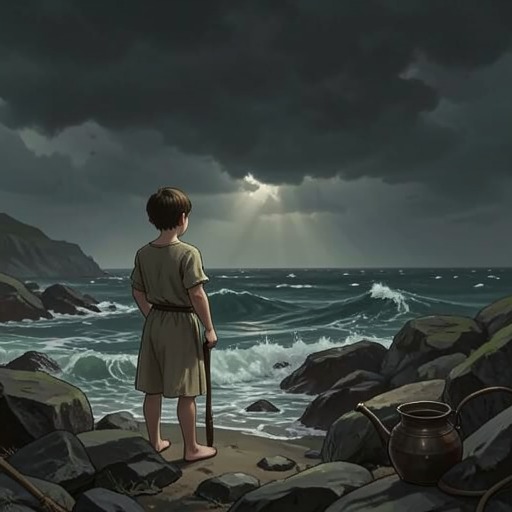
Arsheesh recounts that, in the year the Tisroc began his reign, he woke on a night of full moon and went to the beach. There he heard oars and a faint cry; the tide brought in a small boat carrying a living child, a man who appeared to have died only moments earlier, and an empty water-skin. Arsheesh supposed that the pair had survived a shipwreck and that the man had starved while keeping the child alive. He says he took the infant in, presenting the decision as an act of compassion, though the Tarkaan cuts short his self-praise and emphasizes the labor Arsheesh has received in return.
The account gains a further meaning much later, when Aslan tells Shasta that he was the lion who pushed the boat toward shore and that a wakeful man was there to receive him. This disclosure confirms that Shasta’s arrival at Arsheesh’s home was part of the larger sequence of guidance surrounding his life. Arsheesh’s own story supplies the human circumstances of that arrival, while Aslan’s revelation supplies the unseen cause.
Narrative Role
Arsheesh appears chiefly through Shasta’s recollections and the overheard exchange with the Tarkaan. His small, economically strained household stands at the beginning of Shasta’s movement from constrained service toward escape: the boy’s routine labor, limited freedom, and uncertain status make the prospect of being sold an immediate threat. Arsheesh’s admission also separates Shasta’s assumed family identity from his true origins, setting the first major question of the boy’s past in motion.