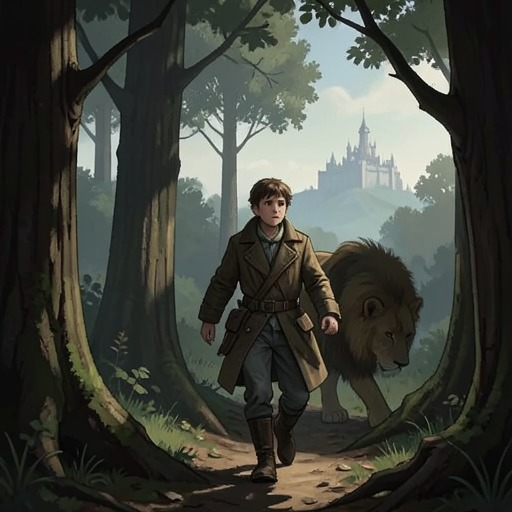
Aslan guides Shasta through the mountain pass
The Horse and His BoyAslan guides Shasta through the mountain pass by guarding him on the perilous route and directing a journey that Shasta had mistaken for a string of accidents. The passage leads him from the heights above Archenland into Narnia, where he can carry his warning onward; its meaning becomes clear when Aslan later explains that he was the lion behind the dangers and rescues along the way.
The passage and its apparent chance
After making his way through the mountains at night, Shasta recognizes the range as the mountains between Archenland and Narnia. From the far side, he sees a green valley with a river winding toward the northwest, and realizes that he must have come through the pass. He first calls his arrival good luck, then corrects himself: it was not luck, but Aslan’s doing.
The path had brought Shasta to a narrow track along a precipice. When he sees it again in daylight, he shudders to think that he had crossed the same exposed route in darkness. He understands why the lion had kept to his left: Aslan had been between Shasta and the edge. The perilous terrain thus becomes evidence of protection that Shasta could not recognize while he was travelling through it.
The journey’s dangers and purpose
At the encounter that explains the journey, Shasta recounts the hardships that had shaped his escape: his unknown parents and stern upbringing by the fisherman, the flight with his companions, the dangers in Tashbaan, his night among the tombs, the desert crossing, and his hunger. He also describes the lion that chased the travellers near their goal and wounded Aravis. To Shasta, these episodes had accumulated as misfortune; the revelation recasts them as parts of a journey whose direction and timing mattered.
Aslan identifies himself as the lion who forced Shasta to join Aravis, comforted him among the tombs, drove jackals away while he slept, and gave the horses strength to complete the last mile to King Lune in time. He also reveals that he had pushed the boat carrying Shasta as a nearly dead child toward the shore, where a man was waiting at midnight. The guidance therefore reaches back beyond the mountain crossing, linking Shasta’s arrival in Archenland to the beginning of his life.
A revelation limited to Shasta’s story
Shasta asks whether Aslan was also the lion who wounded Aravis. Aslan confirms that he was, but refuses to explain Aravis’s experience as though it were Shasta’s to possess: he says that he is telling Shasta his story, not hers, and tells no one any story but his own. The same lion’s actions intersect the travellers’ lives, but their meanings are not interchangeable.
When Aslan later speaks with Aravis, he explains that the wounds she received corresponded to the punishment inflicted on her stepmother’s enslaved attendant after Aravis had drugged her. That explanation belongs to Aravis’s own encounter with Aslan; alongside Shasta’s revelation, it shows how the lion’s guidance can also confront a traveller with the consequences of her actions.
Consequence and narrative significance
The crossing delivers Shasta into Narnia, but its importance lies in more than reaching the other side of the mountains. He has arrived in time to reach King Lune and report the danger facing Archenland. Aslan’s account makes clear that protection, correction, and urgency have been woven through what Shasta experienced as chance: the perilous pass was not a detour from his purpose, but part of the route by which he could fulfil it.