Aslan’s Providence
The Horse and His BoyAslan’s Providence names the hidden design disclosed when Aslan explains that the lions Shasta took for separate threats were one presence guiding the travelers through danger. What seemed to Shasta like a succession of unlucky encounters—including the lion that helped bring him together with Aravis, the encounter among the Tombs of the Ancient Kings, and the pursuit that hurried the Horses toward King Lune—becomes a connected course of events. The design offers help and direction, but it does not make every action comfortable or interchangeable: Aslan also explains why he wounded Aravis, insisting that she must understand the consequences of what she had done.
A Pattern Hidden in Apparent Misfortune
At the coast, the travelers wait for a cloud to obscure the moon before moving toward the shore. When the night becomes dark, a savage roar rises ahead and Bree immediately turns back inland. Shasta initially understands the noise as a new, external danger: Bree identifies lions, and the party flees. The scene establishes the pattern that will recur—the travelers meet an apparent threat without knowing what purpose, if any, lies behind it.
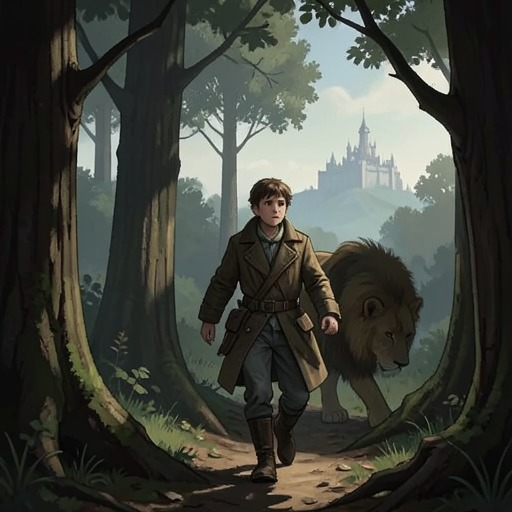
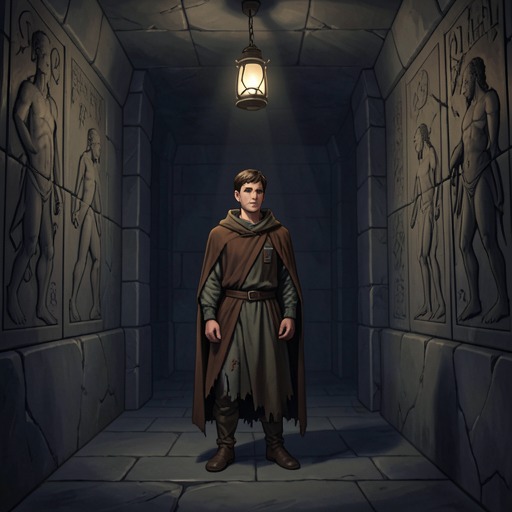
Among the Tombs of the Ancient Kings, Shasta again hears cries approaching and weighs the dangers of going back toward the river against the possibility of beasts in the desert. A huge animal appears between him and the desert, roars, and seems to send the other creatures away before turning to examine him. Shasta expects to be attacked, but the animal settles at his feet. His fear has mistaken the scale and intention of the encounter; later, the scene will be identified as another appearance of Aslan, offering comfort in a place where Shasta had felt exposed and afraid.
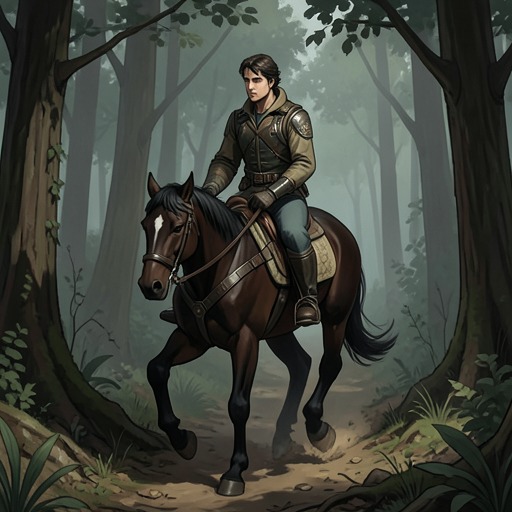
The meaning of the earlier pursuit changes again on the journey to Anvard. Aravis urges Bree to gallop because they must arrive in time, and Shasta recognizes the roar coming from behind them as the same one heard on the night he first met Aravis and Hwin. The sound makes Bree run faster than before, and the Horses pull ahead of Hwin. Shasta assumes that lions ought not to be a danger there, but Aslan later identifies himself as the lion whose intervention gave the Horses the fear-driven strength to cover the last mile in time to reach King Lune.
The Revelation to Shasta
When Shasta speaks with the unseen, deep Voice, he recounts his hardships as a series of separate blows: not knowing his parents, growing up with the fisherman, escaping, being pursued, facing danger in Tashbaan and the Tombs, crossing the hot and thirsty desert, and reaching their goal only for another lion to pursue them and wound Aravis. He also tells the Voice that he has had nothing to eat for a long time. His account is a catalogue of suffering as Shasta understands it, and his question about whether meeting so many lions was bad luck gives the Voice an opportunity to correct that understanding.
The answer is not that there were many lions, but that there was one. Aslan explains that he was the lion who forced Shasta to join Aravis, the cat who comforted him among the Tombs, and the lion who drove the jackals away while Shasta slept. He also says he pushed the boat carrying Shasta as a child, nearly dead, toward the shore where a man was awake to receive him. The revelation reaches back beyond the fugitives’ present journey: even Shasta’s arrival in the care of the fisherman becomes part of the same account of guidance.
Aslan’s explanation does not erase the danger or tell Shasta that his suffering was unreal. Instead, it changes the relation among its episodes. The pursuit, refuge, protection, and timely arrival are no longer unrelated accidents in Shasta’s life; Aslan claims them as actions within his own story for Shasta. The Voice’s refusal to call him unfortunate challenges the conclusion Shasta draws from hardship without denying the hardships he has just described.
Guidance and Individual Responsibility
The revelation also sets a limit on what Aslan explains. When Shasta asks whether Aslan was the lion who wounded Aravis, Aslan confirms it, but says he is telling Shasta his story, not hers, and tells no one any story but his own. Providence is therefore presented through particular relationships and personal knowledge, rather than as a single explanation that Shasta may apply to every person’s experience. The same guiding presence may act in the lives of both companions, but Shasta is not given authority to interpret Aravis’s story for her.
Aslan later addresses Aravis directly. He confirms that he wounded her and explains that the punishment matched the stripes inflicted on her stepmother’s enslaved person after Aravis caused that person to be drugged and fall asleep. He says Aravis needed to know what that experience felt like. The scene connects providential action not only with rescue and progress toward Anvard, but with moral consequence: the lion’s intervention both wounds Aravis and makes the consequences of her own conduct intelligible to her.
Narrative Significance
The account is shaped as a recognition. During the journey, Shasta encounters a roar, a frightening animal, and a race against time; he interprets each from incomplete knowledge, under pressure and in fear. Only afterward does Aslan gather those scenes into a single explanation. The change is not in what happened, but in what Shasta can understand the events to mean: the apparent repetition of danger becomes the recurrence of one presence pursuing a purpose.
Aslan’s Providence thus gives the novel’s coincidences a personal and moral dimension. Its guidance can redirect travelers, protect them, and help them arrive in time, yet the explanation of each person’s experience remains particular. For Shasta, the disclosure reaches from the desert journey back to the boat that brought him to shore; for Aravis, Aslan’s intervention includes a reckoning with harm she caused. The same lion is at once frightening and consoling, and the revelation asks the reader to see those contrasting roles as parts of a guided story rather than as evidence of separate, arbitrary encounters.