Battle of Anvard
The Horse and His BoyThe Battle of Anvard is the decisive relief of King Lune’s castle from Rabadash’s surprise assault, turning a vulnerable siege into a defeat for the invading force. Its outcome rests on the route across the desert, the timing of the Narnian arrival, and the defenders’ sortie; its aftermath makes the conflict a test not only of military strength but of the rules that distinguish a lawful challenge from treachery.
Causes and Strategic Background
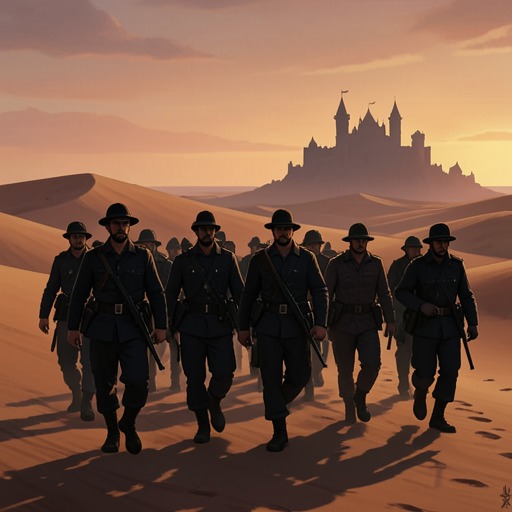
Rabadash’s attack was designed to exploit peace and surprise. He proposed taking two hundred horsemen across the desert, seizing Anvard before King Lune’s forces could prepare, and then riding through Archenland toward Narnia. He expected the castle to fall quickly and intended to use it as a step in a larger campaign. The Tisroc had resisted an open war against Narnia, but Rabadash presented the raid as a way to seize territory while limiting the political cost of failure. The desert made the plan possible only along a difficult route. Sallowpad explained that the great oasis could not supply a large army: its springs would not provide enough water for all the soldiers and animals. A different passage ran from the Tombs of the Ancient Kings toward the double peak of Mount Pire, then down a narrow, easily missed stony valley to a river leading into Archenland. This intelligence gave the attack a practicable approach, but the same terrain and distance made the invading force vulnerable to a relief army arriving from the other side. The immediate Narnian response came after Shasta heard the plan in the palace and the warning reached those able to act. During the desert crossing, the travelers’ water and strength were severely limited. At a low outcrop of rock, about fifty yards long and thirty feet high, they took a brief rest, ate, and shared what little water remained. The march’s hardship underscores the stakes of the intelligence: the forces hurrying toward Anvard had to arrive before the surprise assault became an irreversible capture.
The Relief Force Arrives
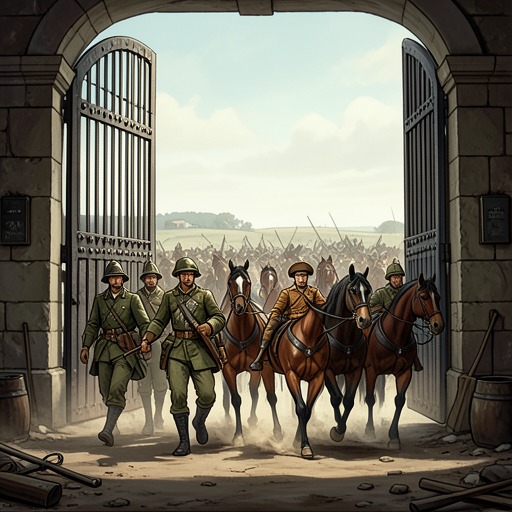
By about eleven o’clock, the relief company was marching westward, with the mountains to its left. Corin and Shasta rode at the rear, immediately behind the Giants, while Lucy, Edmund, and Peridan concentrated on the battle plans. Shasta had little experience of warfare, and the young men’s position kept them away from the front until fighting began. The scene shifts from their tense wait to the castle and the force attacking it, so the battle first appears not as a confident charge but as a rapidly changing view of danger and opportunity. From a low ridge, the rescuers saw Anvard below: a small castle with many towers, its gate shut and portcullis lowered. Around fifty Calormenes had dismounted and were using a great tree trunk as a battering ram. Rabadash’s main force had been on foot to assault the gate, but, upon seeing the Narnians sweep down the ridge, the soldiers remounted and wheeled to meet them. Their quick formation shows that the attackers were disciplined; their predicament was that the relief force had reached them while the siege was still in progress. The two forces galloped toward one another, shields raised and swords drawn. Shasta was frightened, but resolved that yielding to fear now would leave him afraid in every future battle. When the lines met, he could make little sense of the general engagement. His sword was knocked from his hand, his reins became tangled, and he fell from his horse while avoiding a spear. His limited view is important to the account: he experiences the fight as confusion, while the larger result has to be reconstructed from the Hermit of the Southern March’s observations in his pool.
The Battle Turns
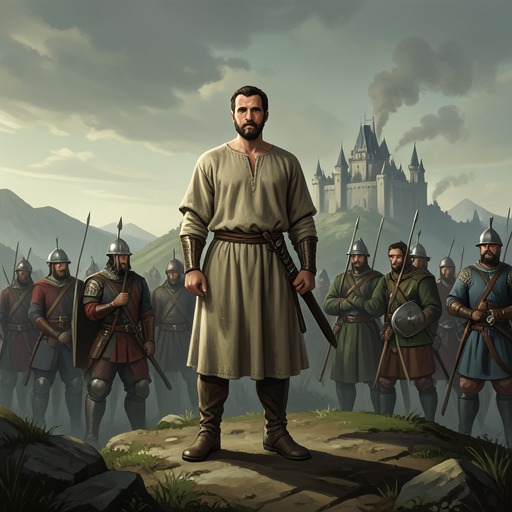
The Hermit reports the decisive movements: the Great Cats had attacked the Calormen horses, leaving the mounted attackers’ retreat without horses either dead or escaped. They then turned against the men operating the ram, which was brought down. The gates opened from within, and King Lune led a sortie with Dar and Darrin beside him. The defenders’ emergence changed the attackers’ position from a siege against a closed gate to a force pressed from both the castle and the approaching relief army. The pressure closed on several sides. The Giants advanced on the right, the Cats on the left, and King Lune’s force struck from the rear, while the Narnian army under Edmund fought the Calormenes from the front. The attackers were driven into a small group fighting back-to-back; some threw down their arms and fled toward the woods, while others surrendered or continued resisting. King Lune defeated Azrooh in single combat, and Edmund fought Rabadash near the castle gate. The Hermit initially could not tell whether Rabadash had been killed, but the battle soon ended with the Calormenes utterly defeated. Shasta, after lying among the confusion of the fight, sat up when the nearby horses had stopped and the sounds were no longer those of battle. He saw prisoners rather than free attackers, the castle gates open, and King Lune and Edmund greeting one another across the battering ram. That image brings the battle’s two fronts together: the defenders have joined their allies, and the weapon meant to break the gate now lies between the victorious kings. A cheerful roar of laughter then draws Shasta toward the castle wall.
Rabadash Captured and Judged
Rabadash had not been killed. A Giant’s spiked boot had torn his chain mail earlier in the battle; later, while fighting Edmund near the gate, Rabadash jumped onto a mounting block to strike from above. When arrows made the raised position dangerous, he leapt sideways. The tear in his mail caught on an old hook in the wall, once used for tying horses, and left him suspended above the ground. The accidental capture transforms the prince’s attempt to display his authority into a public humiliation, and the gathered victors laugh at the sight. Rabadash demanded that Edmund let him down and fight him as a king and man, or kill him. King Lune stopped Edmund from accepting the challenge. He argued that Rabadash had attacked Anvard during peacetime without first issuing a challenge, and had therefore shown himself a traitor rather than a knight. In Lune’s judgment, a man who had broken that rule could not claim the honor of a formal duel after defeat; Rabadash was to be bound and taken inside while the king decided what to do with him. The legal distinction places responsibility on the attacker even when he later seeks recognition as a worthy opponent. The battle thus ends in two linked reversals. Rabadash fails to take Anvard and is captured rather than celebrated as a conqueror; his appeal to personal combat cannot erase the breach that brought the armies together. The relief is a military victory, but the castle’s survival and Lune’s decision also affirm a political order in which strength does not by itself confer legitimacy. At Anvard, the attackers’ defeat is complete when the siege fails, the defenders join the fight, and the prince who sought to impose his will is held accountable under the laws of peace.