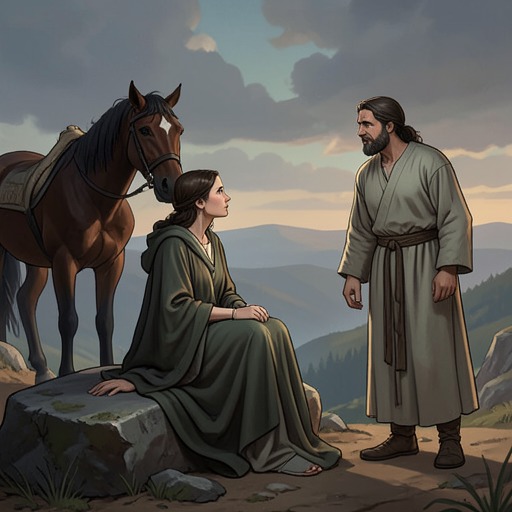
Forced Marriage in Calormen
The Horse and His BoyForced Marriage in Calormen is portrayed as a form of family and political control: Aravis is promised to Ahoshta Tarkaan for his wealth and influence, while Rabadash seeks to make Susan his wife through conquest and force. Aravis’s flight makes the personal stakes of the practice explicit, and the threat against Susan shows how the same assumption can extend from a household arrangement to an imperial ambition.
Aravis’s Betrothal and Flight
Aravis identifies herself as the daughter of Kidrash Tarkaan, a provincial lord with standing at the court of the Tisroc. Her mother is dead, her older brother has fallen in battle, and her other brother is still a child. She says that her stepmother hated her and persuaded her father to promise her in marriage to Ahoshta Tarkaan. Her account makes the arrangement a consequence of household power: her father accepts his wife’s influence and the prospective groom’s status, while Aravis’s own wishes do not enter the decision.
Ahoshta’s rise in Calormen gives the proposal its political and material appeal to her father. Though Aravis describes him as low-born, he has gained the Tisroc’s favor through flattery and counsel, become a Tarkaan and lord of many cities, and is considered a possible future Grand Vizier. He is also at least sixty, and Aravis finds his appearance repellent. Her father sends the marriage offer because of Ahoshta’s wealth and power; Ahoshta accepts and sets the wedding for high summer that same year. The exchange is treated by the men arranging it as a promising alliance, but for Aravis it is a future imposed without her consent.
When the news reaches her, Aravis spends a day weeping. The following day she rises, washes, saddles Hwin, takes a sharp dagger once carried by her brother in the western wars, and rides away alone. In a secluded wood she prepares to take her own life rather than submit to the marriage. Hwin speaks and urges her not to destroy herself, pointing out that life might still bring good fortune. Aravis’s escape begins not as a settled plan for a new life but as a refusal so desperate that she sees death as the alternative; Hwin’s intervention opens another possibility.
Social Pressure and Refusal
Aravis’s friend Lasaraleen responds to the proposed marriage in terms of its social advantages. After Aravis has explained why she is running away, Lasaraleen says that everyone admires Ahoshta and that her husband considers him one of Calormen’s rising figures. She has not even heard that Ahoshta has become Grand Vizier after the death of old Axartha. Aravis answers that she does not care and cannot bear the sight of him. Lasaraleen then lists what the match could provide: three palaces, a lakeside palace at Ilkeen, pearls, luxurious baths, and continued visits with herself.
The contrast is not simply between poverty and wealth, but between the public measure of a good match and Aravis’s own judgment. Lasaraleen presents rank, possessions, and access to a friend as reasons enough to accept Ahoshta. Aravis’s direct refusal rejects that calculus: his new office and promised comforts do not alter her unwillingness to marry him. The scene shows how coercive expectations can be reinforced without an explicit threat, through the assumption that a woman ought to value the prestige and comforts attached to a powerful husband.
The Political Threat to Susan
A separate marriage threat emerges when the Narnians consider how to leave Tashbaan. Edmund warns Queen Susan that while Rabadash hoped she would accept him, they were honored guests; after her clear refusal, he fears that they will become prisoners. He reports that Rabadash, unused to having his will crossed, has grown angry during their delays and has cloaked threats in courtesy. Edmund’s warning connects a woman’s refusal to a political danger for the whole party: Susan’s choice may provoke the prince to use his authority against her companions.
Rabadash states his intention still more plainly to the Tisroc. He proposes invading Narnia, killing its High King and his family except for Susan, whom he says he must have as his wife and intends to teach a harsh lesson first. The Tisroc refuses to be moved into open war against Narnia. Rabadash’s proposal therefore reveals the imperial force behind his pursuit: he treats conquest as a means to secure Susan, and her survival in his plan is tied to his claim over her. The Tisroc’s refusal blocks the immediate proposal for war, but does not make Rabadash’s intention any less explicit.
Consequences and Narrative Significance
Aravis’s story and the threat to Susan place two different settings of forced marriage beside one another. In Aravis’s case, her father’s household makes the arrangement on the advice of her stepmother and in consideration of Ahoshta’s wealth and advancement. In Susan’s, a prince’s desire is backed by the possibility of imprisonment and invasion. Both women’s refusal disrupts the assumption that status, family authority, or political power can settle the matter for them.
The consequences are distinct. Aravis leaves home and undertakes a dangerous journey rather than accept the match; Susan’s refusal changes the Narnians’ standing in Tashbaan from honored guests to people who may be detained. Aravis later tells Shasta of her escape and the dangers that followed, including the lion attack that wounded her. Aslan explains that he wounded her in response to the harm she had caused by drugging her stepmother’s slave; he tells her that the injuries were made equal to the slave’s suffering so that Aravis would understand what it felt like. That later encounter does not turn the betrothal into a consensual arrangement. It gives the escape story an additional moral consequence, while leaving clear that Aravis’s rejection of the imposed marriage was the point at which her journey began.