Freedom and Slavery
The Horse and His BoyFreedom and Slavery is a central contrast in The Horse and His Boy, expressed not only through flight from captivity but through the habits of speech, labor, and relationship that distinguish a free person from a possession. Calormen’s hierarchy treats people and animals as instruments of their owners; the Narnians’ resistance insists that freedom means both self-direction and responsibility toward others.
Work, Ownership, and the Desire to Leave
Shasta’s first life gives the contrast an intimate scale. He lives with Arsheesh, a poor fisherman who calls him his son, but Shasta does the household work: mending and washing nets, cooking supper, and cleaning their cottage. Arsheesh’s treatment depends on how well the fish have sold; in a bad temper he finds fault with Shasta and may beat him. The boy is drawn northward partly because Arsheesh forbids him to go there, and his questions about what lies beyond the hill are answered either with punishment or with a proverb urging him to mind his business. His wish to travel thus begins within a life where his labor is expected and his curiosity controlled.
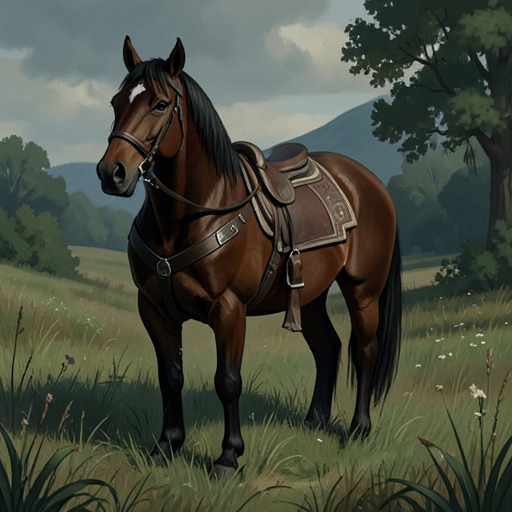
Bree makes the legal and bodily dimensions of captivity explicit. Taken as a foal after ignoring his mother’s warning not to range into Archenland and beyond, he has spent years enslaved to humans, concealing that he can speak and pretending to be an ordinary, witless horse. He kept silent because discovery would have made him a fairground spectacle and brought closer guarding, ending his chance of escape. His account shows that captivity controls not only where he can go but what he can safely reveal about himself.
Shasta’s immediate danger sharpens the distinction between dependence and enslavement. Bree warns that Shasta would be better off dead than sent to serve in the household of his master, Tarkaan Anradin, and proposes that they escape together. In contrast, Bree’s status as an expensive war horse offers him some protection from the worst treatment, but it does not make him free: his value to his owner is still a form of control, and he must disguise his nature to preserve the possibility of flight.
Freedom in Speech and Conduct
For Bree, freedom is also a cultural identity. When Shasta objects that Bree has not used the deferential formula “May he live forever” for the Tisroc, Bree rejects the phrase as the talk of slaves and fools. He says he does not wish the Tisroc to live forever and knows the ruler will not do so regardless. His refusal is a small but pointed act of independence: he will not perform reverence for a human authority merely because Calormene custom demands it. He recognizes Shasta as someone from the free North and asks that they stop using the southern jargon between them.
The same principle changes how Bree understands the relationship between a rider and a horse. When Aravis speaks to Bree instead of addressing Hwin, Bree answers that this is Calormene talk: if Aravis is escaping to Narnia and intends to become free, Hwin is no longer simply her horse. The relation can just as readily be described by saying that Aravis is Hwin’s human. Aravis pauses, having not considered the matter in that way. Bree’s correction turns the escape from a change of country into a change in conduct: freedom requires recognizing the other being as more than property.
That ethic also governs the fugitives’ use of money. Shasta asks whether taking it would be stealing. Bree admits that he had not considered the question, then reasons that captives in enemy country may regard the money as booty, and that they need it to obtain food for Shasta, who cannot live on grass and oats. The exchange does not erase the moral question; it shows Bree trying to distinguish theft from the practical means of survival while accepting that a free horse and a talking horse should be answerable to standards of their own.
Power, War, and the Language of Rule
The contrast reaches beyond household captivity into political ideology. Discussing Narnia, Rabadash argues that a thousand spears could conquer it in five weeks, dismissing it as a small, unprofitable country and an embarrassment on the edge of the Calormene empire. The Tisroc agrees that countries which call themselves free are, in his view, idle, disorderly, and unprofitable. Their language recasts political independence as a defect, making conquest sound like the correction of an inferior order rather than the subjugation of a free people.
This imperial reasoning echoes the treatment of slaves and animals. Rabadash places the proposed punishment of Narnia alongside hanging an idle slave and sending an exhausted horse to be made into dog’s-meat. In that comparison, living beings and independent nations alike are measured by their usefulness to those in power. The juxtaposition makes the conflict over Narnia part of the book’s broader argument: dominion claims the right to decide whether another life, animal or human, is valuable only as a tool.
Escape, Shame, and the Burden of Freedom
Bree’s crisis after the lion attack reveals that freedom is not simply the absence of an owner. Believing that he has galloped away while leaving Aravis, Hwin, and Shasta to be eaten, he says he will return to Calormen and slavery. He considers himself unfit to appear among Narnia’s free horses because, as he sees it, he abandoned the others to save himself. His shame is intensified by Shasta’s conduct: the boy, whom Bree calls a child and a mere foal, ran back in the right direction, while the horse who boasted of a hundred fights fled.
Hwin answers that they all ran as hard as they could, but Bree cannot yet accept that defense. His self-accusation shows that the freedom he has sought carries an ethical demand: a free life is not vindicated by escape alone, but by how one responds when others are in danger. The story therefore brings its central contrast into the group’s relationships. Against a society that reduces persons and animals to property, the fugitives’ developing recognition of one another makes freedom a shared condition, tested in action rather than secured merely by reaching Narnia.