King Edmund
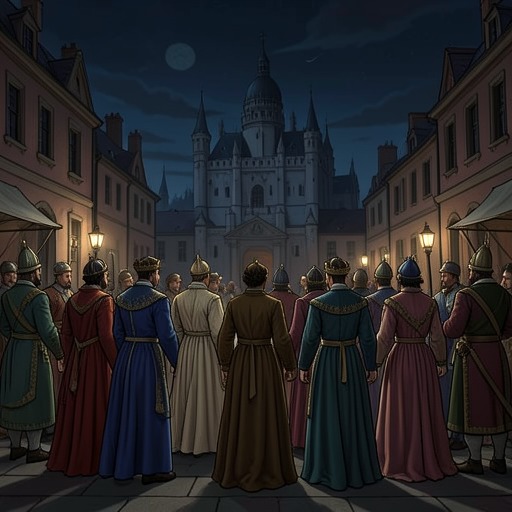
The Horse and His BoyKing Edmund is the Narnian king who recognizes that the apparent courtesy surrounding the royal party in Tashbaan rests on a fragile condition: Prince Rabadash still hopes to marry Queen Susan. Edmund reads Susan’s refusal not simply as a personal decision but as the point at which hospitality may become imprisonment, and he frames the danger in terms of both immediate survival and the ambitions of the Tisroc.
Judgment in Tashbaan
In the cool room where Shasta is resting, Edmund speaks with Queen Susan about the proposal. He asks whether, after three weeks in the city, she has decided to marry Rabadash. When Susan says she will not accept him for all the jewels in Tashbaan, Edmund makes plain that he would have thought less of her had she agreed. He recalls that the Tisroc’s ambassadors first negotiated the marriage in Narnia and that Rabadash later visited Cair Paravel as Susan’s suitor. Edmund now suspects that the courtship may have served the Tisroc’s political purposes as well as Rabadash’s desire.
Edmund immediately connects Susan’s answer to the party’s security. While Rabadash believed Susan might accept him, the Narnians were honored guests; after her unequivocal refusal, Edmund thinks they may be treated as prisoners. His warning changes the room’s focus from the courtship to the danger of getting out of Tashbaan alive. The low whistle from one of the Dwarfs and Sallowpad the Raven’s warning that it is easier to enter than leave reinforce the gravity of his assessment.
The Tisroc’s Ambition
Edmund’s concern extends beyond the party’s immediate predicament. He judges that the Tisroc has little fear of Narnia because it is a small country beside a great empire, and he describes the hostility of powerful empires toward smaller neighboring lands as a political danger. He suspects that the Tisroc may have permitted Rabadash to travel to Cair Paravel as Susan’s suitor in order to create an occasion for aggression. In Edmund’s estimate, the Tisroc hopes to overwhelm both Narnia and Archenland.
This reading turns the failed marriage into a possible pretext for invasion. The threat is not merely that Rabadash might retaliate against Susan’s rejection: Edmund sees a larger design in which the prince’s courtship has brought the two kingdoms into the Tisroc’s calculations. The scale of the danger makes the party’s position in Tashbaan more precarious, even before any attack is attempted.
Escape, Not Victory
When the discussion turns to the desert crossing and the possibility of war, Edmund brings it back to the question that matters in the room: how the Queen’s honor and the party’s lives can be saved from the city. He does not confuse the long-term balance of power with their immediate safety. Even if King Peter were eventually to defeat the Tisroc, Edmund warns, the Narnians could be killed before help arrived, while Susan might be forced into marriage or reduced to slavery.
The Dwarfs point out that they have weapons and occupy a reasonably defensible house. Edmund does not doubt that they would fight fiercely at the gate, or that the attackers would have to pass over their bodies to reach Susan. But he rejects a stand that would leave them enclosed and outnumbered: they would be like rats fighting in a trap. His practical judgment distinguishes courage from a viable escape plan, while his insistence that Susan’s honor matters alongside the party’s lives makes the stakes both political and personal.
Narrative Role
Through Shasta’s presence in the room, Edmund’s conversation is heard by someone who is still trying to understand the strangers around him. The boy has been made comfortable on a sofa and given sherbet, but his thoughts remain divided between the absent companions, the Tombs, and the question of what will happen when the real Prince Corin appears. Against that uncertainty, Edmund’s exchange with Susan reveals the royal party’s precarious position and gives the reader a strategic account of the danger behind its gracious reception.
Edmund’s role here is that of a measured interpreter of political risk. He listens to proposals about Narnian strength, the desert route, and the possibility of defending the house, then separates those larger calculations from the immediate problem of surviving in Tashbaan. His warnings establish the consequences of Susan’s refusal and foreshadow the danger of escape without claiming that the party has yet found a way out.