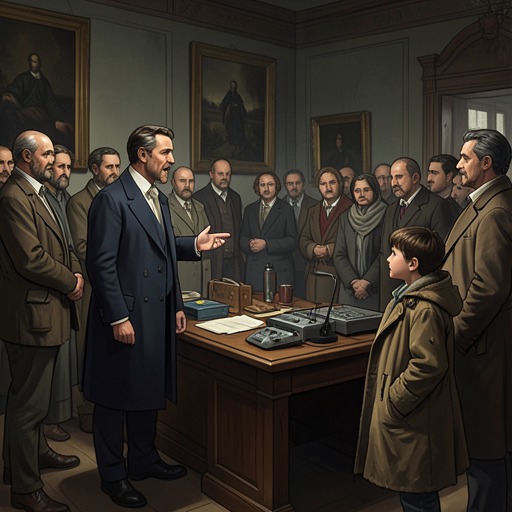
Lasaraleen
The Horse and His BoyLasaraleen is a wealthy Tarkheena and a former friend of Aravis whose access to the Tisroc’s palace helps make Aravis’s escape from Tashbaan possible. Her part is brief but consequential: she can open doors that would otherwise be closed, yet she meets danger with giggles, concern for her dress, and a wish to remain among the pleasures of city life. The difference between the two women gives their cooperation its tension and its force.
Identity and Social Position
Lasaraleen belongs to the privileged social world of Tashbaan. The narrative identifies her as a Tarkheena and presents her in a procession: a crier announces her arrival, four armed slaves precede her, and four bearers carry a litter adorned with silken curtains and silver bells. Female slaves in fine clothes, followed by grooms, runners, and pages, complete the train. The litter’s perfumes and flowers announce not merely wealth but a life organized around display and attendants.
Aravis knows Lasaraleen well, having encountered her repeatedly in the same houses and at the same parties, almost as though they had attended school together. Lasaraleen is therefore not a stranger whom Aravis must persuade from nothing; their shared social past gives Aravis a chance to seek help. Yet familiarity does not mean that they share habits of mind. Lasaraleen enjoys being noticed and speaks loudly enough to draw attention, while Aravis is trying to avoid being seen. Their reunion brings two incompatible ways of moving through the city into the same confined space.
The Meeting in the Street
The encounter begins after Aravis has seen Shasta hurried away by the Narnians. Left with the two horses, she holds Bree by the halter and keeps still until the lords have passed. Though her heart is pounding, she does not show her fear. She tries to continue, but the crier’s announcement of Lasaraleen’s approach stops her. Aravis looks up at her old acquaintance, and that moment of recognition becomes a risk: Lasaraleen’s procession is public, conspicuous, and difficult to approach without attracting notice.
Aravis nevertheless acts quickly. She tells Lasaraleen to hide her and insists that the horses be taken along, that the litter curtains be drawn, and that they leave for somewhere she cannot be found. Lasaraleen initially answers in her usual loud, expansive manner, beginning to call Aravis darling as people stare. Aravis’s sharp command interrupts that performance. Lasaraleen agrees to have the horses taken by slaves, and Aravis draws the curtains around them both, turning the richly scented litter into a private enclosure amid the street’s exposure.
Help, Distraction, and Escape Planning
Inside the litter, Lasaraleen is eager to hear what has happened but remains absorbed in ordinary comforts: she points out that Aravis is sitting on her new dress and asks whether Aravis likes it. Aravis refuses the invitation to treat the meeting as social entertainment and asks where her father is. Lasaraleen replies that he arrived in town the previous day and is asking after Aravis everywhere. She finds the coincidence funny and breaks into giggles; Aravis answers that the situation is dreadfully serious and asks to be hidden.
Lasaraleen offers to take Aravis to her home, explaining that her husband is away and no one will see her there. Her willingness to help is real, but her attention keeps slipping back to her own wishes: she dislikes having the curtains drawn because she wants to see people, and she sees little point in wearing a new dress if she must remain shut away. Aravis has to keep the conversation directed toward escape. The scene makes Lasaraleen’s limitations part of the practical problem: she possesses resources, but she does not naturally share Aravis’s sense of danger.
Eventually, the two discuss how to get the horses out through the North gate and onward to the Tombs. Lasaraleen can send well-dressed grooms with the war horse and Aravis’s saddle horse; she expects that no one will stop or question them on the way down to the river. Aravis herself is harder to conceal. She proposes leaving in the curtained litter, but Lasaraleen points out that litters are used inside the city and would invite questions if seen going out through a gate. The distinction between what can be arranged for the horses and what can safely be done for Aravis forces them to devise another route.
Lasaraleen then remembers that the Tisroc’s garden reaches the water and has a small water-door, ordinarily reserved for palace people. She says that her frequent invitations to the palace make it feel like a second home, and that she could enter with Aravis after dark and let her out at the water-door, where small boats are tied up. Her intimacy with the court, presented partly as a boast about the Tisroc’s kindness and her affection for Prince Rabadash, becomes concrete assistance. Aravis immediately recognizes the danger: if they were caught, all would be lost. The plan depends on Lasaraleen’s access, but Aravis’s caution sets its limits.
The Palace Garden and Lasaraleen’s Limits
In the palace, Lasaraleen is reluctant to hurry away from the company and comforts she enjoys. Aravis has to press her into leaving. When Lasaraleen finally leads her down the steps and through a corridor into the garden, the surroundings offer a marked contrast to the urgency of the escape. The terraced garden slopes toward the city wall under moonlight; Aravis later remembers its gray lawns, bubbling fountains, and the long black shadows of cypress trees, though at the time she is too anxious and hurried to take in the beauty clearly.
At the foot of the garden, the wall rises above the women and the route reaches the river, a landing stage, and several pleasure boats. Lasaraleen is shaking so much that she cannot unbolt the gate, so Aravis opens it herself. Her fear at the decisive moment shows the limit of her courage: she has helped bring Aravis to the exit, but cannot complete the final physical action. Aravis thanks her and apologizes for having been difficult, asking her to consider what she is fleeing. Lasaraleen still asks whether she will change her mind now that she has seen how great Ahoshta is. Her response leaves their difference unmistakable: for Lasaraleen, status and an advantageous match remain persuasive; for Aravis, escape from that fate is the reason the risk must be taken.
Narrative Role and Significance
Lasaraleen’s role is that of a useful but imperfect ally. Her rank, servants, litter, household, and access to the palace supply practical means for Aravis’s concealment and departure. None of these advantages makes her an adventurous or consistently alert companion. She is easily distracted, attracted to public attention, and frightened at the garden gate. Aravis must therefore convert Lasaraleen’s social connections into an escape plan while repeatedly countering her levity and hesitation.
The contrast is not simply between a brave woman and a foolish one. Lasaraleen does agree to help, arranges for the horses to be moved, identifies the water-door, and leads Aravis through the palace garden to the river. Her contribution matters precisely because it comes through capacities shaped by her privileged life: she knows the court and can enter spaces unavailable to an ordinary fugitive. But the escape succeeds through Aravis’s urgency and initiative as much as through Lasaraleen’s access. When Lasaraleen cannot unbolt the gate, Aravis does it herself; when Lasaraleen continues to praise Ahoshta, Aravis’s purpose remains unchanged. The episode uses their friendship to show how assistance can be genuine without being complete, and how the same social world that gives Lasaraleen influence also leaves her unable to understand what Aravis must flee.