Narnia
The Horse and His BoyNarnia is the free northern homeland that gives Shasta’s flight from Calormen a destination and a measure of what life beyond captivity might be. First known to him through Bree’s longing and the glimpse of the mountains, rivers, forests, and speaking creatures, it becomes a real place when Shasta crosses the pass; its inhabitants then answer danger in Archenland with military aid. The story thus presents Narnia not only as a landscape of remembered beauty, but as a community whose liberty entails action for its neighbors.
Setting and Character
The story opens in the Golden Age of Narnia, when King Peter is High King and his brother and two sisters reign as kings and queens under him. Far to the south, Shasta lives with Arsheesh on a little sea creek in Calormen. Narnia lies beyond the northern horizon of that constrained life: while Shasta has visited the village to the south and found nothing to interest him, he is fascinated by the country beyond the grassy ridge to the north. From the cottage, however, he can see only the slope, its level crest, and the sky beyond. His desire for the unknown north precedes any knowledge of Narnia itself.
That distance is also a social contrast. Arsheesh keeps Shasta occupied with mending and washing nets, cooking, and cleaning, and may beat him when dissatisfied. When Shasta asks what lies beyond the hill, Arsheesh either strikes him or answers with a proverb against questions that distract from business. Narnia first exists for Shasta as the possibility of a life outside this household and its narrow horizon; the contrast between the boy’s curiosity and his enforced work makes the north a direction of imagined freedom before it is a destination on a map.
A Homeland Heard About Before It Is Reached
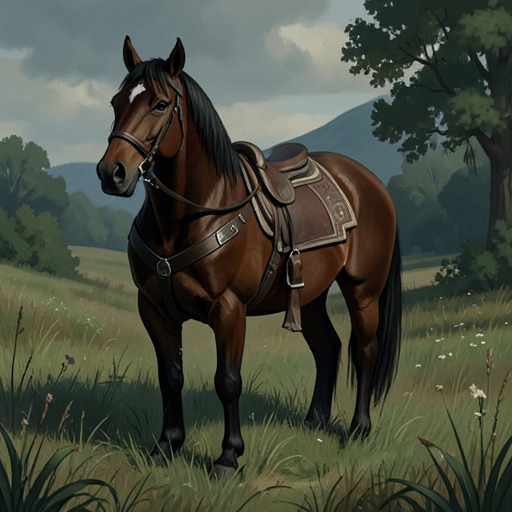
Shasta first learns Narnia’s name from Bree, the talking horse he discovers in Calormen. Bree calls it the happy land and evokes heathery mountains, thyme-covered downs, rivers, glens, mossy caverns, and forests whose Dwarfs ring with hammers. The account ends in a sighing whinny. Bree says he was captured as a foal after wandering too far south, against his mother’s warning, and has spent years enslaved among humans, hiding his ability to speak by pretending to be an ordinary, unintelligent horse. Narnia is therefore not simply a beautiful origin in his account: it is the home from which he was separated and the freedom his disguise has concealed.
For Shasta, Bree’s testimony turns an abstract north into a place worth reaching. Their escape is complicated by the conditions of travel: the boys need food, and Bree reasons that using money taken from their captors is not theft because they are prisoners in enemy country. Shasta, who cannot eat the grass and oats that sustain the horses, depends on provisions for humans. Freedom begins as movement away from Calormen, but the fugitives must still negotiate the practical constraints created by their different needs and circumstances.
The contrast between the two countries also appears in political speech. Rabadash argues that Narnia is a small, supposedly unprofitable land that a thousand spears could conquer in five weeks; the Tisroc agrees that free countries are hateful to those who value empire. Their language reduces Narnia’s independence to a defect and frames conquest as punishment. This makes the fugitives’ destination a contested political reality, not merely Bree’s cherished landscape: Narnia’s freedom is precisely what the Calormene rulers would abolish.
Crossing into Narnia
Shasta does not arrive by a planned, direct route. Separated from the others, he believes they may have gone on without him and wrongly suspects that Aravis would abandon a companion. The narrator corrects that judgment, describing her as proud and sometimes hard, but steadfastly loyal. Alone at night among the Tombs of the Ancient Kings, Shasta is frightened by the closing of Tashbaan’s gates and by the possibility of ghouls; what touches him proves to be a cat. The episode leaves him isolated, with no secure knowledge of where his companions are.
Later, lost in cold, misty high country, Shasta thinks that every good outcome has happened to someone else. He knows neither the mountains nor the way to Anvard and has lost the direction back to Aravis, Bree, and Hwin. In the morning, after drinking from cold, clear water, he looks over an unfamiliar valley and recognizes the high mountains behind him as the range between Archenland and Narnia. He realizes that he crossed the pass during the night. What he first calls luck he immediately understands as something other than luck. The discovery changes his situation: he has reached Narnia, although hunger remains and he believes Anvard may already be under siege.
Narnia’s place in the narrative is sharpened by that passage from ignorance to recognition. Shasta has not mastered the route or earned certainty by knowing the terrain; he reaches the country while tired, hungry, and unsure where he is. The crossing answers his childhood longing to see beyond the ridge, but it does not end the danger. Instead, arrival places him where he can encounter Narnia’s inhabitants and become involved in the defense of a neighboring kingdom.
A Community That Comes to Its Neighbors’ Aid
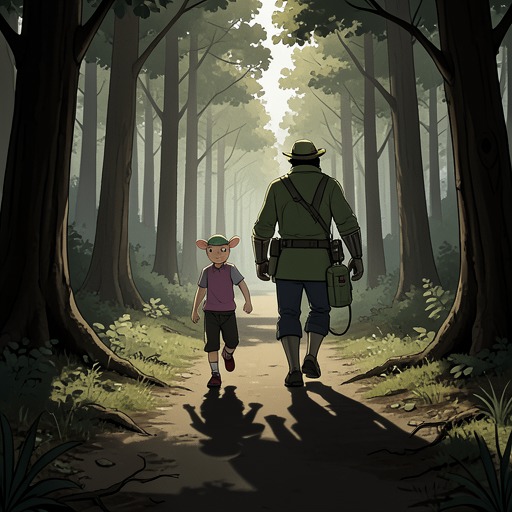
Shasta’s first view of Narnia’s response to the crisis comes among its woodland people. In the Golden Age, after the Witch and the Winter have gone and King Peter rules at Cair Paravel, smaller creatures are so safe and happy that they have become somewhat careless. A gathering of rabbits, a squirrel, magpies, a goat-footed faun, and a mouse talks over news of the danger. The arrival of Duffle, a Red Dwarf, changes the mood: instead of continuing to chatter, they must send word to Cair Paravel and call out the army to aid King Lune of Archenland. The contrast is pointed. Safety has made the woodland gathering complacent, but the news of enemies at Anvard makes the obligations of safety unmistakable.
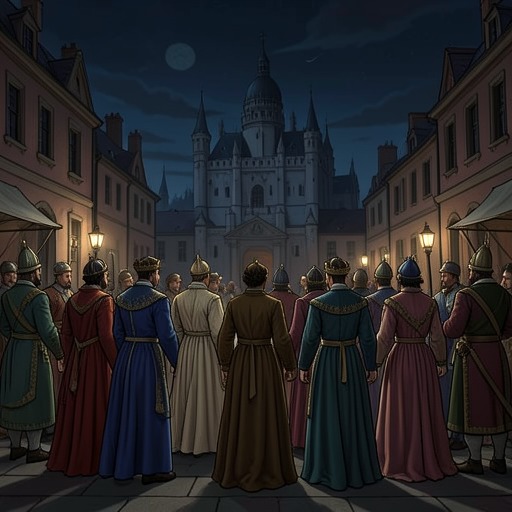
The Narnian army is not a force of humans alone. Shasta sees Lord Peridan carry a red lion on a green ground as the banner of Narnia. King Edmund and Queen Lucy ride among the leaders, and Corin, whom Shasta has met under mistaken circumstances elsewhere, is with them. The main body includes human riders, Talking Horses ridden on this proper occasion of war, centaurs, bears, Talking Dogs, and six giants. The variety makes visible the country’s mixed community, while the army’s purpose is clear: Narnia is going to King Lune’s aid against the threat at Anvard.
The episode gives political substance to Bree’s idealized description. Narnia is celebrated for its natural beauty, but the woodland gathering and the relief force show a country organized around communication and collective action. The Dwarf insists that a message be sent and an army called; the column that arrives includes many kinds of inhabitants under a shared banner. The country’s freedom is not portrayed only as an escape from an empire’s control. It also makes possible an obligation to assist a neighboring king in peril.
Home, Memory, and the Story’s Ending
Narnia is also the home imagined by creatures who have been separated from it. Bree’s longing is explicit, while Hwin and Bree eventually live happily to a great age there. Both marry, but not each other, and they often cross the pass to visit their friends at Anvard. Their return and repeated visits make the relationship between Narnia and Archenland more than a one-time military alliance: the pass connects neighboring homes and allows the friendships formed during the flight to endure.
The closing account reaches beyond the immediate adventure. Cor and Aravis become King and Queen of Archenland after King Lune’s death, and their son Ram becomes the most famous of Archenland’s kings. Corin and Cor continue to quarrel as they grow up; Corin’s boxing prowess earns him the name Corin Thunder-Fist and is later associated with his fight against the Lapsed Bear of Stormness. These futures place Narnia within a continuing northern world of visits, contests, and neighboring rule rather than treating Shasta’s crossing as an isolated escape.
The story’s treatment of Narnia balances enchantment with consequence. Bree’s catalogue of hills, rivers, caverns, and forests makes the country a home to desire; Shasta’s crossing gives that desire a concrete geography; and the call to defend Anvard makes the homeland’s political character visible. For a boy whose early life is bounded by labor and an unseen northern ridge, reaching Narnia is both the fulfillment of a longing and the beginning of participation in a wider community.