Prince Corin
The Horse and His BoyPrince Corin is the Archenland prince whom Shasta accidentally impersonates in Tashbaan. His sudden return exposes the mistake, frees Shasta to continue his escape, and turns an apparent case of royal disobedience into a brief meeting between two boys whose lives have taken sharply different paths.
Identity and mistaken recognition
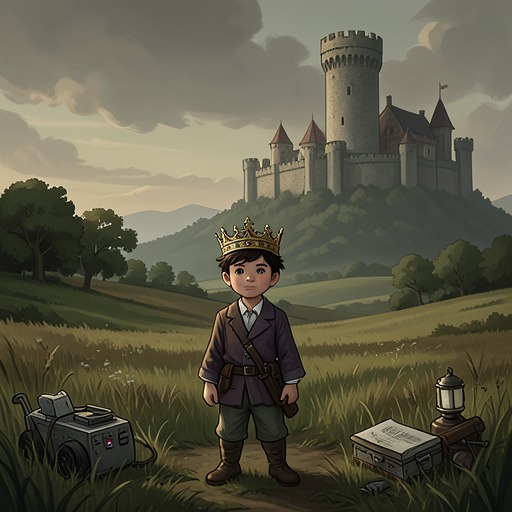
Corin is the son of King Lune of Archenland. Before the real prince appears, the Narnians believe Shasta is Corin: they address the captured boy as a prince and rebuke him for running away. King Edmund tells him that a son of Archenland’s king should acknowledge his actions rather than hang his head like a Calormene slave. The rebuke rests on a false identification, but it establishes the royal standing and expectations attached to Corin’s name.
The deception has consequences beyond Shasta’s immediate predicament. The queen who welcomes him explains that she and Corin have been close friends since his mother died, and that returning without him would have risked a serious quarrel between Archenland and Narnia, longstanding friends. Her affectionate reproach makes the mistaken identity personal as well as diplomatic: Shasta is treated as a missing companion whose absence has alarmed a royal household.
Return to the room
While Shasta waits among the Narnians, he hopes the real Corin will not appear until Shasta has been taken by ship to Narnia. He is preoccupied with his own escape and with the possibility of avoiding the desert crossing; the evidence also shows that he gives little thought to what may have happened to Corin in Tashbaan. That self-interested hope ends when a crash wakes him in the room where he has fallen asleep.
The crash comes from a porcelain vase that has fallen from the windowsill and broken into roughly thirty pieces. Shasta then sees hands gripping the sill from outside, followed by a boy climbing into the room. Corin arrives in a state that contrasts with the splendid clothes he had originally worn: his garments are torn and dirty, and his face bears blood and mud. The evidence establishes that he has had adventures of his own, but does not detail how he came to the window or what happened to him before his return.
Recognition and exchange with Shasta
The boys are nearly identical in appearance under ordinary circumstances, which explains why the Narnians mistook Shasta for the missing prince. Shasta asks the newcomer whether he is Prince Corin, and Corin confirms that he is before asking who Shasta is. Shasta describes himself as nobody in particular and explains that King Edmund caught him in the street, mistaking him for Corin. The exchange resolves the central misunderstanding directly: Corin is not merely a name Shasta has been given but the real prince, returned in person.
Corin does not respond to Shasta as an adversary or expose him to the Narnians. Instead, he wishes him good luck and hopes he gets away safely. Shasta remarks on Corin’s adventures, and Corin answers that they are nothing compared with Shasta’s. The comparison recognizes that both boys have endured unusual journeys, even though their experiences have been unequal and Shasta has not yet told him the full story.
Parting and narrative significance
Corin tells Shasta to go to his father, King Lune, in Archenland and say that he is a friend of Corin’s. This invitation gives Shasta a relationship and a point of contact that will matter beyond the Tashbaan episode. The meeting thus changes Shasta’s position: he leaves not as an unnamed stranger to the Archenland court, but with the real prince’s personal recommendation.
Their farewell is hurried by the sound of someone approaching. Corin warns Shasta to drop lightly from the window and says he hopes they will meet in Archenland. Corin’s brief appearance both ends the mistaken-identity episode and redirects Shasta toward the next stage of his journey. His similarity to Shasta supplies the plot’s confusion; his return and friendly parting turn that confusion into a connection between Shasta and King Lune’s household.