Rabadash’s army
The Horse and His BoyRabadash’s army is the two hundred horsemen with whom Prince Rabadash plans a sudden invasion of Archenland, followed by a drive through Narnia to seize Queen Susan. The expedition is designed to make the conquest of Anvard the foothold for a larger attack, while preserving the Tisroc’s ability to deny responsibility. Its march turns that plan into a test of desert logistics, timing, and political legitimacy; at Anvard, the force is defeated by the combined resistance of Archenland and Narnia.
Formation and Strategic Purpose
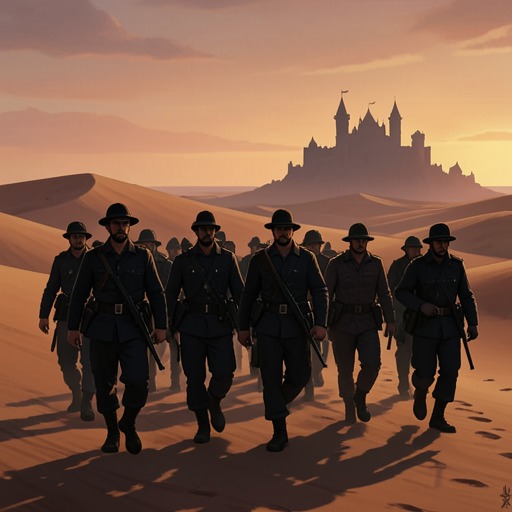
Rabadash presents the expedition to the Tisroc as a private undertaking: he will take two hundred horse and cross the desert that night, while making it appear that his father knows nothing of his departure. He expects to reach Anvard, King Lune’s castle in Archenland, on the second morning and take it before its defenders are prepared. From there, he intends to pass through the route above Anvard into Narnia and ride to Cair Paravel. His immediate personal objective is to capture Queen Susan when she arrives aboard the Splendor Hyaline; the larger military objective is to establish control over Anvard as a permanent entry point into Narnia.
The force is deliberately limited in size and its mission depends on speed. Rabadash says he will order ten men to disarm and bind King Edmund rather than kill him, hoping to prevent the raid from becoming a declared war between the Tisroc and the High King. He also assumes that the Splendor Hyaline will not reach Cair Paravel before him, judging the winds unfavorable to the ship. Those assumptions make the operation a race against warning and reinforcement, not a conventional campaign of occupation from the outset.
Rabadash argues that the capture of Anvard would benefit his father even if the horsemen rode on through Narnia and later withdrew. A garrison could be enlarged gradually until it became a great host, leaving the Tisroc in possession of what Rabadash calls the gate of Narnia. To shield his father from the consequences if the attempt failed, he proposes that the Tisroc claim the prince acted without his knowledge or blessing, driven by youthful impetuosity. The plan thus combines territorial ambition with a calculated attempt to separate military action from political responsibility.
Route, Intelligence, and the Desert Crossing
The desert is central to the plan, but it is not an empty space that can simply be crossed by force. In a discussion Shasta overhears, the Raven Sallowpad explains that a large army could not cross by way of the Great Oasis: its springs would not supply enough water for all the soldiers and animals. He describes another route from the Tombs of the Ancient Kings, northwest toward the double peak of Mount Pire and down a narrow, initially inconspicuous stony valley to a river leading into Archenland. The intelligence establishes both the value of a less obvious passage and the importance of water and terrain in determining which forces can use it.
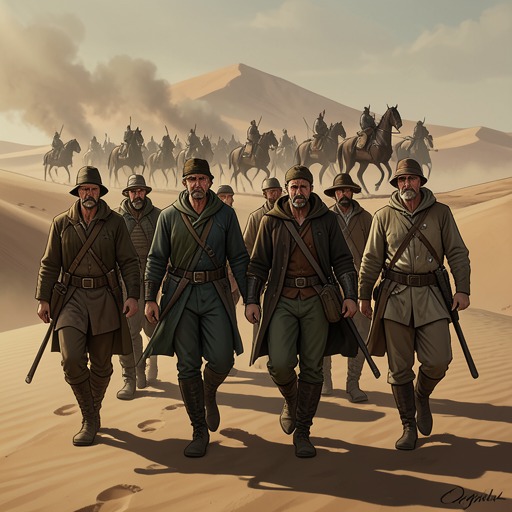
The fugitives’ crossing gives a close view of the physical demands of desert travel, though it does not establish that their small party and Rabadash’s army follow precisely the same timetable or conditions. Under the high sun they find only a small rock outcrop, about fifty yards long and thirty feet high, whose limited shade offers a brief place to eat and drink. The horses manage water from skin bottles, but neither people nor animals have enough. After a short rest they continue across the level sand into the night, still searching for the valley described by Sallowpad. These details underscore how vulnerable a mounted force can be to thirst and distance, and why route knowledge matters as much as numbers.
The evidence of Rabadash’s approach becomes visible before the fugitives reach Anvard. Aravis recognizes the approaching force as Rabadash’s army, and the party turns north in an urgent race. The horses crest ridge after ridge without knowing how far the castle lies. From the second ridge Shasta sees the army as a moving mass on the far bank of the Winding Arrow, apparently looking for a ford. The river, ridges, and uncertain distance impose a final timing problem: the fugitives must warn the defenders and arrive before the attackers can cross and reach the castle.
Orders and Conduct on the March
At a crossroads near Anvard, Shasta overhears a commander instructing the column. The orders distinguish sharply between the planned passage through Narnia and the immediate assault in Archenland. Once inside Narnia, the horsemen are to kill as little as possible, treating Narnian lives as unusually valuable for the purposes of this venture. The speaker says that a later, happier hour will come for destroying everything between Cair Paravel and the Western Waste, but insists that the present priority in Archenland is speed.
The assault on Anvard is framed in very different terms. The commander demands that the castle be taken within an hour and offers the attackers the spoils, reserving none for himself. His orders call for the death of every adult male in the castle, including a newborn child, while women and material goods are assigned as booty. He threatens that any man who hangs back at the gates will be burned alive, invoking Tash as he sends the column forward. The speech presents the force’s immediate operation as a brutal seizure, not as the restrained intervention Rabadash had described to the Tisroc.
This contrast exposes a gap between the prince’s account of the expedition and the conduct ordered at the castle. Rabadash had promised to spill as little Narnian blood as possible and to avoid giving the High King a deadly cause for war. Near Anvard, however, the assault is to proceed by speed, coercion within the ranks, and indiscriminate violence against the castle’s defenders. The difference matters to the expedition’s political character: the proposed deniability does not make the invasion peaceful, and the immediate orders reveal the violence on which its seizure of Anvard depends.
The Assault and Defeat at Anvard
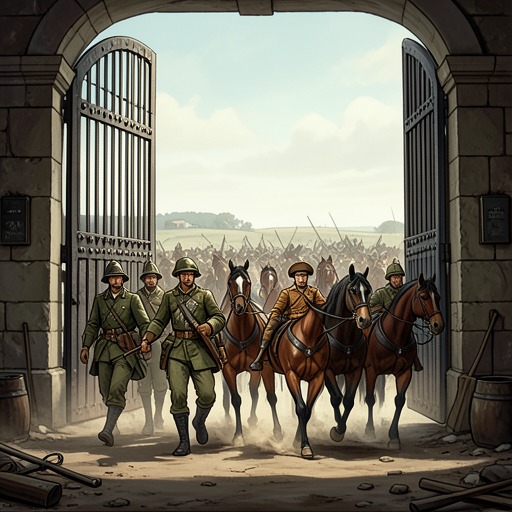
When the Narnians arrive, the defenders’ gate is shut and the portcullis is down. Around fifty Calormenes have dismounted and are swinging a tree trunk against the gate as a battering ram. The rest of Rabadash’s force has been on foot, ready to assault, but the advancing relief party appears on a ridge. The attackers rapidly remount, form a line, wheel around, and ride to meet them. Their training allows them to respond quickly, but the change from siege to mounted combat cannot prevent the relief force from engaging them.
The battle is confused and costly. Shasta is unseated early in the clash, and the Hermit of the Southern March reports the fighting from a distance. The Talking Cats have attacked the horses left without riders, leaving the Calormenes without those animals as a means of retreat; they then turn against the men operating the ram. With the ram disabled, the defenders open the gates and King Lune leads a sortie, accompanied by the brothers Dar and Darrin. Narnian forces, including King Edmund and the Giants, join the fighting, while the Cats press from another side. The Calormene line is forced back, then reduced to a small group fighting back to back; some surrender and others flee toward the woods.
The defeat closes with the castle gates open and the surviving Calormenes taken as prisoners or driven from the field. King Lune and King Edmund meet across the battering ram and shake hands. Rabadash is found alive, despite the uncertainty during the battle over whether he has been killed. His force has failed to take Anvard, and the tactical result overturns the political premise of his plan: rather than securing a permanent base from which to enlarge the Tisroc’s presence in Narnia, the expedition leaves its leader captured in the very castle he meant to seize.
Consequences and Political Meaning
Rabadash demands to be released so he can fight King Edmund, but King Lune refuses to treat the demand as an honorable challenge. He explains that an earlier challenge would have been answered, but that attacking Anvard in peacetime without first issuing a defiance makes Rabadash a traitor rather than a knight entitled to cross swords with a person of honor. The refusal gives the defeat a legal and moral dimension: the force’s failure is not only a military reversal, but the consequence of beginning its attack outside the accepted rules of challenge.
The prince is bound and carried into the castle, shouting, threatening, cursing, and crying. His humiliation is especially difficult for him because he has always been taken seriously in Tashbaan. The army’s defeat therefore strips away both the strategic advantage he expected and the authority on which his self-image depended. His seizure of a peaceful castle has not created a defensible foothold; it has left him subject to the judgment of the rulers he meant to overpower.
King Lune later states that the allied rulers have a right to Rabadash’s head under the law of nations and prudent policy, but offers to release him unharmed under conditions, citing his youth and the poor upbringing he has received in a land of slaves and tyrants. Rabadash rejects the terms while still in chains and demands a sword instead. The account establishes that the army’s defeat brings its commander into the custody of the victors and places his fate within a political and legal settlement; it does not, in this exchange, describe the final outcome of those conditions.
Narrative Significance
The expedition’s structure links military decisions to the story’s competing ideas of rule. Rabadash treats Anvard as a gate to be captured, Narnia as a country whose freedom makes it a target, and the Tisroc’s authority as something that can be preserved through a convenient denial. Against that calculation, the narrative gives practical weight to the defenders’ readiness, the terrain and river crossing, and the rule that a peaceful kingdom cannot be attacked without consequence. The force is defeated not by an abstract warning but through the specific failure of its timetable and assault at Anvard.
The army also makes visible the distance between Rabadash’s promises and the violence of his campaign. His proposed restraint in Narnia is paired with an order at Anvard to kill the castle’s male inhabitants and reward the attackers with its people and possessions. The contrast turns the expedition into evidence of the invasion’s coercive purpose, while its defeat prevents the proposed garrison from becoming the basis for a larger conquest. Rabadash’s force begins as an instrument for taking territory and a queen; it ends as a defeated column whose leader is a prisoner under the judgment of the rulers he attacked.