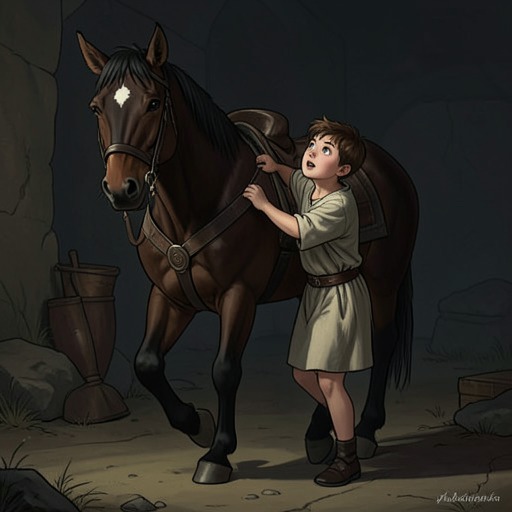
Shasta leaps from his horse to help Aravis
The Horse and His BoyShasta leaps from his horse to help Aravis at the moment a desperate ride toward Anvard turns into a test of whether the travelers will leave one another behind. With Hwin nearly overtaken by a lion and Aravis in immediate danger, Shasta jumps from Bree and runs back. His choice helps bring Aravis and Hwin inside the Hermit’s green-walled enclosure, while Bree’s flight ahead becomes a source of shame and self-reproach. The action makes courage a matter of what someone does under pressure, not what he claims to be.
Causes and Setting
The travelers are racing to reach Anvard in time. Aravis urges Bree to gallop and reminds him that he is a war horse; Shasta holds back from shouting similar instructions because he believes Bree is already doing everything he can. Bree has caught up with Hwin, and the two horses thunder side by side, but Hwin seems unable to keep up much longer. Their urgency is tied to the danger facing Anvard, yet a new threat comes from behind rather than from the expected pursuit of enemy riders.
Shasta recognizes the snarling roar as the same sound heard on the night he first met Aravis and Hwin. Bree recognizes it too, and his response is immediate: his eyes gleam, his ears flatten, and he accelerates. Only then does he discover that he had not been running quite as fast as he could. The lion’s arrival changes the pace and purpose of the ride. The group is no longer simply hurrying toward a destination; it is trying to escape a predator that is gaining on them.
Ahead stands a high, smooth wall of green turf, about ten feet high, with an open gate. A bearded man in a robe the color of autumn leaves leans on a staff beside the entrance. Shasta notices the wall and gate without taking in their significance. Looking back, he sees the lion closing on Hwin, snapping at her hind legs, while Aravis remains on her back. The open gate offers a possible refuge, but reaching it without turning back would mean leaving Hwin and Aravis to face the lion alone.
The Decision to Turn Back
Shasta orders Bree to stop and says they must go back to help. Bree later insists that he neither heard nor understood the command, though the narration notes that he is generally truthful. Whatever Bree hears, he continues forward. Shasta therefore has to choose without being able to rely on his companion: he slips his feet from the stirrups, swings both legs to one side, hesitates for an instant, and jumps down.
The leap hurts and nearly leaves Shasta winded. He has never done anything like it before and scarcely understands why he is doing it; nevertheless, he staggers back toward Aravis. His action is not framed as a calculated plan or a display of established martial skill. Shasta has no weapon, not even a stick or stone, and responds to the unfolding danger with an improvised attempt to help. His decision turns him away from the apparent safety of Bree’s forward flight and toward the people and horse at risk behind him.
The Lion and the Gate
Aravis bends low over Hwin’s neck and seems to be trying to draw her sword. Shasta, Aravis, Hwin, and the lion converge before the gate can become an uncomplicated escape. The lion rears and strikes at Aravis; Shasta sees its claws, moves toward it in horror, and shouts for it to go home as though addressing a dog. He has neither weapon nor advantage in the encounter. His intervention is an act of nerve rather than force.
The lion suddenly checks itself, turns head over heels, gets up, and rushes away. Shasta does not assume that it has fled for good. He turns and runs for the gate he had barely noticed before. Hwin is stumbling and nearly fainting as she enters; Aravis stays mounted, but her back is injured. The party crosses the threshold together, and the bearded man welcomes Aravis as his daughter and Shasta as his son before the gate closes behind them. He then begins helping Aravis down from her horse.
The enclosure is a broad, circular space protected by the high turf wall. It contains a still pool, a great tree, a low stone house with an old thatched roof, goats, and grass covering the level ground. These details establish a striking contrast with the exposed ground outside: the wall and gate have converted a perilous pursuit into shelter. Shasta’s return toward danger does not defeat the lion by itself, but it brings him back to the group just as they reach the refuge.
Consequences and Significance
The event’s consequence extends beyond escape. Bree later says he will return to Calormen because he believes slavery is all he deserves. He condemns himself for leaving a mare and a girl to the lion while galloping to save his own skin, and compares his failure with Shasta’s return. Bree had called himself a war horse and boasted of a hundred fights; now he sees that the inexperienced boy, who has never held a sword, acted more bravely than he did. Hwin answers that they all ran as hard as they could, but Bree insists that Shasta at least ran in the right direction.
This contrast gives the leap its lasting force. Shasta is not presented as someone who has mastered fear: he hesitates, is horrified by what he sees, and has no clear method for confronting the lion. His courage lies in turning back despite those limits. Bree, by contrast, has the strength and identity of a war horse but initially uses his speed to save himself. The episode separates courage from reputation and experience, making conduct under pressure the measure of both characters.
The action also marks a change in how the companions understand one another. Bree’s later self-accusation acknowledges a moral example he did not expect from Shasta, while Shasta’s return treats Aravis and Hwin as companions whose danger demands a response. The immediate movement is simple—away from Bree, back toward the lion, and then through the gate—but its consequence is a new judgment of what bravery means. The ride’s escape depends not only on speed but on Shasta’s refusal to let speed become abandonment.