Shasta—Bree
The Horse and His BoyShasta—Bree is a partnership forged in captivity and tested on the road: Bree’s escape plan gives Shasta a means to leave forced labor behind, while Shasta’s conduct ultimately shows Bree that courage is not a title earned in battle but a choice made when someone needs help. Their relationship moves from mutual necessity through practical companionship to a humbling reversal in which the inexperienced boy acts more bravely than the veteran war horse.
Captivity and the Escape Compact
Shasta begins as a boy laboring in the household of Arsheesh, the fisherman who calls himself his father. His work includes mending and washing nets, cooking supper, and cleaning their cottage; when Arsheesh is in a bad temper, he finds fault with Shasta and may beat him. Shasta’s life is constrained by both this domestic service and his ignorance of what lies beyond home. His northward curiosity has no answer in the household, where questions about the hill bring either punishment or a proverb urging him to attend to business.
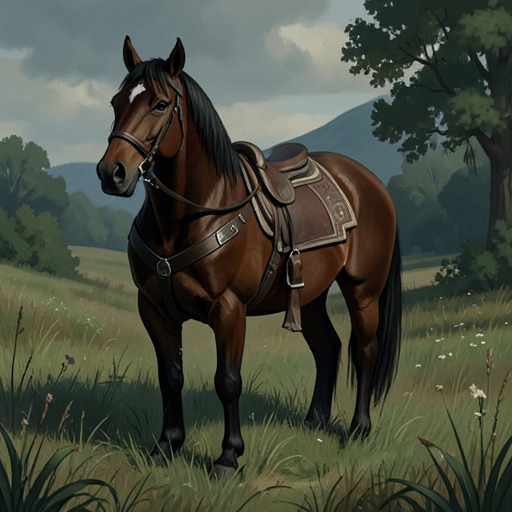
Bree’s own captivity has a different history. A Narnian horse, stolen as a foal after wandering beyond the Southern slopes, he has spent years among humans hiding that he can speak and pretending to be an ordinary, witless horse. He explains that revealing his nature would have made him a fairground curiosity and brought closer guarding, destroying his chance of escape. His concealment is therefore not passivity but a survival strategy maintained until a useful opportunity appears.
That opportunity arises when Shasta faces the prospect of becoming a human slave in the household of Bree’s master, the Tarkaan Anradin. Bree warns him that such a fate would be worse than death and proposes that they flee together. The plan depends on the two captives’ different abilities: Bree needs a rider so that people who see him will take him for a horse being ridden rather than a stray to be pursued, while Shasta needs a swift mount because his own legs cannot carry him far enough to escape. Their compact begins not in sentiment but in reciprocal need, with each supplying what the other lacks.
Even at the start, Bree is not simply a tool for Shasta’s escape. He sets the terms of practical cooperation and makes clear that they must act rather than spend time on questions. At the same time, he treats Shasta as a potential partner rather than merely as a burden: the boy’s presence makes the escape possible for Bree, just as Bree’s strength and speed make it possible for Shasta.
Learning to Travel Together
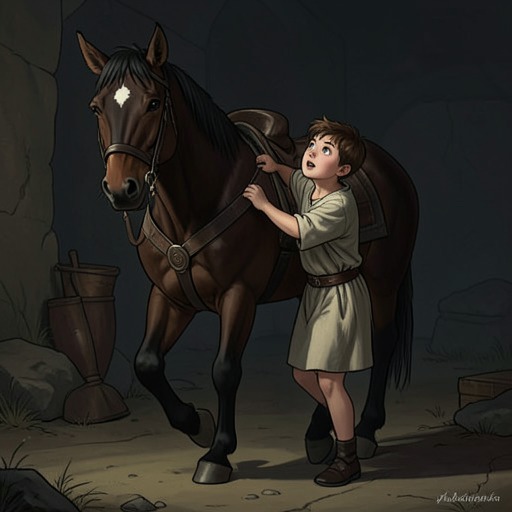
The escape does not instantly make Shasta a capable rider. His legs ache as he mounts, and at first he falls often and sits badly in the saddle. Bree nevertheless carries him at a soft pace through the afternoon, adjusting the journey to the boy’s physical limits. Their shared travel develops through small acts of accommodation rather than a single declaration of loyalty.
They also establish a cautious routine for obtaining food. Bree says that taking the money they have found is permissible because they are prisoners in enemy country and need to feed Shasta, who cannot live on grass and oats as a horse can. On travel days they keep to the coast rather than risk the cultivated land and main roads inland. When they reach a village at twilight, Shasta dismounts and goes in on foot to buy a loaf, onions, and radishes, while Bree circles around the fields and meets him beyond it. They repeat this arrangement every second night, dividing tasks according to what each can safely do.
Bree becomes Shasta’s riding instructor. He is still rude about the boy’s seat, comparing him to a bag of flour, and says he would be ashamed to be seen with him on a main road. Yet the criticism sits alongside patient teaching. Shasta learns to trot, canter, jump, and keep his seat when Bree stops suddenly or swings to either side—movements Bree explains may be necessary in battle. The mismatch between the boy’s initial clumsiness and his progress makes their partnership a form of apprenticeship: Bree’s experience becomes useful knowledge, and Shasta gradually becomes more than the rider required to disguise a runaway horse.
Their conversations reveal the difference between Bree’s past and the future he wants. He recounts forced marches, river crossings, cavalry charges, and fierce fights in which trained stallions bit, kicked, and used their weight in combat. But he does not want to keep talking about wars fought for the Tisroc while he was enslaved and treated as a dumb beast. He longs instead for wars in which he can fight as a free Horse among his own people, and his cry of “Narnia and the North!” signals an imagined home that gives direction to their journey. For Shasta, these stories turn riding lessons into glimpses of the world beyond the household he has escaped; for Bree, they keep the distinction between service under compulsion and action as a free being firmly in view.
The Test of Courage
The partnership is tested when the travelers are pursued by a lion and Hwin is in immediate danger. Shasta sees the animal snapping at her hind legs and recognizes that there is no hope in her frightened, foam-flecked face if no one turns back. He orders Bree to stop and says they must help. Bree later claims that he neither heard nor understood the command, though the narrator notes that Bree is generally truthful and leaves the claim standing as his account.
Shasta does not wait for Bree to choose. He slips out of the stirrups, swings both legs to one side, hesitates for an instant, and jumps from the horse. The fall hurts and nearly winds him, but before he can attend to the pain he is staggering back to help Aravis. He has never acted this way before and scarcely knows why he is doing it. The moment matters to the relationship because it reverses the roles established during the journey: the experienced war horse has the physical power and battle history, yet the boy who once needed instruction is the one who turns toward danger.
Afterward, Bree judges himself more harshly than anyone else does. He says that he will return to Calormen and slavery because he cannot face the free Horses of Narnia after galloping away to save his own skin. Hwin objects that they all ran as hard as they could, but Bree insists that Shasta at least ran in the right direction. What shames him most is that a human child, with no sword and no good example or upbringing, has surpassed him in the decisive test.
Shasta’s action also changes how Aravis sees the boy and how she understands her own conduct toward him. She admits that she has been snubbing him and looking down on him, and says he has turned out to be the best of them. Rather than accept Bree’s proposed return to bondage, she urges him to stay and apologize. Shasta’s courage thus becomes the turning point not only in his relationship with Bree but in the group’s judgment of him: the boy treated as inexperienced and socially beneath his companions has demonstrated the clearest moral resolve.
Humility and the Meaning of Freedom
Bree interprets the failure as proof that he has lost everything, but the Hermit of the Southern March corrects him. Bree has lost his self-conceit, not his prospects. The Hermit explains that Bree’s superiority to the poor, dumb horses among whom he lived does not mean he will be exceptional in Narnia; if he can understand that he is not particularly special, he can still become a decent Horse. This rebuke answers Bree’s despair without pretending his fear did not matter. The change required is not a return to boastfulness but a more accurate estimate of himself.
The contrast between the companions’ forms of captivity gives their bond its larger significance. Shasta performs exhausting work under Arsheesh’s authority and risks punishment; Bree has been hidden in plain sight as an animal denied the recognition of his speaking nature, kept useful as a war horse and made to serve in the Tisroc’s wars. Bree’s escape depends on acting out the role expected of a mounted horse until he can leave it behind. Their journey therefore joins the practical question of getting away with a larger distinction between compelled service and chosen action.
That distinction is not resolved by Bree’s longing alone. He already dreams of fighting as a free Horse, but his response to danger shows that freedom also demands conduct that matches the identity he claims. Shasta, who has had little experience or instruction, acts without the standing or confidence Bree associates with a war horse. Bree’s humiliation is consequently a moral education: he must learn to measure himself not by his past campaigns or imagined place among the free Narnians, but by whether he can listen, accept limits, and act honorably alongside them.
The relationship ends this part of their journey not in a simple exchange of teacher and pupil, but in a more equal recognition of what each has to learn. Bree has taught Shasta how to ride and helped carry him out of Calormen; Shasta’s return toward danger forces Bree to confront the gap between his pride and his courage. Their escape alliance becomes a bond in which practical dependence leads to mutual correction: the horse gives the boy mobility and skill, while the boy shows the horse what bravery looks like when it costs something.