Shasta’s arrival in Calormen
The Horse and His BoyShasta’s arrival in Calormen begins as a tale of rescue told by the fisherman Arsheesh, but Aslan later identifies himself as the one who brought the infant’s boat to shore. The revelation recasts Shasta’s apparent misfortune as the opening of a life guided through danger toward a purpose he could not yet know.
The Infant Brought Ashore
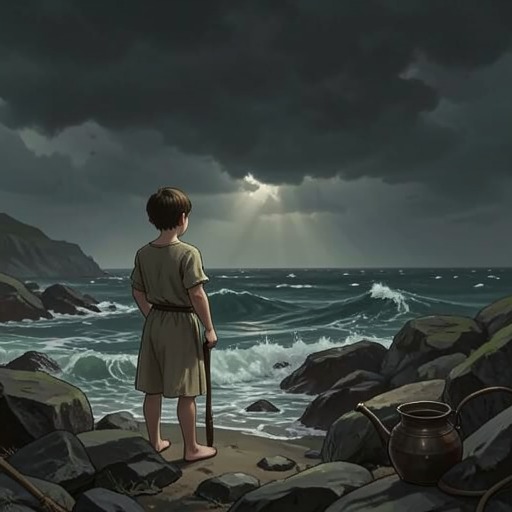
Arsheesh tells his guest that he had never married and had no child. One full-moon night, unable to sleep, he went from his hut to the beach. He heard oars and a faint cry, and the tide carried in a small boat containing a living child, an empty water-skin, and a man who appeared to have died shortly before. Arsheesh inferred that the pair had escaped a shipwreck and that the adult had starved himself to keep the child alive until land was near.
The account is delivered during a negotiation over Shasta’s sale. When the guest points out that Shasta’s fair appearance does not match Arsheesh’s, Arsheesh admits that the boy is not his son and offers the beach discovery as his explanation for taking him in. The guest cuts short Arsheesh’s praise of his own compassion and observes that Shasta’s labor has repaid far more than the cost of his food. The arrival story therefore enters the narrative in a practical, self-interested setting: it explains Shasta’s origin while also exposing the unequal household into which he was taken.
A Rescue Reframed
Years later, while traveling through the mountains, Shasta tells a mysterious Voice that he never knew his real parents and was raised sternly by the fisherman. He recounts the dangers of his escape and journey, including the desert crossing and the pursuit that left Aravis wounded. Shasta understands the many lions he has encountered as a run of bad luck; the Voice corrects that view by revealing that there was only one lion, Aslan.
Aslan then connects the infant’s arrival to his own actions: he was the lion who pushed the boat carrying Shasta, a child close to death, toward the shore where a man remained awake at midnight. What Arsheesh narrated as a fortunate outcome of the gods’ designs is thus given a more specific cause. Shasta’s rescue was not merely an episode before the adventures of the novel; it was the first in a sequence of interventions whose meaning only becomes apparent when Aslan tells Shasta his story.
The Limits of Shasta’s Knowledge
The revelation does not supply Shasta with a full account of his birth or identify his parents. Instead, it explains how he survived and reached the household where he grew up. When Shasta asks whether Aslan also wounded Aravis, Aslan confirms that he did but refuses to explain her experience to Shasta, saying that he is telling Shasta his story, not hers. This boundary makes the revelation personal rather than comprehensive: Shasta learns the meaning of his own rescue without being given another person’s explanation.
Narrative Significance
The event is presented twice, first as Arsheesh’s remembered account of finding the boat and later as Aslan’s disclosure of having directed it to shore. The second telling changes the significance of the first without erasing its concrete circumstances: the full moon, the sleepless fisherman, the tide-borne boat, the dead adult, and the surviving child remain the material facts of Shasta’s arrival. Their reinterpretation joins his unknown infancy to the guidance he encounters during his later journey, while the limits Aslan places on what he tells preserve the distinction between Shasta’s story and Aravis’s.