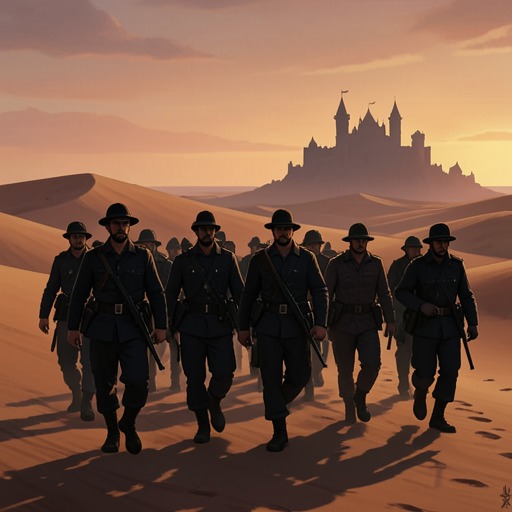
The Great Oasis
The Horse and His BoyThe Great Oasis is a desert water source whose limited capacity shapes both the threat to Archenland and the fugitives’ choice of route. Its springs could not supply a large army, making the oasis a barrier to one invasion route rather than a dependable staging point; the alternative valley route leads to a river and offers access into Archenland.
Strategic Importance
When Edmund questions whether the desert is a sure defense against the Tisroc’s ambitions, Sallowpad explains the logistical constraint. An army taking the route by the Great Oasis could reach it by the end of its first day, but the springs would provide too little water for all the soldiers and their animals. The oasis is therefore strategically significant not simply as a landmark, but as a bottleneck: access to water limits how large a force can cross by that route.
Sallowpad describes another way into Archenland, beginning at the Tombs of the Ancient Kings and heading northwest with the double peak of Mount Pire straight ahead. After a day’s ride or a little more, a traveler reaches a narrow, inconspicuous stony valley. Though it appears to offer neither grass nor water, following it down leads to a river, beside which a rider can travel into Archenland. The contrast between the apparently barren valley and the river beyond makes knowledge of the terrain a military advantage.
The Crossing and the Question of Distance
Shasta and his companions follow the Raven’s route across the desert. During the crossing, they take shelter briefly beside a rock about fifty yards long and thirty feet high, eat some food, and drink a small amount of water. Bree and Hwin manage to drink from a skin bottle, but the group has nowhere near enough water. The stop shows the bodily and logistical cost of crossing the desert with limited supplies; it does not establish that the Great Oasis itself lies on their chosen path.
Afterward, the travelers continue through the daylight and into the night, searching for the valley Sallowpad described. Bree assumes they must be far ahead of Rabadash because the Raven called the route a shortcut. Shasta corrects that assumption: Sallowpad said it was better because it led to a river, not that it was shorter. Since the oasis lies north of Tashbaan, Shasta fears their route may in fact be longer. The distinction is central to the oasis’s significance: the alternative route promises access to water, but not a faster journey.
Role in the Invasion Plan
Rabadash’s plan to attack Anvard also depends on crossing the desert. He proposes taking only two hundred horsemen, traveling secretly, and arriving at King Lune’s castle before its defenders are prepared. The Great Oasis enters the larger military context through Sallowpad’s assessment of what a large army could or could not sustain: the springs cannot support a mass crossing by that route, while the hidden valley and river offer a distinct way into Archenland. The evidence establishes the landscape’s strategic constraints, not that Rabadash’s small force follows either route.
The Great Oasis thus represents a limit on military movement rather than a simple source of replenishment. Its water is insufficient for an army, while the less obvious route described by Sallowpad joins geographical knowledge to survival. For the fugitives, the river is the practical advantage; for the kingdoms threatened by invasion, the scarcity of water helps determine what routes and forces are feasible.