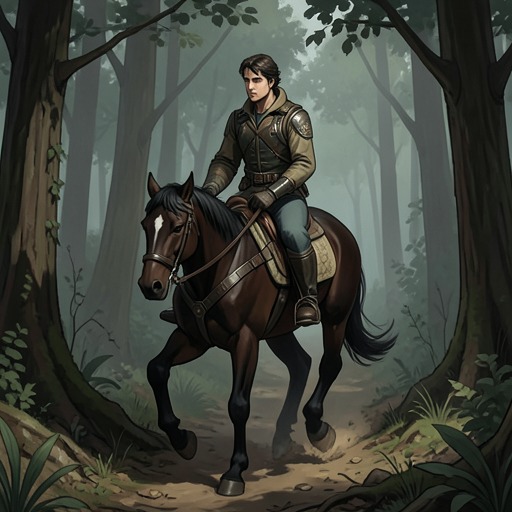
The lion attack at the Hermit’s enclosure
The Horse and His BoyThe lion attack at the Hermit’s enclosure interrupts the fugitives’ desperate race ahead of Rabadash’s army and makes Shasta choose between his own safety and turning back for Aravis and Hwin. His leap from Bree is the decisive reversal: while the lion’s pursuit endangers the others, Shasta goes back toward it, and the party reaches the Hermit’s enclosure. There, the rescue is only the beginning of his task; the Hermit sends him on to warn King Lune before Rabadash crosses the Winding Arrow.
Causes and Approach
The attack comes as the fugitives ride north toward Anvard. Aravis recognizes the distant moving glint of helmets and armor as Rabadash’s army, and Hwin urges the party to reach the castle before it. Bree and Hwin gallop side by side, while Shasta, riding Bree, understands that both horses are already straining themselves. Their immediate danger is the approaching army; the sound from behind changes the crisis into something more immediate.
Shasta recognizes the snarling roar from the earlier night when he first met Aravis and Hwin. Bree recognizes it too, and fear makes him run faster than before. Looking back, Shasta sees a large tawny lion closing on them. Ahead stands a high green wall with an open gate and, in the gateway, a bearded man in a robe the color of autumn leaves. Shasta takes in the scene but does not yet grasp the importance of the gate; his attention returns to Hwin, whom the lion is almost upon.
Shasta Turns Back
With the lion snapping at Hwin’s hind legs and no hope apparent in her face, Shasta calls to Bree to stop and go back. Bree later maintains that he never heard or understood the order. Shasta slips his feet from the stirrups, swings both legs over one side, hesitates for a fraction of a second, and jumps. The fall hurts him and nearly leaves him winded, but he staggers back toward Aravis without pausing to weigh what he is doing. He has never made such a choice before and hardly understands his own reason for it.
Aravis stoops over Hwin and appears to be trying to draw her sword. As the lion reaches them, it rises on its hind legs and strikes at Aravis; she reels in the saddle. Shasta has no weapon—not even a stick or stone—and shouts at the lion as if it were a dog. The lion abruptly checks itself, turns, and runs away. Shasta does not assume the danger has ended. He turns for the gate he had glimpsed, while Hwin stumbles through it and Aravis remains mounted, her back bloodied.
The Enclosure and the Next Task
The bearded man welcomes Aravis and Shasta into the enclosure and helps Aravis down. Inside, a high green turf wall surrounds a circular space with a still pool, a great tree shading it, a small stone house with an old thatched roof, goats, and fine grass. The quiet refuge is also a place of urgent decisions: the horses are spent, Aravis is wounded, and Rabadash is finding a ford over the Winding Arrow.
Shasta initially wonders whether the old man is King Lune of Archenland. The man identifies himself instead as the Hermit of the Southern March and tells Shasta not to waste time on questions. He must run at once to warn King Lune. The Hermit points out the opposite gate and directs him to go straight ahead, whether the way is level or steep, smooth or rough, dry or wet. Shasta has little strength left and feels the demand to be unfair, but he asks where the King is, listens to the directions, and leaves through the northern gate. The Hermit remains with Aravis, supporting her and then taking her into the house.
Courage, Freedom, and Consequence
The attack exposes the difference between a name or boast and an action. Bree had called himself a war horse and boasted of a hundred fights, but when the lion appears he runs ahead. Afterward he says he will return to Calormen, believing himself fit only for slavery and ashamed that he left a mare, a girl, and a boy in danger to save himself. Hwin answers that they all ran as hard as they could; Bree distinguishes Shasta, who ran back in the right direction, and admits that the child he considers inexperienced has shamed him.
The scene also carries forward the fugitives’ escape from imposed service. Shasta had been raised by Arsheesh in a household where he performed work such as mending nets, washing, cooking, and cleaning, and faced fault-finding or blows when Arsheesh was displeased. Bree, for his part, explains that he was taken as a foal and spent years enslaved among humans, hiding that he could talk lest he be displayed and more closely guarded. Their flight is therefore not merely a race between armies: the danger of recapture is tied to lives in which others controlled their work and freedom.
The wider conflict sharpens that contrast. Rabadash argues that Narnia can be conquered with a thousand spears in five weeks and dismisses free countries as idle and disordered. Against that contempt, the attack makes freedom a matter of conduct as well as political status: Shasta risks his own escape for his companions, while Bree confronts the failure of his self-image. The Hermit’s command then extends the scene’s moral pattern. After Shasta turns back to do one difficult good deed, he is asked to undertake another, harder one: to run on alone and warn King Lune before the invading force can cross the river.
Narrative Role
The episode links three lines of action—the flight from Rabadash’s army, the lion’s pursuit, and Shasta’s warning to King Lune—at the enclosure’s open gate. The apparent route to safety is interrupted by the sound from behind, and Shasta’s decision to reverse direction transforms him from a passenger carried north by Bree into a rescuer and messenger acting on his own. The lion’s sudden retreat ends the immediate attack, but it does not settle the larger danger: the army is still approaching, Aravis needs care, and Shasta must continue without resting.
The scene’s consequences also differ among the fugitives. Shasta proceeds to warn the King; the Hermit stays with Aravis and later tends to the horses. Bree’s later shame shows that the attack remains a test after its physical danger has passed. Its lasting significance lies in the contrast between flight for personal survival and the courage to turn back, and in the way the first act of courage brings not reward or rest but a new responsibility.