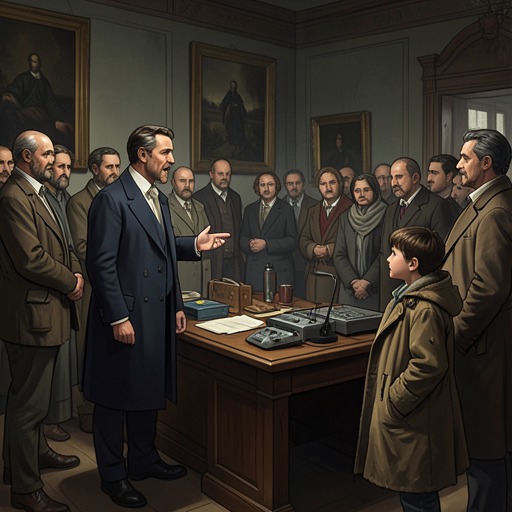
To hear is to obey
The Horse and His Boy“To hear is to obey” is a formula of submission in Calormene speech, but its repeated use reveals more than a simple rule of etiquette. It passes through the mouths of an imperial messenger, a beloved but enslaved secretary, a Grand Vizier, and a groom; each utterance answers a different command, and the circumstances show how obedience can mean service, concealment, survival, or merely the appearance of loyalty.
Formula and Social Setting
The expression belongs to a world in which people answer their superiors with ritualized deference. Its force comes partly from its repetition: the words sound like a promise of immediate compliance, whether the speaker is carrying out an ordinary instruction or being drawn into a dangerous scheme. But the phrase does not establish that all its speakers have the same power, motives, or freedom to refuse.
Shasta encounters that hierarchy first in the household of Arsheesh. He is called the fisherman’s son, yet he must mend and wash the nets, cook supper, and clean their cottage; when Arsheesh returns in a bad temper after selling fish poorly, he finds fault with Shasta and may beat him. The boy’s practical dependence is paired with a limit on his curiosity: questions about the country beyond the northern ridge can be met with a blow or a proverb insisting that attention to business is prosperity. Against this domestic pattern of command and punishment, “To hear is to obey” sounds like the compact verbal form of a broader social expectation: the subordinate is expected to serve, not to ask where a command leads.
The same hierarchy reaches beyond human households. Bree says that he was captured as a foal and spent years enslaved to humans, hiding that he could talk and pretending to be an ordinary, witless horse. Revealing his nature would have made him a fairground spectacle and brought closer guarding, closing his chance of escape. In another conversation, he explains that he and Shasta have taken money because they are prisoners and captives in enemy country and need food for the boy. Those details place the expression within a society where control extends over labor, movement, and even a captive’s ability to disclose who he is.
A Secret Message for Aravis’s Escape
The most consequential early use comes from the old secretary in Aravis’s father’s household. Aravis is being married to Ahoshta Tarkaan against her will. She first wins her father’s permission to leave for three days by pretending that she intends to perform rites associated with Zardeenah, then turns to the family’s oldest enslaved servant: the secretary who had dandled her as a baby and, she says, loved her more than air and light. She swears him to secrecy and asks him to write a letter. He weeps and begs her to reconsider, but finally answers, “To hear is to obey,” and does what she asks.
His compliance is not uncomplicated consent. The narration gives both sides of the moment: his distress and his devotion, and the act he undertakes despite that distress. The phrase is therefore not a detached maxim but a response shaped by unequal status and intimate attachment. Aravis has the authority to ask; the secretary is enslaved, yet his affection for her is part of what moves him to help. His obedience assists an act of self-emancipation, rather than merely preserving the household’s arrangements.
The letter he prepares is a calculated deception. Aravis sends it as if it had been written by Ahoshta to her uncle, Kidrash Tarkaan, claiming that Ahoshta met and married her in the forest and asking Kidrash to bring her dowry without delay. The false account turns her disappearance into an apparent marriage and gives her time to escape. The secretary’s repeated phrase thus precedes a concrete intervention in the plot: obedience to Aravis helps her evade the forced match and misdirect the people who might pursue her.
The Imperial Post and Its Echo
Aravis carries the deception into Azim Balda, a city where imperial posts travel by swift horses in every direction. As a Tarkaan’s daughter, she invokes the privilege of sending messages through the service, pays the Chief of the Messengers five crescents, and asks him to forward the letter. He replies, “To hear is to obey.” In this setting the words accompany an official transaction: the messenger accepts her request and sets the forged communication on its way.
The repetition links Aravis’s private escape to the machinery of the empire. The secretary wrote the message under pressure of her appeal and his own loyalty; the Chief of the Messengers receives it as a paid dispatch under a recognized privilege. Each responds to a different kind of authority, while the same formula makes their compliance sound alike. The contrast sharpens the phrase’s ambiguity: it may express a subordinate’s constrained service, a personal commitment, or routine performance within an imperial institution.
A Courtly Performance of Loyalty
Later, Aravis overhears the Tisroc and his Vizier, Ahoshta, discussing the Prince’s intended attack on Anvard. The Tisroc plans to conceal his knowledge and his consent, so that the Prince can be represented as having gone without royal approval. If the attack succeeds, the Tisroc expects to gain Archenland and perhaps later Narnia; if it fails, he has eighteen other sons, and Rabadash’s ambition has begun to make him dangerous. The apparent fatherly concern therefore sits beside a calculation of dynastic risk.
When the Tisroc instructs Ahoshta to forget the Prince’s plans, the Vizier answers, “To hear is to obey.” Here the formula serves a ruler’s demand for secrecy. Ahoshta has helped arrange a meeting where no council is held and household members have no reason to come; he also accepts the Tisroc’s proposal that both men behave as if they know nothing of the plan. The words do not prevent them from understanding the political purpose of their exchange. Instead, they furnish the obedient response through which an incriminating conversation can be sealed in practiced denials.
Ahoshta repeats the same expression when the Tisroc ends the meeting and orders that the Prince’s pardon for a cook be recalled. The scene moves from the concealed invasion scheme to the sovereign’s concern about a pardon and his expectation of indigestion, then closes with Ahoshta crawling backward on all fours, rising, bowing, and leaving. The courtly formula accompanies this physical display of deference. Yet the Tisroc’s own speech makes clear that his obedience is not a general moral principle: his governing allegiance is to the strength and glory of his throne, above his son, his own comfort, or ordinary human attachment.
Unequal Meanings of Obedience
The phrase returns in a smaller, practical scene after Aravis reaches the fugitives near the Tombs of the Ancient Kings. She tells the groom he can return to his mistress and gives him money for his trouble, forgetting that the city gates will not open until morning. He answers, “To hear is to obey,” and hurries toward the city, already frightened by the thought of ghouls. Here compliance is neither an imperial secret nor a dramatic act of loyalty: it is a paid servant’s quick response, colored by immediate fear.
Bree’s later judgment of himself provides a counterpoint. After fleeing the lion attack, he says he will go back to Calormen because he believes he is fit only for slavery. He is ashamed that he ran to save his own skin while leaving a mare, a girl, and a boy in danger, and particularly that Shasta ran back toward them. Bree’s shame is not expressed through the formula, but it gives the expression’s recurring obedience a moral contrast: submission to an imposed role is not the same as choosing to act bravely or faithfully. Across the secretary’s aid, the messenger’s service, the Vizier’s courtly response, and the groom’s hurried return, “To hear is to obey” remains verbally constant while the power behind the command, and the human meaning of answering it, continually changes.