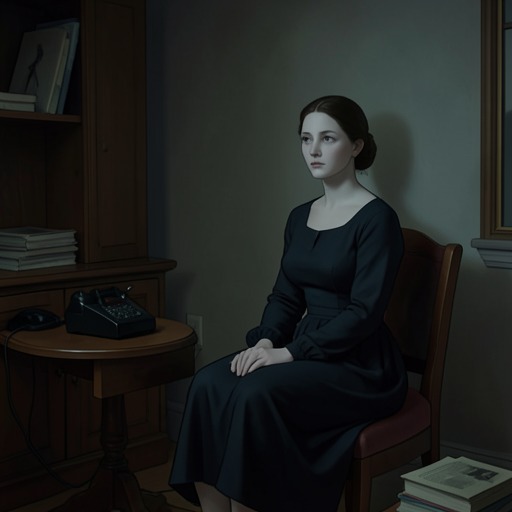
“A needle and thread for women. A whip and a mule for men.”
The House of Bernarda Alba“A needle and thread for women. A whip and a mule for men.” is Bernarda Alba’s blunt formula for gendered life in The House of Bernarda Alba. It assigns women domestic labor and men the tools and freedom associated with work beyond the home, making a household command sound like an unquestionable social law. Its force comes from the speaker: Bernarda does not merely repeat a convention but enforces it over her daughters.
A Household Rule
Bernarda gives the line after declaring that the household will do what she commands. With their father no longer available as someone to whom they can carry complaints, the daughters are directed toward needlework, while the men’s corresponding instruments are a whip and a mule. Bernarda adds that this is how life works for people with means, tying the rule to her household’s position as well as to its expectations of women and men.
The contrast is compact but expansive. Needle and thread confine women to sewing and embroidery; whip and mule associate men with authority and activity outside the domestic sphere. The sentence presents these roles as complementary and settled, not as choices open to discussion. Its placement inside Bernarda’s command makes gender hierarchy part of the discipline by which she governs the house.
Social Meaning
The play’s critical account identifies the maxim with a traditional view of women’s subservience and their domestic role. A married woman is expected to serve her husband, manage the home, and bear children; an unmarried woman’s life, as Bernarda’s daughters’ circumstances show, is directed toward sewing and embroidery. Bernarda’s later advice to Angustias—to speak when her future husband speaks and look at him when he looks at her—extends the same principle from work to conduct within marriage.
That order is not presented as Bernarda’s private eccentricity. The play’s social world also accepts men’s sexual freedom while subjecting women’s conduct to far harsher judgment. Concern about family reputation reinforces the control of women: Bernarda watches what her daughters do and what neighbors might hear, and after Adela’s death insists that the village be told she died a virgin. The maxim belongs to this wider structure of domestic restriction, sexual double standards, and surveillance.
Conflict and Dramatic Significance
Bernarda’s rule stands against the daughters’ frustration with the narrow lives prescribed for them. Magdalena’s immediate response, cursing women’s lot, makes the cost of the maxim audible within the scene: the rule may be spoken as settled fact, but it is experienced as a burden. Across the play, Bernarda’s authority repeatedly meets desire and resistance, while the family’s insistence on outward respectability helps intensify the conflict rather than resolve it.
The line also fits Lorca’s stated ambition to expose contemporary social and moral conditions through a play conceived as a documentary of village life. Its spare, memorable parallelism gives a broad system of inequality the form of an everyday saying. The apparent symmetry of the two halves conceals their unequal consequences: one side prescribes domestic confinement, the other grants a route into public labor and authority. As a result, the maxim is at once a rule within Bernarda’s house and a concise expression of the social order the play puts under scrutiny.
Translation and Performance
The English wording is one rendering of the Spanish line. The commentary on translation emphasizes that an English version should preserve the cultural world of the play and the concise, confrontational quality of Lorca’s prose. It contrasts this translation’s “A needle and thread for women. A whip and a mule for men” with a literal alternative that uses “female” and “male,” observing that the chosen wording maintains the line’s direct, proverbial character.
The same discussion warns that translation can weaken the play when culturally specific language is generalized or its force diluted. Because this sentence condenses a social rule into two balanced clauses, its meaning depends not only on the objects it names but on the sharpness of the contrast. On stage, that compressed form allows Bernarda’s authority and the gender order she voices to register together.