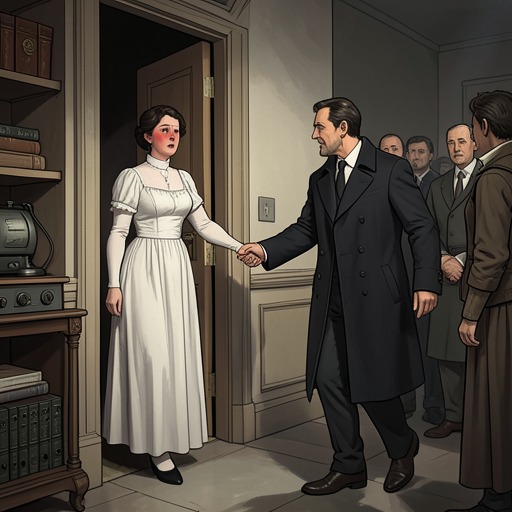
“My body will be for whoever I please!”
The House of Bernarda Alba“My body will be for whoever I please!” is Adela’s emphatic claim to bodily autonomy in a household where her sister watches her and marriage, sexuality, and reputation are controlled by others. The declaration makes her desire speak in her own terms, while the drama’s repeated commands for silence and its final concealment of her death reveal the force arrayed against that claim.
The Claim and Its Immediate Context
Adela speaks after Martirio has left and Poncia reminds her that Martirio is her sister and loves her. Adela describes Martirio following her everywhere and sometimes looking into her room to see whether she is asleep. The intrusion makes the house’s restrictions concrete: even Adela’s private space offers no reliable refuge from scrutiny.
Adela recounts Martirio lamenting that her face and body will belong to nobody. She rejects that judgment and answers with the declaration that her body will belong to whomever she chooses. The line turns a comment about her appearance and future into an assertion of agency: Adela does not accept that others may define what her body is for.
Desire Under Surveillance
Poncia immediately asks whether Adela means Pepe el Romano. Adela is taken aback by the question. The exchange places her assertion in the specific context of desire for Pepe, while also showing how quickly a claim of personal choice becomes subject to questioning. Her words assert self-determination; the response identifies the relationship that makes that autonomy socially dangerous.
The same English line appears again in the play, preserving the force of Adela’s refusal in translation. Its context links physical surveillance—Martirio’s attempts to see whether she is asleep—to the larger struggle over who may determine Adela’s intimate life. Her speech is not simply an abstract statement of independence: it follows an account of being watched and denied room to breathe.
The Household’s Counterlanguage
Adela’s assertion stands against Bernarda Alba’s insistence that what happens in the house is what she commands. Bernarda orders silence, dismisses the servant’s grief over Antonio María Benavides, and tells her to leave; she also declares that women are assigned needle and thread while men are assigned a whip and a mule. Together, these commands and prescriptions establish an order in which authority, work, and permissible conduct are divided by gender and rank.
Later, when the daughters’ conflict erupts, Bernarda again demands silence and describes them as five chains in the house their father built. The image gives the household’s control a physical weight: the daughters are bound both to the home and to one another by the restrictions Bernarda enforces. Against that language of command and confinement, Adela’s line names a competing principle—that her body and desire should be hers to determine.
The Ending and the Limits of Speech
At the close, Bernarda declares that Adela died a virgin, orders the family not to speak, and insists that no one will say anything. Her declaration attempts to settle the public meaning of Adela’s death by imposing the very sexual respectability that Adela’s earlier words rejected. The contrast is stark: Adela claims the right to choose, while Bernarda claims the authority to define what others will be permitted to know.
The line therefore resonates beyond its immediate exchange with Martirio. It gives Adela a clear verbal position within a household that repeatedly regulates speech and behavior, but it does not secure her freedom from surveillance or the family’s power to control her story. Its force lies in that tension between a woman’s explicit claim over her own body and an order determined to overrule, silence, and reinterpret her.
The Household’s Counterlanguage
Adela’s assertion stands against Bernarda Alba’s insistence that the household obey her. Bernarda orders the servant to be silent and leave after the servant grieves for Antonio María Benavides; she then dismisses the poor as if they were made of a different substance. Her authority is therefore both domestic and class-based: she controls who may speak and who belongs in the space of mourning.
Bernarda also describes the prescribed division of work and power: “A needle and thread for women. A whip and a mule for men.” The maxim makes gender hierarchy sound like an unquestionable rule of life, assigning women domestic labor and men outward authority. Adela’s claim to choose what happens to her body challenges that order at its most intimate point: it gives a woman a voice not defined by the roles Bernarda enforces.
Later, when the conflict among the daughters erupts, Bernarda again demands silence and calls them five chains in the house their father built. The image gives confinement a material weight: the daughters are bound to the house and to the restrictions imposed there. Against this language of command and enclosure, Adela’s declaration names a competing principle—that her body and desire should be hers to determine.
The Ending and the Limits of Speech
At the close, Bernarda declares that Adela died a virgin, orders the family not to speak, and insists that no one will say anything. Her declaration attempts to fix the public meaning of Adela’s death by imposing the sexual respectability that Adela’s earlier words rejected. The contrast is stark: Adela claims the right to choose, while Bernarda claims authority over what others may know and say.