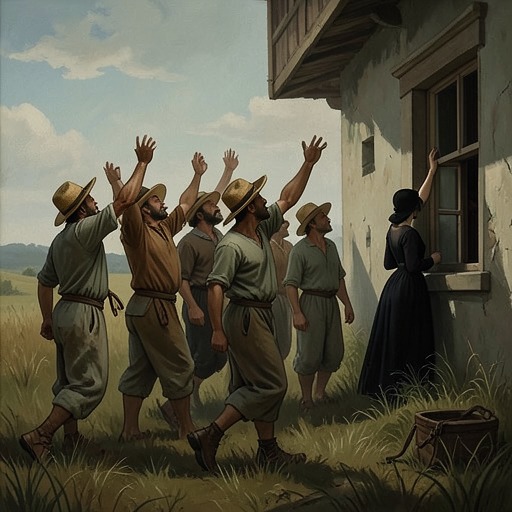
“Open your doors and windows”
The House of Bernarda Alba“Open your doors and windows” is the opening appeal of the harvesters’ song in Act Two of The House of Bernarda Alba. The words address girls confined indoors and summon them toward the world beyond the house: a world of work, courtship, and natural vitality that contrasts with the women’s restricted domestic lives. Through the song’s images of doors, windows, and roses, the play gives a brief, public voice to the freedom its household denies.
The Song and Its Address
Sung as the harvesters pass the house, the song begins, “Open your doors and windows,” then calls to “You girls who live in the town.” The appeal is collective rather than private: it reaches toward the young women inside from a group moving through the village, making the threshold between interior and exterior central to the expression. The command to open doors and windows gives the refrain its force. It imagines a passage out of enclosed domestic space, even as the women remain on the other side of it.
The song continues with the reaper’s wish for the girls’ roses, which he would use “To decorate his crown.” That image makes the call both celebratory and suggestive. Its language of flowers and adornment evokes attraction and courtship, while the harvesters’ song places those desires in the open, communal world beyond the house. The address thus carries a freedom that is not only spatial: it presents young women as participants in a world of social and natural vitality, rather than figures confined to sewing and waiting indoors.
Contrast with the House
The refrain’s invitation acquires significance from the restrictions governing the household. Bernarda’s home is marked by confinement and mourning, while the girls’ lives are tied to repetitive domestic work. The open doors and windows imagined by the song stand against that closed routine. The contrast does not mean that a door is literally opened; instead, the song briefly makes the possibility of release audible as the harvesters pass outside.
The opposition extends beyond architecture. Bernarda’s reference to the village without a river evokes a sun-baked landscape and a community deprived of vital or creative energy. Against that dry and emotionally constricted setting, the harvesters’ song belongs to the play’s network of images associating natural life with desire. It brings the energy of the fields and the moving group into earshot of women whose world is governed by the house’s boundaries. Its appeal is therefore pointed precisely because the song can be heard without its invitation being fulfilled.
Roses, Colour, and Natural Vitality
The song’s roses connect it to the play’s wider use of colour and natural imagery. Adela is associated with the green of her dress, and the olive grove, green with the vitality and fertility of nature, is the setting for Paca la Roseta and the young men who take her there. In Act Two, Poncia also describes one of the strong young harvesters as having green eyes. These recurring associations make the harvesters’ song part of a broader contrast between instinctive vitality and the restrictive order of the household.
Red flowers on Adela’s fan provide another point of connection: red traditionally signifies passion, and Bernarda angrily rejects the fan. The song’s roses likewise place floral imagery within a world of attraction that differs from Bernarda’s austere control. The comparison does not reduce the song to a single symbol. Rather, the flower, the harvest, and the call to open the house work together to evoke a living world that the play sets against enclosure and monotony.
Dramatic and Thematic Significance
The song’s importance lies in the way its words transform a passing moment into a contrast between possible freedom and actual confinement. The harvesters sing from outside; the girls are addressed from within. Their call to open the house makes the division between those positions explicit, while the roses give the appeal the language of attraction and vitality. The scene therefore carries the play’s wider conflict between natural desire and a social order that restricts women’s movement and expression.
Lorca’s imagery works suggestively through particular actions and settings rather than through a single fixed explanation. Here, a song heard as the harvesters pass links the household’s closed space to the village beyond it, and the roses join the human appeal to a wider pattern of natural life. The refrain’s brief invitation does not undo the women’s restrictions; its dramatic force comes from placing that invitation within hearing distance of the closed house, where the contrast remains unresolved.