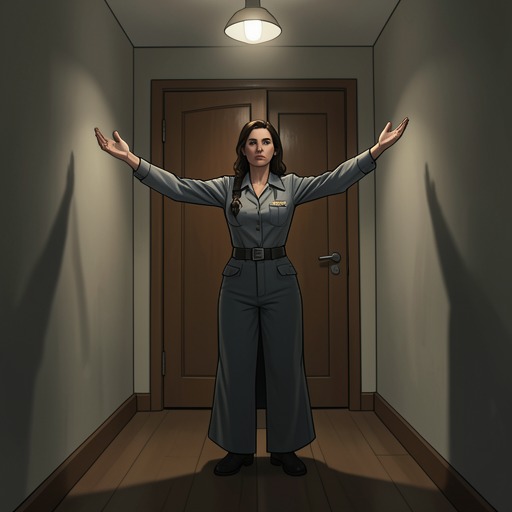
Adela Breaks Bernarda’s Staff
The House of Bernarda AlbaAdela Breaks Bernarda’s Staff is the decisive physical gesture in Adela’s confrontation with Bernarda Alba: after Martirio exposes that Adela has been with Pepe el Romano, Adela takes her mother’s staff and breaks it. The gesture rejects the authority the staff represents, but it does not end the conflict. Bernarda’s response is to pursue Pepe and then control the account of Adela’s death, making the broken staff a brief, forceful breach in a household order that survives her defiance.
The crisis that precedes the gesture
The confrontation emerges from a wider conflict over the household’s control of its daughters and the secrecy surrounding Adela’s relationship with Pepe el Romano. When Martirio points to straw on Adela’s petticoat as evidence that she has been with him, the discovery gives the sisters’ conflict an immediate, concrete focus. Bernarda approaches Adela in anger; Adela faces her rather than retreating. The staff is broken at the instant when a concealed relationship becomes an open challenge to maternal authority.
The scene’s stakes are illuminated by the play’s concern with family honour and public reputation. Bernarda fears that sexual conduct and domestic conflict will become village gossip. She objects when the daughters’ argument might be heard by neighbours, and her insistence that Adela be declared a virgin after her death shows how far she will go to protect the family’s public image. The confrontation therefore pits not only mother against daughter but private truth against the appearance Bernarda insists the family maintain.
The break and its meaning
Adela seizes Bernarda’s staff and breaks it in two. The action turns an argument into a visible reversal: the object associated with Bernarda’s command is no longer intact, and Adela asserts that her mother cannot continue to govern her as before. Adela’s accompanying declaration that Bernarda is no longer her jailer makes the act’s immediate meaning explicit. Her resistance is not an abstract complaint; it is directed at the authority that confines her and controls her choices.
Yet Adela’s defiance does not establish a new freedom within the household. In the same confrontation, she makes clear that Pepe is the person whose authority she recognizes. The assertion opposes Bernarda’s control, but it also locates Adela’s desired independence in her relationship with him. The break is consequently both a rebellion against her mother and a concentrated expression of the desires that have brought the family conflict to a crisis.
A village order beyond the house
The play places the household struggle beside the village’s treatment of an unmarried mother. Poncia reports that Librada’s daughter had a child whose father is unknown, killed the child to conceal her shame, and now faces a crowd seeking to kill her. Dogs have uncovered the child’s body and left it at her doorstep; men come running from the paths and olive groves. Bernarda endorses the crowd’s demand for violence, while Adela objects that the woman must not be killed. Martirio says that she and the others should go out as well.
This episode makes the social pressure surrounding Adela’s rebellion especially stark. The village’s punishment of a woman whose sexual and family circumstances have become public contrasts with Bernarda’s later effort to keep Adela’s own circumstances from public view. The play’s commentary connects such conduct to a gendered honour code, noting the historical persistence of a legal provision that permitted a husband to cleanse his honour with blood in specified cases until its repeal in 1963. The village mob is not presented as a court, and its pursuit is not the direct application of that law; together, however, the episodes show how social ideas of honour can license coercion beyond formal legal procedure.
Aftermath and significance
The break does not prevent the next escalation. As the confrontation continues, Bernarda goes after Pepe with a gun; he escapes. Bernarda then tells the household that Adela has died a virgin, orders that she be dressed as one, and forbids anyone to speak of the truth. She also orders the family not to weep openly and repeats her command for silence. The decisive consequence of the broken staff is thus not a lasting change in household power: Bernarda’s control reappears in her management of the death and its public meaning.
The action condenses the play’s conflict between a daughter’s resistance and the social authority that confines her. Bernarda’s staff can be broken, but the family’s concern with reputation and the village’s policing of women’s conduct remain in force. The contrast between Adela’s physical refusal and Bernarda’s final insistence on silence makes the scene’s outcome especially clear: rebellion becomes visible, while the household’s public account is once again dictated by Bernarda.