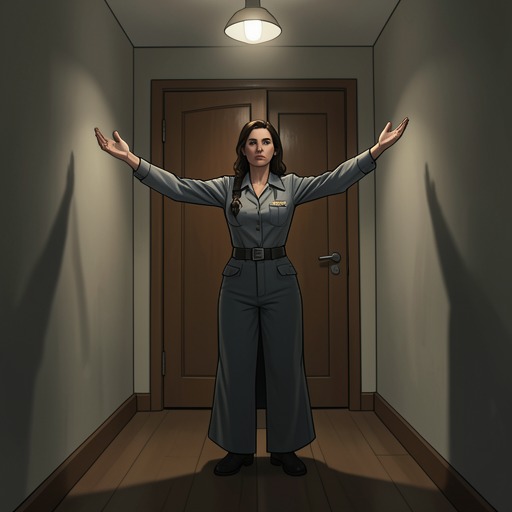
Adela’s defiance of confinement
The House of Bernarda AlbaAdela’s defiance of confinement turns the enforced mourning in Bernarda Alba’s household into an open contest over who may determine a woman’s life. When her sisters discuss Angustias’s engagement to Pepe el Romano, Adela rejects the prospect of adapting to the closed house: she announces that she will wear her green dress and go out into the street. Her declaration gives a concrete form to the freedom she wants, and sets her against both Bernarda’s commands and a village order that restricts women while granting men greater liberty.
The house as a system of confinement
Bernarda announces that mourning for her husband will last eight years. During that period, she says, the wind from the street must not enter the house; she imagines the doors and windows sealed with bricks. The daughters are directed toward domestic work instead: Bernarda has twenty pieces of linen ready for sheets, and Magdalena is told she can embroider the trousseaus. Mourning thus means not only grief but the suspension of ordinary life and the assignment of women to the home.
That arrangement reflects a wider rural custom rather than an isolated household rule. The play presents long mourning, women’s domestic role, and the prospect of spinsterhood or loveless marriage as recognisable conditions of village life. Its account of the community also stresses the comparatively greater freedom enjoyed by men. Against this backdrop, Adela’s refusal is more than impatience with a particular restriction: she challenges a gendered division in which women sew and wait while men move through the world more freely.
The declaration in the sisters’ conversation
The immediate context is the news that Angustias, the eldest daughter and the wealthiest, is to marry Pepe el Romano, a young man fourteen years her junior. The announcement provokes disbelief in Adela and leads her to voice her wish to be free of the house. Later, when Martirio asks what she is thinking, Adela explains that the mourning has come at the worst time in her life for her to endure it. Magdalena replies that she will get used to it; Adela answers through tears and anger that she will not.
Her refusal takes the form of a specific plan. She says she does not want to be shut away, does not want to lose her whiteness in the rooms, and will put on her green dress the next day to walk down the street. She ends by insisting that she wants to go out. The green dress and the street give the dispute its sharpest contrast: the clothing and movement she claims for herself stand against the enclosed rooms and prescribed embroidery of the mourning household. When the Servant appears, Magdalena calls Adela’s name with authority, a brief interruption that underscores how quickly her declaration draws the household back toward discipline.
Authority, honour, and the limits of protest
Bernarda’s authority rests on more than her direct orders. The household’s expectations are tied to a social order that assigns women a domestic role, treats marriage as a principal prospect for them, and fears the damage that public gossip may do to family reputation. The play’s commentary describes Bernarda as a forceful advocate of traditional gender roles and a figure whose concern for reputation contributes to her cruelty and lack of compassion. Adela’s public wish to leave the house therefore contests a rule that is at once maternal command and social convention.
The risk attached to that convention becomes explicit when Poncia reports the case of Librada’s unmarried daughter, who gave birth, killed the child, and was pursued by villagers after the child’s body was discovered. Bernarda urges the crowd to kill her; Adela cries out that they must not. The episode makes visible what the honour code can authorize beyond the walls of the house: communal punishment of a woman whose conduct is judged shameful. Adela’s protest connects her own demand for movement with a refusal to accept that violence as justice.
The play’s critical account distinguishes this social force from formal law. It notes that Spain’s Penal Code of 1870 allowed a husband, in specified circumstances involving adultery or rape, to defend honour with blood, and that this provision was not removed until 1963. The play does not depict that precise legal situation. Rather, the comparison situates Bernarda’s and the villagers’ attitudes within a history in which patriarchal honour could carry legal as well as informal force. Adela’s dissent exposes the human stakes of a code enforced through household control, public opinion, and the threat of collective violence.
Defiance and its tragic frame
Adela’s declaration does not end the confinement imposed on the household, but it establishes a measure against which the later action can be read: she has named the life she refuses to surrender to mourning and obedience. The play’s ending returns to the conflict between private reality and public reputation. After Adela’s death, Bernarda insists that her daughter died a virgin, orders the family to suppress its grief, and commands silence. The ending shows the persistence of the family-honour rule even when the truth of the household’s suffering can no longer be contained by the mourning routine.
The movement from Adela’s wish to walk freely to Bernarda’s final insistence on silence also clarifies the work’s larger dramatic pressure. A village society may condemn a woman in the name of honour, while a household may treat obedience and concealment as the conditions of respectability. Adela’s protest makes that contradiction audible: she refuses to accept confinement as natural, and her defence of the pursued unmarried mother shows that her resistance reaches beyond her own desire to leave the house.