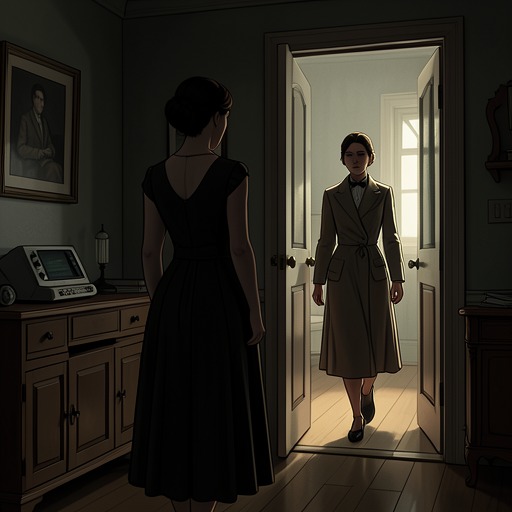
Adela’s suicide
The House of Bernarda AlbaAdela’s suicide is the closing catastrophe of the play: after a gunshot and Martirio’s false report that Pepe el Romano is dead, Adela rushes away in anguish and dies by hanging. Pepe has in fact escaped. Bernarda then responds not by allowing the household to speak openly about the death, but by ordering Adela’s body cut down, declaring that her daughter died a virgin, and imposing silence. The ending makes death, sexual reputation, and control of the story inseparable.
Causes and Immediate Circumstances
As the confrontation reaches its crisis, Bernarda returns after going out to pursue Pepe. A shot has been heard. Martirio reports that Pepe is dead, and Adela cries out his name before running from the room. The report is false: Martirio subsequently admits that Pepe escaped on horseback. The timing is decisive. Adela flees on hearing that the man with whom she has a secret relationship has supposedly been killed, and the truth arrives only after she has shut herself away.
The earlier account of the ending makes the sequence explicit: once Martirio reveals that Pepe has not been killed, Adela has already locked herself in another room. Poncia’s actions and words make clear that Adela has hanged herself. The play does not present a suicide note or give Adela a final explanation; her death is disclosed through the household’s reaction, leaving the false report and the locked door as the immediate frame for the tragedy.
Discovery and Household Reaction
When Bernarda hears a sound from Adela’s room, she calls for her and orders the door opened. Poncia pushes her way inside, cries out, and comes back out; the sisters recoil, and the Servant crosses herself. Bernarda advances, but Poncia warns her not to enter. The scene communicates the discovery through interrupted movement and the reactions of those at the doorway rather than through a detailed depiction of the death.
Bernarda orders that Adela be cut down and carried to her room. Martirio’s bitter remark that Adela was fortunate to have had Pepe sharpens the sisters’ final conflict: even in the aftermath of death, their responses remain divided by jealousy and by what each knows of the relationship. Bernarda, meanwhile, directs attention away from the circumstances of the death and toward the account that will be given to the village.
Reputation, Silence, and the Official Story
Bernarda insists repeatedly that Adela died a virgin and commands that nobody say anything. She orders that Adela be dressed as a virgin and that the bells ring twice at daybreak. These instructions make the aftermath an act of public narrative-making as well as mourning: Bernarda seeks to determine how the death will be understood outside the household, regardless of the secret relationship that has preceded it.
This insistence belongs to the play’s larger concern with family honour and public perception. Bernarda fears the damage gossip can do to a family’s name; at the end, her response to Adela’s death is to protect that name by dictating what others may say. The distinction between truth and reputation becomes stark: the secret has shaped the catastrophe, yet the mother’s first public account suppresses it. Her commands turn the household’s silence into a means of enforcing the family’s honour code.
Ending and Significance
The final exchange joins mourning to control. Bernarda declares that the household will drown in a sea of mourning, demands that there be no weeping except in private, and repeats her order of silence. Her words announce a collective state of grief while denying the family the freedom to express that grief together. The curtain falls on the command rather than on reconciliation or an open account of what has happened.
The play’s commentary connects Bernarda’s fixation on reputation with a society in which family standing is vulnerable to sexual gossip and women bear the sharper burden of sexual regulation. It also notes that the historical Penal Code of 1870 permitted a husband to defend his honour with blood in specified circumstances, and that this provision was not removed until 1963; the play does not depict that precise legal situation. Adela’s death is therefore not presented as an instance of that statute, but its aftermath resonates with a broader culture in which women’s sexual conduct and family reputation are bound together. Bernarda’s claim that her daughter died a virgin is the final effort to preserve that order in speech, even as the death exposes its human cost.