Appearance versus reality
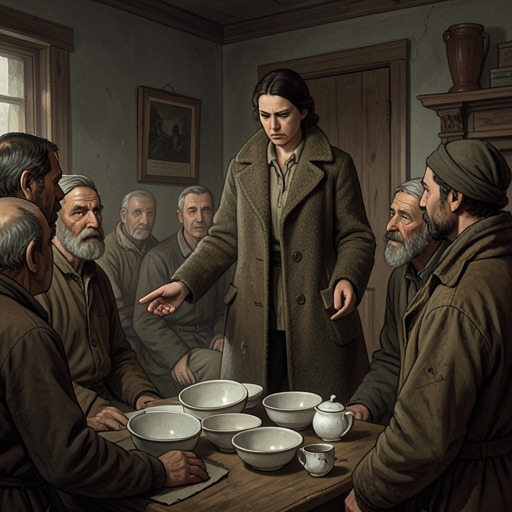
The House of Bernarda AlbaAppearance versus reality is the conflict between the respectable public image Bernarda Alba enforces and the private life that image cannot control. The household’s silence conceals rather than resolves its tensions: when the truth threatens to become public, Bernarda’s response is not to face it but to dictate what others may say. The play makes that gap visible in the contrast between her claims of domestic order and the feelings and events that persist beyond her watchfulness.
Respectability as a Household Rule
Bernarda treats respectability as something to be maintained before an audience. She tells Angustias that private feelings are a family’s own affair, but immediately insists on “a respectable appearance” and harmony within the family. The distinction is decisive: inward truth may remain hidden, provided the household looks orderly from outside. Her response turns concealment into a rule, not an occasional expedient.
That rule extends beyond the family’s intimate affairs. Bernarda criticizes the Servant over the cleanliness expected for mourners, and she worries that the neighbours will hear her daughters arguing. Her vigilance is directed toward what other people might see, hear, and repeat. In a society where gossip can damage a family name, outward propriety becomes a form of social protection; in Bernarda’s hands, it also becomes a justification for cruelty and a lack of compassion.
Surveillance and the Limits of Control
Bernarda believes her watchfulness can contain whatever matters in the house. Poncia challenges that confidence: outwardly, nothing may be visible, but the daughters live as if shut away, and no one can see inside their hearts. The exchange sets the observable household against its hidden emotional life. Bernarda can control movement and speech more readily than desire or knowledge, so her claim to command the whole house is already undermined by the people who live within it.
The play also shows that this divide is not confined to Bernarda. Poncia shares the concern for respectable standing, despite her differences from her mistress, and Bernarda’s daughters recognize both men’s greater freedom and the risks gossip poses to their family. Prudencia’s account of her husband’s quarrel with his brothers over an inheritance offers another instance: a private dispute becomes common talk and damages his reputation, bringing anguish to the family. The concern with public judgment belongs to a wider village culture, not to one household alone.
Public Shame and the Unmarried Mother
The story of Librada’s daughter makes the cost of that culture explicit. Poncia reports that the unmarried woman killed her child and concealed it beneath stones, but dogs uncovered the body and left it at her doorstep. The villagers then pursue her, and Bernarda welcomes their intention to kill her. Adela protests against the threatened violence, while Martirio says that they should go out too. Their opposed responses expose a conflict between punishment in the name of shame and resistance to that punishment.
The episode links secrecy to public violence rather than treating concealment as a private matter. Librada’s daughter’s attempt to hide what happened fails; once the truth becomes visible, the village answers with collective pursuit. Bernarda’s approval shows that the same honour-bound outlook she enforces at home can endorse punishment beyond its walls. Adela’s objection, by contrast, interrupts the apparent consensus and reveals that the demand to defend reputation is not accepted by everyone in the household.
The Lie at the Ending
The final crisis brings the distinction between appearance and reality to its sharpest point. After Adela’s death, Bernarda orders that her daughter be dressed and presented as a virgin, declares that nobody will say anything, and repeats the claim to the household. The statement is not a discovery about Adela; it is a public account Bernarda commands others to uphold. A death has occurred, but the mother’s first concern is to fix the meaning the village will hear.
Bernarda’s commands to stop weeping and keep silent turn grief itself into something that must be regulated. She describes the family as drowning in mourning while insisting that Adela died a virgin: sorrow is admitted, but the truth that might threaten the family’s reputation is suppressed. The contradiction leaves the household’s façade intact only at the cost of honesty. Rather than restore order, the final insistence on appearances makes the distance between the family’s public story and its private reality unmistakable.
Dramatic and Social Significance
The play connects household concealment to a wider concern with family honour, sexual conduct, and public gossip. Its realism presents the pressure of provincial Spanish life as more than Bernarda’s personal fixation: the family’s fear of neighbours’ judgment finds counterparts elsewhere in the village. The commentary also distinguishes this social code from formal law. Spain’s Penal Code of 1870 permitted a husband to defend his honour with blood in specified cases involving adultery or rape, and that provision was not abolished until 1963; the exact legal situation is not enacted in the play, but the commentary places Bernarda’s mentality within a history of honour defended through gendered violence.
The pattern also helps explain the play’s continuing public reach. In 1979 a New York production was praised for the strength of its staging, and when the same company performed the play again in 1989, a reviewer observed that it had lost none of its relevance. Its central conflict remains legible because it is both intimate and social: a mother tries to protect a family name by controlling what can be said, while the concealed reality of that family steadily exposes the limits and human cost of her control.