Bernarda Alba—María Josefa
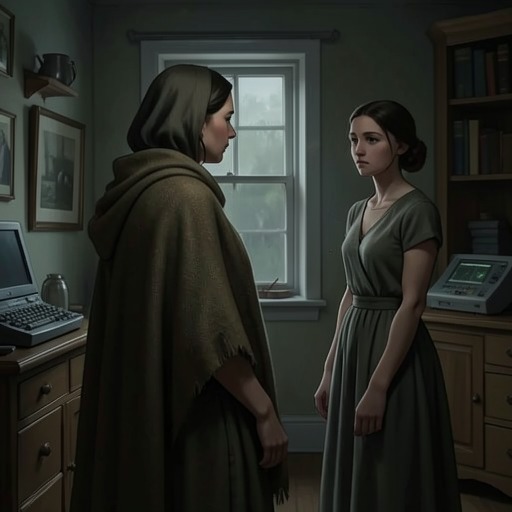
The House of Bernarda AlbaBernarda Alba—María Josefa is a relationship of mother and daughter structured by confinement and command. Bernarda rules the household and keeps her very elderly mother under lock and key; María Josefa repeatedly seeks to get out, insists that she wants to marry, and speaks with a mixture of fantasy and insight. Their conflict makes the house’s control of women visible across generations: María Josefa is not only a dependent elder whom Bernarda confines, but also a voice that articulates desires and dangers the rest of the household cannot safely acknowledge.
Identity and Family Position
María Josefa is Bernarda’s mother and the maternal grandmother of Bernarda’s five daughters. The play presents her as very old and afflicted by senile dementia, moving between fantasies and perceptive observations. Her presence connects the household’s current crisis to an older generation, while her repeated attempts to leave show that confinement is imposed not only on Bernarda’s unmarried daughters but on Bernarda’s own mother as well.
The family has a foundation in real people, though the play reshapes its source. The woman behind the character of Bernarda was Frasquita Alba Sierra, who had seven children, including daughters named Amelia and Magdalena. The commentary identifies María Josefa as based on a Lorca relative who suffered from erotic hallucinations. This biographical basis helps explain the character’s mixture of imagined marriage and moments of striking perception, but the play’s relationship between mother and daughter remains its own dramatic construction.
Confinement and Resistance
Bernarda’s control of María Josefa is made concrete through locks and orders. In the opening, Poncia asks whether the old woman is securely locked away; the servant answers that the door has been locked twice, and Poncia insists that the bar must also be put in place. The exchange treats confinement as a practical household routine, maintained because María Josefa may escape. Later, when she appears in the main room, Bernarda asks why the servant let her in and orders her mother to be locked up again.
María Josefa’s entrance is a brief but forceful breach in Bernarda’s control. Decorated with flowers in her hair and at her breast, she asks for her mantilla and pearl necklace and declares that none of her possessions should go to her granddaughters, whom she says will not marry. Her demand to recover her things turns the family’s anxiety about marriage into a dispute over property and inheritance. Bernarda answers not by engaging her mother’s claims but by trying to restore the household boundary and remove her from sight.
The conflict becomes explicit when María Josefa refuses Bernarda’s command to be quiet. She says she does not want to look at her granddaughters, whom she sees as unmarried women longing for marriage and suffering in the house, and tells Bernarda that she wants to return to her village. She also demands a man to marry and make her happy, then asks to be allowed out. Bernarda’s response is a direct order to lock her up; the servant takes hold of María Josefa. Her wishes remain unfulfilled, and the scene ends with physical containment rather than negotiation.
Perception, Desire, and Generational Conflict
The marriage fantasy that Bernarda treats as evidence of María Josefa’s disorder also gives the older woman a language for naming what the family suppresses. Her imagined wish to marry a handsome young man by the seashore is not a practical plan, but it echoes the younger women’s frustration at being denied freedom and marriage on their own terms. The contrast is sharpened by the household’s circumstances: Angustias is to marry Pepe el Romano, while the other daughters remain under Bernarda’s rules and face the prospect of spinsterhood. María Josefa’s demand to leave therefore resonates beyond her personal condition, even as the play marks it as fantasy.
Her perceptions are not limited to fantasy. The commentary describes her as unusually perceptive when she recognizes that all her granddaughters desire Pepe el Romano and warns that he will destroy them. She also calls Bernarda predatory. These observations do not undo the household’s view of her as mentally unwell, but they complicate it: the character’s speech can be disordered and lucid at once. Because Bernarda confines her, this insight reaches the audience from the margins of family life rather than through an accepted position of authority.
Relationship and Dramatic Significance
Bernarda’s treatment of her mother mirrors the system she imposes on her daughters. In both cases, a woman’s desire to leave the restricted household is met with an order to be silent or remain inside. María Josefa’s elder status does not protect her from Bernarda’s authority; instead, their relationship shows Bernarda exercising control in both directions, as daughter to a dependent mother and as mother to unmarried daughters. The locks, the servant’s watch, and the repeated command to confine María Josefa turn that authority into an everyday practice.
The relationship also unsettles the family’s management of appearances. Bernarda seeks to keep disorder and scandal within the house, while María Josefa’s demands and observations bring suppressed desires into the open. The play’s wider social setting gives this conflict weight: village life is shaped by long mourning, strict divisions between men’s and women’s roles, marriage expectations, and close scrutiny of reputation. María Josefa’s frustrated wish to marry and her recognition of her granddaughters’ longing expose the human cost of those conventions from within Bernarda’s own family.
María Josefa’s relationship with Bernarda remains one of unyielding control rather than reconciliation. Her attempted escape is checked, and Bernarda continues to command the household. Yet the old woman’s words persist as an uncomfortable counterpoint to her daughter’s rule: although Bernarda can lock her away, she cannot make her longings or her insight disappear. In this way, the mother–daughter conflict reveals both the reach and the limits of Bernarda’s authority.