Bernarda’s eight-year mourning decree
The House of Bernarda AlbaBernarda’s eight-year mourning decree makes her husband’s death the pretext for a sweeping restriction on her daughters’ lives. By sealing the house against the street and assigning the young women embroidery for their trousseaus, she recasts mourning as a domestic order of gendered labor, obedience, and control. The decree’s reach is measured not only in its duration but in how the household’s rules of silence and reputation govern later crises.
The decree and its daily rules
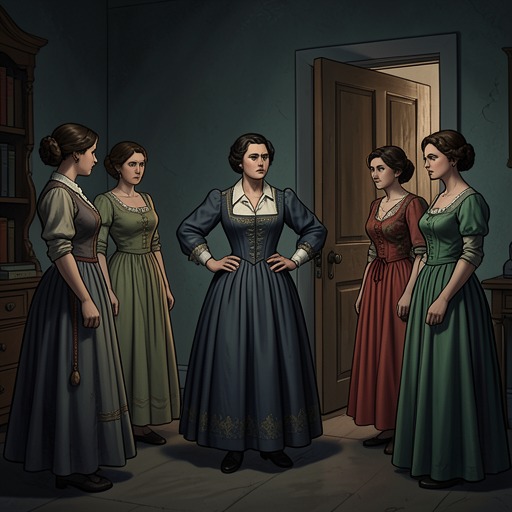
After rejecting the brightly decorated fan Adela offers as unsuitable to the occasion, Bernarda announces that mourning will last eight years. She tells her daughters to imagine that the doors and windows have been bricked up, and says that the wind from the street must not enter the house. The image makes a social prohibition feel like a physical barrier: the outside world is excluded, and the daughters are expected to remain inside.
Bernarda gives the imposed years a practical routine. A chest holds twenty pieces of linen to be cut into sheets, and the daughters are to embroider their trousseaus; Magdalena is singled out to do the sewing. When Magdalena says she will never marry, Bernarda silences her. The decree thus directs the daughters’ work toward marriage even as their confinement sharply narrows their choices.
Inherited authority and gendered labor
Bernarda presents the household regime as custom rather than personal preference, pointing to the same practice in her father’s and grandfather’s houses. Elsewhere she declares that she gives the orders and invokes the division between needlework for women and the whip and mule for men. The mourning decree belongs to this broader traditional gender order: women are confined to domestic work, while men are associated with movement and authority.
The work is part of the play’s portrayal of rural community life, where long mourning periods and a division between men’s and women’s roles were familiar. In that setting, the daughters’ embroidery is more than an activity to pass the time. It is unpaid domestic labor that prepares them for marriage and maintains the household’s social order, while the decree makes that work the permitted shape of their lives.
Class, reputation, and the limits of the household
Bernarda’s authority is also backed by wealth and status. She owns a substantial house, employs people on her land, and can afford fine lace and expensive furnishings for Angustias’s marriage. Her social superiority shapes her treatment of those less fortunate and of the people working in her household. The mourning rules therefore operate within a wider hierarchy: Bernarda can impose restrictions from a position of material power.
The family’s separation from the street does not free it from village scrutiny. Bernarda is concerned with the family’s good name, criticizes the Servant over the house’s presentation to mourners, and insists that her daughters’ arguments must not be heard by the neighbors. The repeated command “Silence!” makes that concern an order within the house. In practice, the decree encloses not only the daughters but also the household’s conflicts, which Bernarda seeks to keep from public view.
Crisis and the decree’s lasting force
The play later shows the severity of the village’s sexual-honor code through the pursuit of an unmarried mother. Poncia reports that the woman’s child was killed and hidden, that dogs exposed what had been concealed, and that villagers were bringing her away while men ran toward the scene. Bernarda urges the crowd to come and kill the woman. Her response reveals that respectability and punishment matter more to her than compassion; the authority exercised inside her home aligns with a harsher social judgment beyond it.
After Adela’s death, Bernarda continues to govern the meaning of what has happened. She orders that Adela be dressed as a virgin and insists that no one speak of anything else, declaring that her daughter died a virgin. The final command to keep the matter within the family carries the decree’s logic into the aftermath: silence is used to protect reputation, even when it cannot undo the tragedy. The mourning order consequently stands not as an isolated rule about bereavement but as the opening expression of Bernarda’s enduring effort to control her daughters’ labor, movement, speech, and public image.