Bernarda’s stick
The House of Bernarda AlbaBernarda’s stick is both a practical instrument of discipline and a visible sign of Bernarda Alba’s rule over her household. It appears when she strikes her daughters, and its authority is challenged when Adela breaks it; yet the final emphasis on mourning and silence shows how little that act changes the household’s underlying confinement.
Form and Function
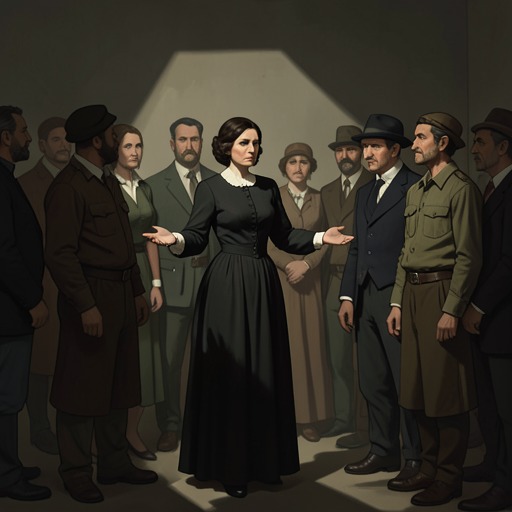
Bernarda’s authority is present from her first entrance, when she commands silence and establishes her control over daughters and servants. The stick gives that verbal dominance a physical counterpart: Bernarda uses it to strike her daughters and asserts that she will remain in command of the house for as long as she lives. Its significance therefore lies not only in particular moments of discipline, but in the way a household rule becomes an object that can be carried and wielded.
The stick’s meaning is reinforced by Bernarda’s economic and social position. She owns a substantial house, employs workers on her land, and can provide fine lace and expensive furniture for Angustias’s marriage. Her material power supports her sense of social superiority and her capacity to control those who depend on her. The stick makes that hierarchy immediate within the home, where commands, punishment, and the demand for obedience fall most directly on the women under her authority.
Mourning and Household Control
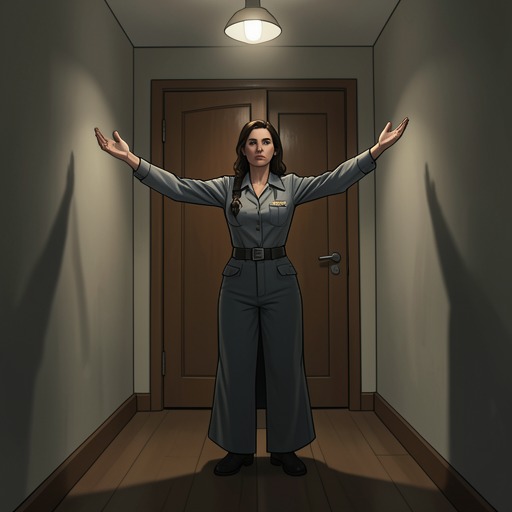
After her husband’s death, Bernarda declares that mourning will last eight years. She rejects Adela’s brightly decorated fan as inappropriate to the occasion and directs her daughters toward embroidering their trousseaus. She also imagines the house sealed off from the street, with even its doors and windows blocked. In this setting, the stick belongs to a broader system of control: enforced mourning, domestic work, and restricted movement turn the household into a place governed by Bernarda’s will.
That domestic order reflects the gendered division of life described in the play’s commentary. The daughters’ prescribed work is sewing and embroidery, while men are granted greater freedom. Bernarda’s rule reproduces this convention rather than merely responding to bereavement: she insists on obedience and on a public appearance of propriety. Her concern for reputation is also apparent in her efforts to keep family conflict from being overheard by the neighbours. The stick’s disciplinary role thus connects the private household to the social rules that limit women’s choices and make reputation a matter of collective scrutiny.
Repeated Uses and Escalation
Bernarda uses the stick in more than one domestic confrontation. When she learns that Angustias has been listening to men’s gossip, she strikes her and dismisses the daughters. Later, after Angustias discovers that her portrait of Pepe el Romano has been taken, Bernarda questions the sisters and orders Poncia to search their rooms. The portrait is found among the sheets on Martirio’s bed, and Bernarda strikes her as bitter accusations break out between the young women. These episodes make the stick a recurring means of imposing order, even as the disputes reveal tensions that her commands cannot settle.
The contrast between the stick’s repeated use and the household’s continuing conflicts matters. Bernarda can silence or punish her daughters, but she cannot eliminate the desires and rivalries that bring them into conflict. Her declaration that she will command both her property and her daughters until she is carried out of the house presents authority as absolute; the recurring need to enforce it shows, in turn, that it is constantly contested.
Breaking and Aftermath
The decisive challenge comes when Adela seizes and breaks Bernarda’s stick. She declares that her mother is no longer her jailer, turning the object that had embodied discipline into something that can be openly resisted. The gesture is an unmistakable break in their struggle over confinement, but it does not secure Adela’s freedom or end Bernarda’s power over the household.
After Adela’s death, Bernarda returns to commands, mourning, and silence, insisting that her daughter died a virgin and ordering that no one speak of the truth. The stick’s authority therefore outlasts its physical breaking: what it represented is sustained through Bernarda’s control of the family’s account of events and her demand for obedience. The object marks both the possibility of resistance and the reach of the order that resistance fails to dismantle.