Female subordination
The House of Bernarda AlbaFemale subordination in The House of Bernarda Alba is not only a matter of Bernarda’s authority inside her home; it is a social order that assigns women domestic work, limits their choices, and makes their conduct answerable to public judgment. The daughters recognize the inequality even as the household reproduces it: men’s behavior is forgiven, while women bear the consequences of sexual rules and family reputation. The play’s decisive contrast is between women who can name the injustice and a community whose customs keep enforcing it.
Domestic Labor and Confinement
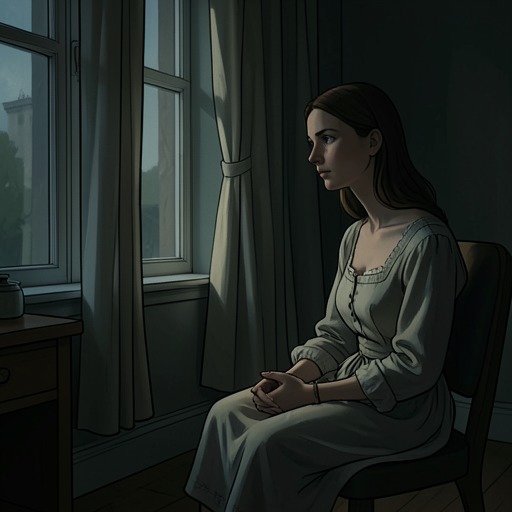
The household’s daily routines make women’s prescribed role visible. In rural life as the play represents it, women’s domestic position is exemplified by sewing and embroidery, while men enjoy greater freedom to move beyond the home. Bernarda turns that division into a command: during the eight years of mourning she orders the windows and doors effectively sealed against the street and tells her daughters to begin embroidering their trousseaus. She has twenty pieces of linen ready for sheets, assigning Magdalena the embroidery. Mourning thus becomes more than a period of grief: it extends the daughters’ confinement and directs their labor toward a future organized around marriage.
The material resources of the household also show how gender and class authority reinforce one another. Bernarda owns a substantial house, employs people on her land, and can spend sixteen thousand reales on furniture. Her wealth gives her power over those who work for her and strengthens her command of the daughters’ living conditions. The daughters’ sewing and preparation for marriage are unpaid domestic obligations within a household whose property and decisions Bernarda controls; their work does not give them comparable authority over their futures.
The Gendered Double Standard
The play states the inequality directly through the women’s own observations. When Adela protests that men are excused for their conduct, Amelia answers that being born a woman is the greatest punishment. Magdalena adds that even their eyes do not belong to them. Their exchange moves from a specific complaint about unequal forgiveness to a broader sense of women’s lives and perceptions being controlled. The lines are not an abstract commentary detached from the action: the daughters’ restricted movement and prescribed domestic work have already made the unequal order part of their everyday existence.
The commentary on the play situates this division within traditional gender expectations that assign women the roles of wife and mother, while restricting unmarried women to sewing and embroidery. Bernarda embodies that outlook in her maxim, “A needle and thread for women. A whip and a mule for men.” The image sorts the sexes into distinct kinds of work and mobility: women are tied to the household, while men are associated with action beyond it. The women’s speech exposes the cost of that supposed common sense, even though recognizing the inequality does not by itself enable them to escape it.
Sexual respectability is another instrument of the double standard. The village condemns women’s sexual conduct while accepting men’s sexual freedom as ordinary. The commentary describes a moral framework in which women are judged as either virtuous or disreputable and sexual activity is treated as legitimate only within a narrow ideal of marriage and procreation. Men’s premarital and extramarital conduct, by contrast, can be accepted as evidence of masculinity. This difference helps explain the daughters’ complaint that men are forgiven: the rule does not impose the same risks on both sexes.
Marriage and Obedience
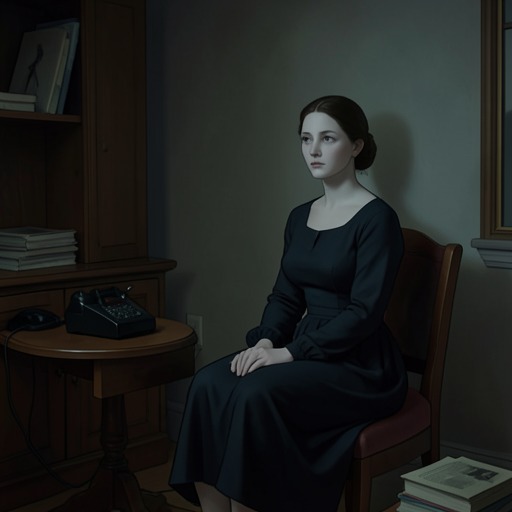
Bernarda’s advice to Angustias makes the expected marital hierarchy explicit. Angustias says Pepe seems distracted and suspects that he is hiding something. Bernarda does not encourage her to investigate or insist on candor between the prospective spouses. Instead, she tells Angustias not to ask questions, to speak when he speaks, to look at him when he looks at her, and never to let him see her cry. The advice treats a wife’s restraint and deference as the means of avoiding disagreement, placing the burden of preserving marital peace on the woman rather than requiring mutual openness.
The arrangement is reinforced by the household’s resources and expectations. The daughters embroider trousseaus while Bernarda prepares the linen, making domestic work part of marriage’s anticipated future. Angustias’s marriage is thus not presented as a simple route to independence: Bernarda’s instruction shows that marriage itself carries an expectation of obedience. The play links gendered labor before marriage to gendered conduct within it, suggesting that a change in household status need not free a woman from subordination.
Sexual Honor, Violence, and Reputation
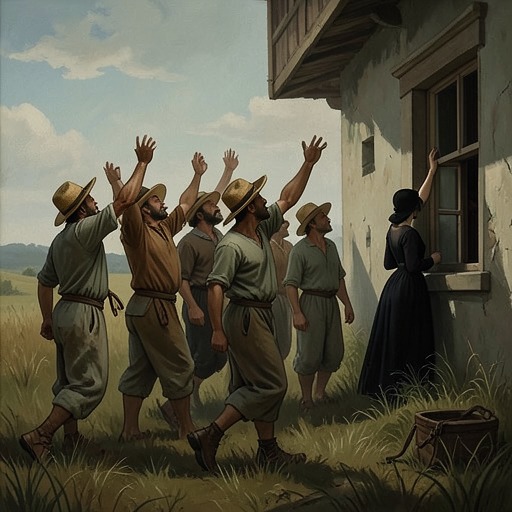
The public treatment of Librada’s daughter shows how the village’s rules can move from judgment to collective violence. Poncia reports that the unmarried woman gave birth to a child, killed it, and hid it beneath stones; dogs uncovered the body and left it at her doorstep. The villagers then pursue her, with men running from the paths and olive groves. Bernarda endorses their demand that the woman be killed, while Adela protests that she must not be killed. The scene makes the gendered stakes stark: the unmarried mother is exposed to punishment by the community, and Adela’s response briefly refuses the solidarity of that punishment.
The account also distinguishes social violence from a precise reenactment of law. The commentary notes that Spain’s 1870 Penal Code allowed a husband to defend his honour with blood in specified circumstances involving adultery or sexual assault, and that this provision was not abolished until 1963. The play does not depict that exact legal situation. Rather, Bernarda’s response and the villagers’ pursuit reveal a broader honour mentality that can authorize punishment without being identical to a formal legal proceeding. The distinction matters: the village’s power operates through custom, public judgment, and collective action as well as through law.
Family reputation extends the same control into private life. Bernarda worries that the neighbours may hear the daughters arguing, and she insists that Adela be represented as a virgin after her death. She orders that Adela be dressed as a virgin and that no one speak otherwise. The announcement does not undo the household’s tragedy; it attempts to govern what the community will know about it. The final command for silence therefore completes the pattern: women’s conduct is policed while they live, and the family’s public account of a woman’s sexuality is controlled even after her death.
Social Meaning and Historical Context
The play’s social realism connects the household’s gender rules to contemporary Spanish provincial life. Its rural setting includes long mourning, the separation of men and women, women’s embroidery, village gossip, and the public scandal surrounding illegitimacy. These practices make Bernarda’s home legible as part of a wider community rather than an isolated tyranny. Poncia, despite her different position from her employer, also fears disgrace and values respectability; the daughters, though resentful, understand both men’s greater freedom and the damage gossip can do to a family name. Subordination persists not only through Bernarda’s orders but through norms shared and repeated across households.
The commentary also places those norms against the political history of the Second Spanish Republic. The left-wing government attempted reforms to improve women’s status, but the Right’s return to power in 1933 undermined them. Lorca strongly supported the Republic, and the play’s depiction of rigid domestic expectations and female obedience stands in contrast to those reform efforts. The commentary argues that Bernarda’s views align with the Right and with the Francoist ideal that a woman’s place is in the home. The household’s closed doors and prescribed tasks thus carry a significance beyond one family: they dramatize a social order in which women’s lives are shaped by domestic duty, male privilege, and the demand to protect reputation.