Horse
The House of Bernarda AlbaHorse is the stallion in Bernarda Alba’s household, an animal whose appearances connect the house’s physical restrictions with the desires its inhabitants cannot openly express. Heard striking the stable walls and later seen loose in the stable-yard, it becomes a recurring presence in Act Three, where its unrest parallels the conflict gathering among Bernarda’s daughters.
Place in the Household and Plot
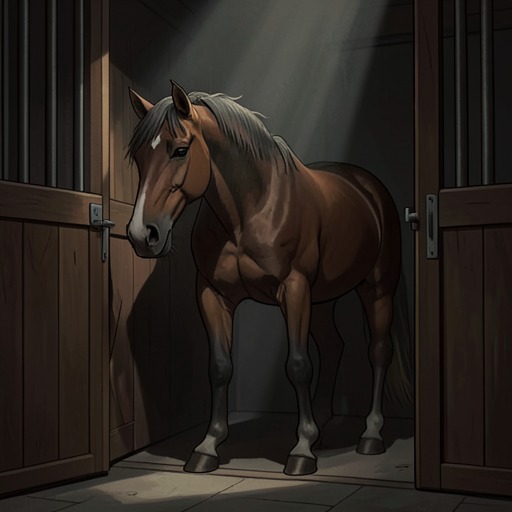
The stallion is kept in the stables beyond the stable-yard, a distinct area of the house that becomes a focal point in the final act. During Prudencia’s visit, the sound of the animal kicking against the stable walls interrupts conversation twice. On Bernarda’s orders, it is released into the stable-yard. The action brings the animal into view while leaving the household’s boundaries intact: it can move within the yard, but remains within Bernarda’s property.
Later, Adela, Amelia, and Martirio return from a walk after seeing the white stallion in the stable-yard. Their reactions differ: Adela regards it with wonder, Amelia with fear, and Martirio with indifference. The shared sight therefore does not produce a single response; it sharpens the differences among the sisters even as they remain subject to the same household rules.
Sound, Movement, and Desire
The stallion’s first role in the act is acoustic. Its blows against the stable walls interrupt the conversation between Bernarda and Prudencia, bringing force and disturbance into a scene governed by talk of inheritance, obedience, and respectability. The sound comes from beyond the main courtyard, but cannot be ignored. The animal makes the stable’s hidden activity present in the domestic space without entering the conversation as a human speaker could.
Its release into the yard turns that offstage sound into a visible encounter. The stallion’s movement contrasts with the daughters’ closely managed lives: they can take only a brief walk, and Bernarda decides when the household goes to bed. Within that contrast, Horse works as a symbol of desire pressing against restraint, while also remaining a concrete part of the household’s geography and routine.
Relation to the Final Conflict
The stable-yard is not merely a place where the stallion is seen. Later that night, Adela slips out to meet Pepe el Romano in the stables. When Martirio calls her back, Adela appears with her hair dishevelled and straw on her petticoat, signs that reveal where she has been. Her meeting there brings the secret conflict between the sisters into the open and leads Bernarda to rush out in search of Pepe.
The act does not state that the stallion causes or witnesses the meeting. Its significance comes from the setting and sequence: the same stable complex that contains the restless animal becomes the place of Adela’s forbidden encounter. Horse’s earlier disturbance thus helps establish the stable-yard as a charged space, where the household’s controlled surface gives way to movements that Bernarda cannot fully command.
Dramatic Significance
The animal’s appearances concentrate the play’s contrast between physical enclosure and unruly life. Bernarda’s house is described through thick walls and carefully separated interior spaces; against that architecture, the stallion’s repeated blows make pressure audible. Its release offers movement, but only within the household grounds, a limited freedom that mirrors the constrained choices available to the women.
The stallion’s differing reception by Adela, Amelia, and Martirio also prepares the act’s larger division among them. Its presence does not resolve their conflict, but gives it a material counterpart: force contained behind walls, then briefly visible in the yard. In a drama that links social order to domestic space, Horse makes the tension between desire and control part of the stage action itself.