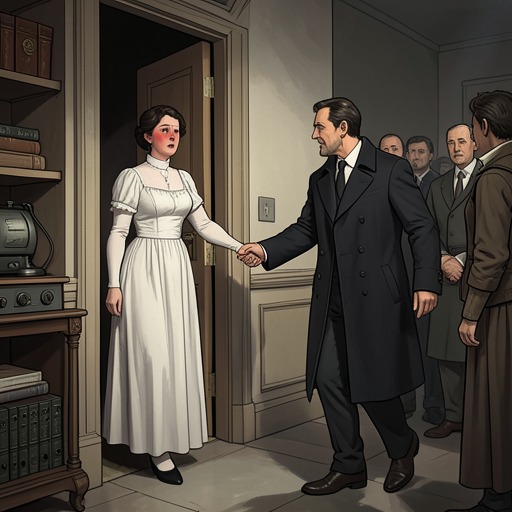
Librada’s daughter’s infanticide and threatened lynching
The House of Bernarda AlbaIn Act Two of The House of Bernarda Alba, Librada’s daughter’s infanticide and threatened lynching turns a report of a private crime into a public test of the village’s honor code. When Poncia describes the woman’s act and the crowd’s pursuit, Bernarda endorses her killing; Adela instead begs that she be allowed to escape. The brief scene exposes the consequences of a social order that condemns unmarried motherhood and treats collective punishment as a defense of sexual respectability.
The Report and the Pursuit
Poncia brings the news to Bernarda: Librada’s daughter, unmarried and pregnant by a father no one knows, had a child and killed it to conceal what she regarded as her shame. Dogs uncovered the body and left it at the woman’s doorstep. By the time Poncia tells the household, villagers are already dragging the woman down the street, while men run from the paths and olive groves toward the scene. The report supplies the immediate cause of the crowd’s pursuit, but the language of shame also identifies the social judgment driving it.
Adela’s brief question about the child gives way to an unequivocal objection once she hears that the woman is in danger. Bernarda, by contrast, calls for the villagers to come with olive switches and pick-handles and kill her. Her response is not presented as a legal judgment or a measured inquiry into what happened; it is an open endorsement of punishment by the crowd. A woman’s violation of the village’s sexual expectations becomes, in Bernarda’s view, grounds for violence.
Bernarda and Adela: Opposed Responses
The exchange sets Bernarda’s insistence on punishment against Adela’s refusal to accept it. Adela urges the others not to go out and pleads for the unmarried mother to be allowed to escape. Bernarda repeats her demand that the woman die, while Martirio supports the idea of going out to join the crowd. The sisters’ opposing reactions show that the household does not respond to the village’s code with a single voice, even though Bernarda’s authority shapes its rules.
As the noise of a woman’s cry and the uproar outside reach the house, Adela’s resistance grows more urgent: she calls again for the woman’s escape and warns the others not to go out. Bernarda answers from beneath the arch by demanding that the crowd finish the killing before the guards arrive. Adela’s appeal is thus set against not only Bernarda’s judgment but the speed and force of a pursuit already under way. The scene establishes an ethical divide without showing the outcome for Librada’s daughter.
Social Code and Historical Context
The commentary on the play situates the episode within a rural community where gossip, public criticism, and anxiety about family reputation are pervasive. The villagers’ response to an unmarried mother reflects a sexual code that condemns women’s conduct while allowing greater freedom to men. The incident is presented as an example of the scandal and intense feeling attached to illegitimacy in village life, not as a formal judicial proceeding. Its force lies in how quickly social condemnation becomes an apparent license for collective punishment.
The book also places Bernarda’s attitude within a broader history of honor and law, while distinguishing the play’s scene from a direct representation of a legal case. It notes that the Spanish Penal Code of 1870 permitted a husband to kill in certain circumstances to restore his honor, including a wife’s adultery or the rape of his wife or daughter; that provision was not repealed until 1963. The episode does not depict that precise situation or establish that the pursuing villagers act under the statute. Rather, the legal history illuminates a wider culture in which male-centered ideas of honor could normalize violence, while the crowd’s pursuit in the play remains an instance of social, not formally adjudicated, punishment.
Dramatic Function and Significance
The episode’s placement near the end of Act Two brings the village’s values into the household through Poncia’s report and the audible disturbance outside. It expands the play’s conflict beyond the walls of Bernarda’s home: the community that watches and gossips also acts collectively against a woman who has broken its sexual code. The crowd’s approach gives an external, immediate form to the social surveillance that shapes life inside the house.
The incident also throws light on Adela’s later crisis without making the two women’s situations identical. The commentary notes that Adela’s gesture of clutching her belly during the report suggests her fear or recognition of a possible pregnancy. The scene therefore gives the threat surrounding unmarried motherhood a personal urgency for her, while her defense of Librada’s daughter marks a clear departure from Bernarda’s punitive response. In a play presented as a documentary-like portrait of Spanish provincial life, this brief confrontation links household confinement, public reputation, and gendered sexual judgment to the danger faced by women beyond Bernarda’s doors.