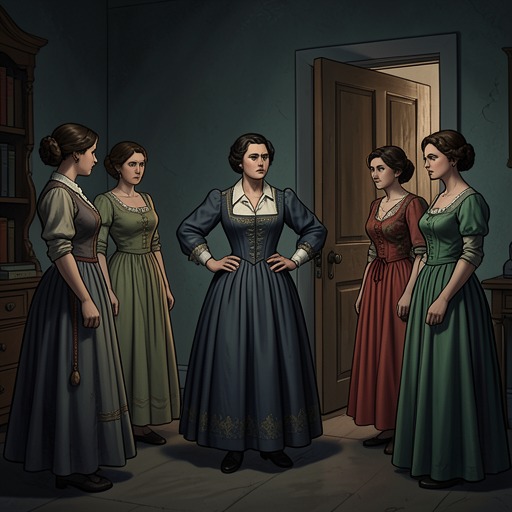
Magdalena
The House of Bernarda AlbaMagdalena, the second daughter of Bernarda Alba, stands between open protest and accommodation. In the household’s eight-year mourning period, she declares that she will never marry, yet elsewhere repeats her mother’s assumptions about class and women’s roles. Her presence links the sisters’ frustrated prospects to the larger systems of inheritance, domestic labour, and reputation that govern their lives.
Identity and Background
Magdalena is one of Bernarda’s five daughters. The play gives her a place in a family whose circumstances are sharply divided by inheritance: Angustias, the eldest, is the only wealthy daughter, while the younger sisters face a future shaped by their mother’s rules and by the limited choices available to women in their village. Magdalena’s response to that predicament is not simply rebellion or compliance; she can voice refusal, but also speaks as if the existing order cannot be changed.
The character’s name has a real-life source. Frasquita Alba had seven children, including daughters named Amelia and Magdalena, and Lorca retained those names for characters in the play. This biographical connection places Magdalena among the figures whose names draw on the world that inspired the drama, without making the fictional character identical to her historical namesake.
Mourning and the Household
After the funeral, Bernarda rejects Adela’s brightly decorated fan as inappropriate to the occasion and announces that the household will mourn their father for eight years. She tells the daughters to occupy themselves by embroidering their trousseaus, turning mourning into a regulated domestic routine and marriage preparation. Magdalena answers that she will never marry. Bernarda silences her, and the exchange ends not in negotiation but in the mother’s dismissal of the daughters.
Magdalena’s declaration is significant within a village culture where women’s lives are conventionally restricted to sewing, embroidery, and marriage. The social commentary accompanying the play identifies spinsterhood and arranged or loveless marriage as genuine possibilities in rural life. Her refusal therefore registers a limit placed on her future, even as the evidence does not show her leaving the household or escaping its constraints.
Inheritance and Family Tensions
Angustias’s position makes the sisters’ unequal prospects concrete. Amelia observes that Angustias has her father’s money and is the only rich woman in the house, and that this wealth draws suitors now that the estate is being divided. Magdalena is among the sisters who must live with the consequences of an inheritance that concentrates resources in Angustias’s hands.
The family’s financial divisions are entangled with its silences. Antonio María Benavides, Bernarda’s husband and Angustias’s stepfather, left Angustias considerably more money than he left his four natural daughters. Commentary on the play notes that Bernarda strikes Angustias after the revelation of the will, while cautioning that any explanation involving a closer relationship or Bernarda’s suspicion remains an unstated possibility, not an established fact. Magdalena’s circumstances thus belong to a household where money determines status and where the reasons behind unequal treatment are not fully disclosed.
Class and the Limits of Change
Magdalena echoes Bernarda’s class outlook in the statement, “Each class does what it must.” The line places her closer to her mother’s acceptance of hierarchy than to an imagined rejection of it. The accompanying commentary describes her as having accepted, after thirty years, the seemingly inevitable and unchanging nature of things. Her resignation is a distinct response to confinement: she can reject marriage for herself, yet still frame the social order as something each class must endure.
That outlook reflects the material setting of Bernarda’s household. Bernarda owns a substantial house, employs people on her land, and can afford fine lace and expensive furniture for Angustias’s marriage. The commentary presents wealth as a source of authority and social superiority, while the rural division between men’s and women’s lives assigns the daughters domestic work. Magdalena’s speech about class makes visible how that hierarchy may be repeated not only through explicit commands, but through the language of acceptance.
Presence Among the Sisters
Magdalena remains part of the sisters’ shared domestic world even when she is not at the center of its most consequential confrontations. She enters with Martirio and Amelia in one stage direction, and later, when salt is spilled, Amelia addresses her with a brief warning. These moments place her within the ordinary rhythms of the household, amid the small gestures and exchanges that continue beneath its larger conflicts.
When the sisters discuss Angustias’s engagement to Pepe el Romano, Magdalena says, “You are both mad.” The evidence does not specify exactly which of the others she addresses, but the remark shows her intervening in their argument without resolving it. The question of Angustias’s marriage also resurfaces when Martirio asks why her fiancé has not come that night. Magdalena’s role in these exchanges is less a decisive intervention than a measure of how the engagement holds the household’s attention.
The play’s final crisis brings the sisters into open conflict over Pepe and the family’s reputation. Angustias accuses Adela of taking him and shaming the house; Bernarda then orders the truth about Adela’s death concealed and insists that her daughter be presented as having died a virgin. The evidence does not assign Magdalena a separate action or speech in this ending. Her absence from the reported decisive exchange is consistent with the play’s distribution of attention: her characterization rests chiefly on her brief refusals, her acceptance of class convention, and her place within the group of daughters whose lives Bernarda regulates.