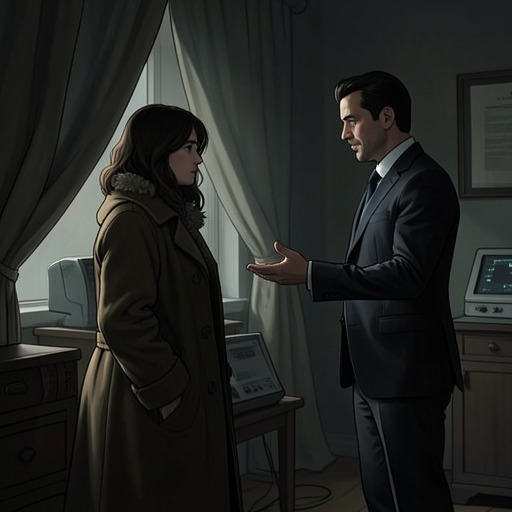
Martirio’s theft of Pepe’s portrait
The House of Bernarda AlbaMartirio’s theft of Pepe’s portrait is the moment when an intimate, concealed attachment becomes a public conflict inside Bernarda Alba’s household. Angustias discovers the image missing from beneath her pillow; Bernarda orders a search, and Poncia finds it between the sheets of Martirio’s bed. Bernarda strikes Martirio with her stick, and the discovery sharpens the sisters’ accusations and rivalries rather than restoring order.
Discovery and Immediate Consequences
The theft comes amid growing tension among the women. After Angustias demands to know who took the portrait, Bernarda questions her daughters and directs Poncia to search their rooms. The image is found in Martirio’s bed, converting suspicion into evidence and drawing Bernarda directly into the conflict. Her blow and renewed insistence on authority demonstrate that the household’s rules are enforced through discipline, while the sisters’ bitter accusations show that the discovery has made their divisions harder to contain.
The episode also belongs to a larger pattern of watchfulness. The women discuss the presence of someone in the stable-yard in the early hours, and Poncia later tells Bernarda that Pepe has been seen talking with Angustias at half-past four in the morning. Angustias denies this, but the report produces further dissension. In a house where neighbours’ judgment matters and arguments are feared as material for gossip, the portrait’s disappearance is not treated as a private curiosity: it threatens to expose feelings that the family’s public respectability is meant to conceal.
Desire, Rivalry, and Secrecy
The recovered portrait gives tangible form to the sisters’ competing attachments to Pepe. Martirio’s act reveals her interest in him through a secret appropriation of his image, while Angustias’s demand reflects her claim as the woman engaged to marry him. The book’s account places the theft within a sequence of tensions involving Angustias’s resentment, Adela’s fascination with Pepe, and the strained relations between Adela and Martirio. The portrait does not resolve these competing claims; its discovery makes them harder to deny.
The revelation is followed by an even more direct confrontation. When Bernarda and the other women leave, Martirio threatens to expose Adela’s affair with Pepe, and Adela insists that he will be hers. The stolen image and the later disclosure are distinct turns in the conflict: first Martirio’s attachment is exposed through an object hidden in her bed; then she uses the threat of exposure against Adela, whose secret relationship carries much greater consequences for the family’s honour.
Family Honour and the Wider Conflict
The portrait episode sits within the play’s depiction of a society in which women’s conduct is closely monitored and family reputation is treated as a matter of public consequence. Bernarda objects to private disagreements being overheard by neighbours, and the critical account connects her final insistence that Adela be declared a virgin to her determination to protect the family name. In this context, Martirio’s theft is both a personal act and a breach of the household’s demand that desire remain hidden.
The play’s realism grounds that household conflict in village customs and social pressures: domestic work defines women’s expected lives, men are granted greater sexual freedom, and gossip can damage a family’s standing. The portrait is a small, specific object within that larger structure, but its movement from Angustias’s pillow to Martirio’s bed makes concealed rivalry legible. Its discovery briefly exposes the truth of what the family’s rules attempt to suppress, even as Bernarda responds by tightening her control.
Place in the Play’s Tragic Movement
The incident foreshadows the exposure of Adela’s relationship with Pepe and the final breakdown of Bernarda’s efforts to govern her daughters through silence and obedience. The play’s later crisis intensifies the same conflict between private desire and public honour: after Adela’s death, Bernarda insists that the villagers be told her daughter died a virgin and again commands silence. The portrait theft does not cause that ending, but it establishes an early pattern in which a hidden attachment surfaces, provokes punishment, and is met with efforts to control what others may know.
The episode also reflects the work’s blend of social realism and symbolic force. The household and its relations are presented as grounded in recognizable village life, while the portrait concentrates the sisters’ rivalry in a single object that can be hidden, searched for, and found. Its discovery makes the private conflict visible without freeing the women from the social order that constrains them.