Mourning
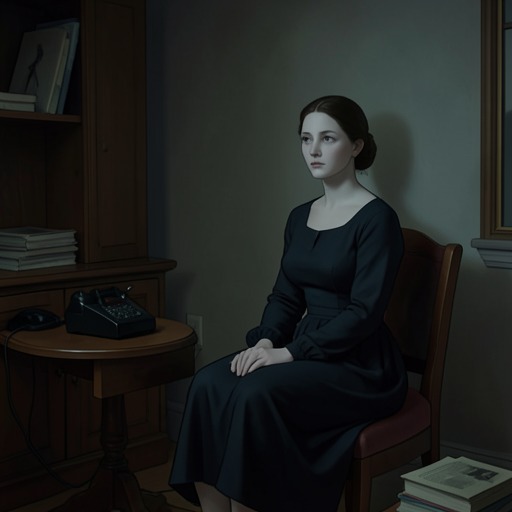
The House of Bernarda AlbaIn The House of Bernarda Alba, mourning is not only grief for the dead but an imposed social order. It governs how the household appears, what its members may say, and how they are expected to behave; its black garments and enforced silence stand against María Josefa’s visions of children, neighbors, and life beyond the house. At the close, Bernarda makes mourning the public frame for her daughter’s death, demanding silence while asserting a version of events that protects the family’s reputation.
Mourning as Household Order
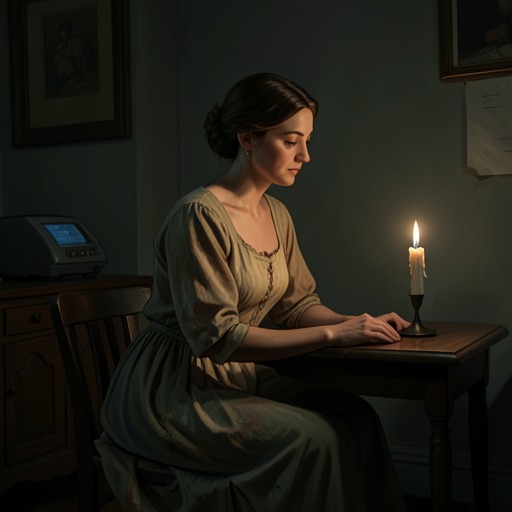
The play’s final act opens at night in an inner courtyard of Bernarda Alba’s house. Four white walls are lightly tinted blue, and the table is lit by an oil lamp as the household eats. The stage directions specify complete silence, broken only by plates and cutlery; Poncia serves, and Prudencia sits with Bernarda and her daughters. The quiet is thus built into the scene before anyone speaks: mourning has become an atmosphere and a discipline, not merely an individual response to loss.
The visual order carries a wider meaning. The commentary on the play connects the white walls to the daughters’ expected purity, Bernarda’s concern for an unblemished reputation, and the monotony and sterility of their lives. The thick walls suggest physical and emotional imprisonment, while the tolling of bells evokes the hold of the Church and tradition on village life. Against that confinement, mourning is not simply a private observance; it is one of the social forms through which the household’s isolation and restrictions are maintained.
A World Without Renewal
María Josefa’s words provide the sharpest counterimage to the house’s mourning. She imagines that her white hair does not prevent her from having children and pictures successive generations becoming a single wave, their hair white as foam. She then contrasts that imagined abundance with the reality around her: there is no foam, only mourning veils. Her repeated vision of births and a future extending beyond one generation sets life’s continuation against the household’s stasis.
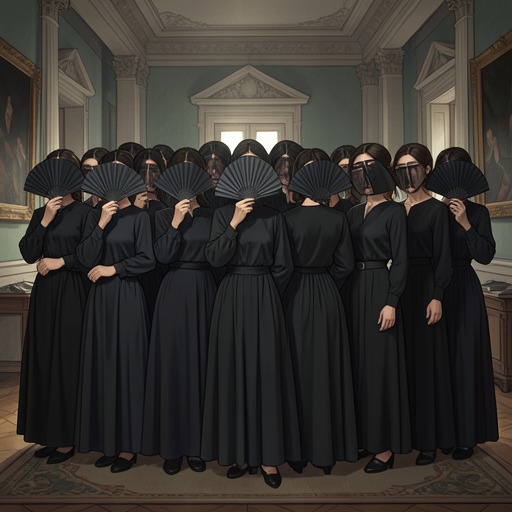
Her memories of exchanging visits with a neighbor after each woman had a child make that imagined world socially specific. She longs to leave the countryside for open houses, neighbors with their small children, and men sitting outside. The contrast is not simply between sadness and cheerfulness: María Josefa describes a community of reciprocal visits and family life that Bernarda’s closed household excludes. Mourning’s dark coverings mark that absence, while her restless wish to depart makes the limits of the house audible.
Mourning, Honor, and Social Punishment
The episode of Librada’s daughter shows the punitive social world against which Bernarda’s household defines its respectability. Poncia reports that the unmarried woman killed the child she had concealed and that dogs uncovered the body and left it at her door. Villagers are pursuing her, with men coming from the paths and olive groves; Bernarda approves their demand that she be killed. Adela objects, and Martirio says the women should go out as well. The scene reveals how quickly sexual shame becomes collective punishment, rather than a matter confined to the woman’s own household.
The commentary places such judgments within a wider culture of sexual honor and reputation. It notes that the Spanish Penal Code of 1870 permitted a husband to kill in certain circumstances to restore his honor, and that the provision was not abolished until 1963; the play does not stage that precise legal situation. Instead, its village pursuit dramatizes an informal violence licensed by communal attitudes, while Bernarda’s later insistence on controlling what neighbors hear and believe shows honor operating inside the house too. Mourning, reputation, and silence are linked by the demand that public appearance take precedence over compassion or disclosure.
The play’s social criticism also reaches beyond Bernarda as an individual. Its account of village life treats traditional gender roles and concern for family reputation as attitudes shared, though not identically, by members of the household and community. The commentary connects Lorca’s realist project to his stated interest in exposing contemporary Spain’s social and moral ills, and to the play’s description as a drama of women in Spanish villages. Mourning therefore belongs to the work’s representation of a broader provincial order, not just to one family’s response to bereavement.
The Final Command
After Adela’s death, Bernarda refuses to go inside and addresses Pepe, saying he has escaped this time but will fall one day. She then orders that Adela be cut down, carried to her room, and dressed as a virgin. She insists that no one will say anything and repeats that her daughter died a virgin. The sequence makes the distinction between death and its public interpretation stark: Bernarda’s first concern is to determine what the village will be told.
She next forbids weeping, tells the household to face death, and commands one daughter after another to be quiet. The play ends with Bernarda declaring that they will drown in a sea of mourning, identifying Adela as her youngest daughter and again insisting that she died a virgin. The theatrical close gives the command its final force: silence is repeated until the curtain falls. Mourning becomes both the language of collective loss and an instrument for concealing the circumstances and implications of that loss.
Meaning and Reception
The play’s treatment of mourning depends on the contrast between visible respectability and hidden conflict. Its walls, veils, bells, and silences give grief a material and social form, while María Josefa’s imagined births and open homes expose the life that the household’s discipline cannot accommodate. Bernarda’s final declaration gathers these tensions into one public account, in which the family’s reputation is guarded even as its members are ordered to suppress their grief.
The endurance of this dramatic conflict is reflected in later reception. A 1979 New York production by Repertorio Español drew praise for the strength of its production, and when the company staged the play again in 1989, a New York Times reviewer observed that it had lost none of its relevance. That continued relevance accords with the play’s presentation of mourning as more than a period after death: it is a social practice entangled with gender, reputation, and the power to dictate what may be spoken.