Social class and hierarchy
The House of Bernarda AlbaSocial class and hierarchy in The House of Bernarda Alba are not a distant backdrop but a working system: money confers authority, birth determines whom a daughter may marry, and domestic labor marks women’s place in the household. Bernarda both commands this order and is governed by it. Her power over servants and daughters is real, yet her insistence on class boundaries narrows the choices available to the family and helps turn social convention into private conflict.
Wealth, Authority, and Dependence
Bernarda’s substantial house, paid workers, and expensive possessions establish her elevated position in the village. She can buy fine lace for Angustias’s marriage and spend sixteen thousand reales on furniture. Her wealth is not merely a matter of comfort: it gives her power over people who depend on her employment and allows her to perform social superiority. The servants, meanwhile, are treated with such scant regard that they take food when they can. The household’s hierarchy is therefore visible in the unequal distribution of property, authority, and basic consideration.
That authority is also tied to Bernarda’s own sense of origins and rank. When Poncia warns that Martirio has been denied freedom to marry Enrique Humanes, Bernarda replies that she would refuse the match again: Humanes’s father was a farmhand, and she will not mix her blood with his. Poncia asks what Bernarda’s airs and graces have achieved; Bernarda answers that she has them because she can afford them, unlike Poncia, whose origins she invokes as a rebuke. The exchange lays bare how money and ancestry work together in Bernarda’s judgment: class distinction is not an abstract principle but a weapon used to dismiss a person who challenges her.
Class Boundaries and Marriage
The rejection of Enrique Humanes makes social rank an active limit on the daughters’ prospects. Poncia says Bernarda sent word to him not to come to Martirio’s window on the very day he was expected. Bernarda openly defends that intervention on class grounds. The episode shows that a daughter’s romantic choices are subject not only to family command but to a hierarchy in which a suitor’s background can disqualify him before the relationship develops.
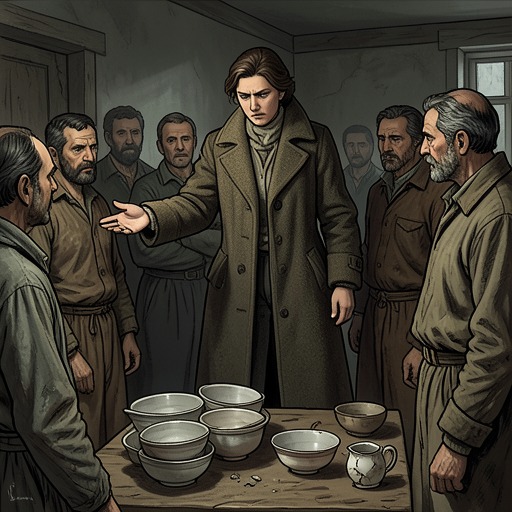
The play also connects rank with the division of work and gender. As the harvesters arrive, Adela longs to go out to the fields, while Magdalena says that each class must do its own work and Martirio agrees. Poncia remarks on the joy of the fields at harvest time and notes the arrival of forty or fifty young men, but the daughters remain seated within the household’s prescribed role. Class appears here as an accepted explanation for unequal access: the women recognize the world beyond the house but describe its divisions as something each group must observe.
Bernarda’s mourning decree makes that domestic order concrete. She declares that for eight years the wind from the street will not enter the house, imagines the doors and windows sealed with bricks, and directs the daughters to embroider their trousseaus from linen stored in a chest. Magdalena is assigned the embroidery, while Adela challenges her over whether the work should be done. Mourning, confinement, and sewing thus organize the daughters’ time around domestic labor and future marriage, even as their ability to choose that future remains constrained by family authority and class distinctions.
Work, Speech, and Social Rank
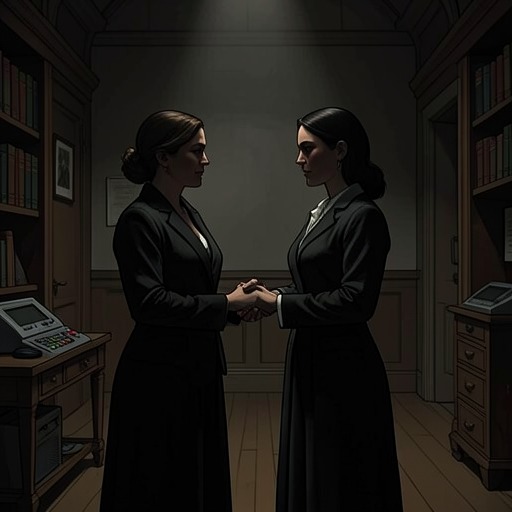
The hierarchy between Bernarda and Poncia governs not only marriage decisions but also who is entitled to speak. When Poncia tries to warn Bernarda about what is happening in the household, Bernarda tells her that her duty is to work and keep her mouth shut because she is paid to work. Poncia’s employment gives her access to the household and knowledge of its tensions, but Bernarda uses that same employment to deny her standing as an adviser. The relationship reveals how class can make a person’s insight useful to those in power while leaving that person without recognized authority.
Poncia’s position is complicated by her long service and her awareness of the household’s divisions. She says she has always been grateful for Bernarda’s protection, but resents being reminded of her origins. Her warnings do not erase the social distance between the women. Instead, their exchange shows that dependence can coexist with judgment and that a subordinate person may understand the consequences of power without being able to compel the powerful to act.
Inheritance and Unequal Standing
Property also shapes rank within the family itself. Angustias is Bernarda’s daughter from her first marriage, and Antonio María Benavides leaves her much more money in his will than to his four natural daughters. After this inheritance is revealed, Bernarda physically attacks Angustias by wiping powder from her face. The sequence makes the unequal distribution of property a source of suspicion and tension, not simply a financial detail. Commentary on the play raises, without resolving, whether Benavides’s preference for Angustias may point to a closer relationship and whether Bernarda suspects one. The possibility remains a question rather than an established explanation, but it underscores how the family’s public order conceals unresolved matters of kinship and inheritance.
The larger village world similarly turns property and reputation into sources of lasting division. Prudencia’s husband has quarrelled with his brothers over an inheritance, and the dispute has become common gossip, damaging his reputation and causing family anguish. The incident extends the play’s concern beyond Bernarda’s household: inheritance disputes are part of the community’s ordinary social life, and their consequences travel from property to public standing.
Hierarchy, Respectability, and Consequences
Social rank intersects with the village’s unequal standards of sexual conduct and public honor. When Poncia reports that Librada’s unmarried daughter has killed her child and that villagers are pursuing her, Bernarda supports the crowd’s demand that the woman be killed. Adela protests that they must not kill her. The scene shows how a community’s power is exercised not only through wealth or household authority but through collective punishment, with an unmarried mother made the target of public outrage. Bernarda’s response offers no comparable scrutiny of men’s greater freedom, a double standard the play repeatedly connects with the prevailing social order.
The final crisis returns the language of rank and reputation to Bernarda’s own family. After Adela’s death, Bernarda insists that her daughter died a virgin, orders the household to keep silent, and directs the others to carry her away and dress her as a virgin. The insistence seeks to preserve the family’s standing by controlling what the community will be told. Bernarda’s command cannot undo the events that have produced the crisis; it can only impose a public account upon them. Her authority is strongest in managing appearance, even as the concealed truth exposes the failure of the order she has enforced.
Across the play, hierarchy operates through inheritance, employment, marriage, labor, and reputation. Its effects are not confined to open commands: the daughters’ domestic work, the barred possibility of a marriage with a farmhand’s family, Poncia’s enforced silence, and the village’s response to an unmarried mother all show how convention becomes ordinary practice. Bernarda’s household concentrates these pressures, while the wider community confirms that they are not hers alone. The result is a social world in which wealth and respectability grant power, but preserving that power requires the suppression of choices and truths that the household cannot finally contain.