Sterility and vitality
The House of Bernarda AlbaIn The House of Bernarda Alba, sterility and vitality form a recurring opposition between a house organized around mourning and control and the force of life that its inhabitants cannot entirely suppress. The contrast is carried through practical details—linen set aside for marriage, lace imagined as a baby’s bonnet, a stallion kicking its stable wall—and through María Josefa’s vision of children becoming waves and foam. Fertility is not merely a private hope: it exposes what the household’s rules deny, while the images of life and reproduction register the pressure those rules place on women.
A household organized against life
Bernarda turns the eight years of mourning into a regime of enclosure. She declares that the wind from the street will not enter the house and compares its shut doors and windows to openings sealed with bricks. The daughters are to begin embroidering their trousseaus, with twenty pieces of linen already waiting in a chest to be cut into sheets. Marriage and its expected domestic future are present in the fabric, but the women’s immediate work is to sew within a house barred from the world. Magdalena answers that she does not care; Adela sharply tells her that if she will not embroider the others’ trousseaus, she can leave them plain, so that her own will look better. The exchange turns sewing from a neutral pastime into a sign of constrained futures and resentful differences among the sisters.
The play’s social world gives that domestic order a material basis. The daughters’ sewing and embroidery reflect a traditional division in which women’s lives are confined to household work, while their prospects are spinsterhood or an arranged, loveless marriage. Bernarda’s maxim assigns women needle and thread and men a whip and mule; her instruction that Angustias should speak when her future husband speaks and look at him when he looks at her makes marriage another structure of obedience. The women’s reproductive role is expected, but their own desires and choices are not given comparable freedom.
The lace offered for a baby’s bonnet or christening gown brings that expectation into a small, concrete object. Poncia says Angustias might use it if she begins having children, in which case the daughters would be sewing day and night. Magdalena refuses to sew even one stitch; Amelia says she is even less willing to care for someone else’s children and points to the women nearby, worn down by their little ones. The conversation connects fertility to the unpaid labor that would follow it: birth is anticipated not as an uncomplicated fulfillment, but as more sewing and childcare assigned to women already denied room to shape their own lives.
A force pressing at the walls
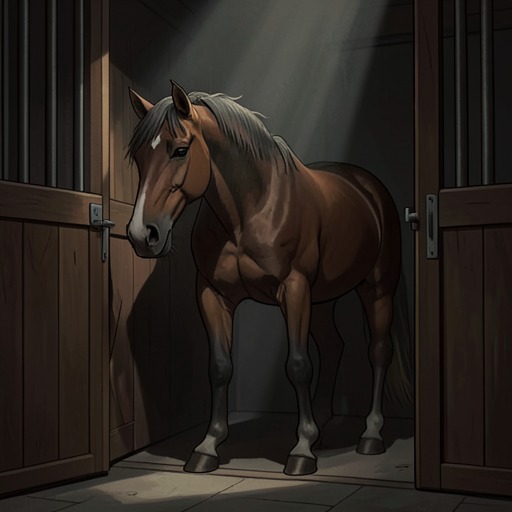
Against the closed house, the stallion makes vitality audible. A heavy blow sounds against the walls, and Bernarda identifies the horse locked in the stable as kicking. She orders that it be hobbled and let out into the yard, saying in a normal voice that it must be hot. When Prudencia asks whether Bernarda will let it loose among the new mares, Bernarda answers that this will happen at sunrise. The exchange places breeding within the household’s ordinary management of animals and property, even as the stallion’s force appears as an insistent disturbance of walls and containment.
That energy also has an economic dimension. Bernarda attributes the expansion of her stable to money and considerable worry. Elsewhere, her wealth is visible in the expensive furniture she says cost sixteen thousand reales, as well as the fine lace bought for Angustias’s marriage. Property and money give her authority over the household and those who work for her; in this setting, reproduction is both a matter of life and part of the management of household resources. The contrast is therefore not simply between a living animal and a lifeless house. It sets the body’s demands against a social order that regulates women’s domestic work, marriage, and sexual conduct.
María Josefa’s vision of fertility
María Josefa gives the theme its most expansive and unsettling image. Holding a lamb, she insists that it may stand for a child and says that having a lamb is better than having nothing. She imagines that, despite her white hair, she can still have children, and then children after them: each child will have another, until all of them have white hair like snow. They will become like waves, one after another, and finally foam. Her repeated generations stretch beyond the solitary household, turning fertility into continuity and abundance.
The image collides directly with the house she inhabits. María Josefa asks why there is no foam there, answering that there are only mourning shawls. The sea’s waves traditionally suggest fertility; here they oppose a household marked by mourning and sterility. Her white hair also links her image to Adela, who appears in a white petticoat and bodice, while the dark shawls give the home a visual identity of bereavement. The contrast makes María Josefa’s vision more than an eccentric fantasy: it gives language to the life the house excludes.
Her imagined future is communal as well as reproductive. She remembers exchanging chocolate with a neighbour after the neighbour had a child, a reciprocal practice that continued “always, always, always.” She laments that the neighbours will no longer come and longs to leave the fields for open houses, where women sleep beside their little children and men sit outside. Her desire is for a world in which birth is accompanied by neighbourly exchange and open doors, rather than confined behind the household’s walls. Yet fear remains in the image: she worries that dogs will bite her as she leaves, and asks to be accompanied past the fields.
The conflict’s wider meaning
The play’s opposition between sterility and vitality brings bodily reproduction into conflict with social repression. Bernarda’s house prepares trousseaus and anticipates children, but it also seals out the street, assigns women domestic labor, and insists on obedience. A baby’s bonnet promises a future while the women discuss the exhausting work that would accompany it; the stallion’s breeding power is managed as part of the stable, while the daughters’ desires remain subject to the house’s rules. Life is present throughout, but its terms are shaped by unequal authority and constraint.
María Josefa’s waves finally offer a counter-image to the household’s closed repetition of mourning. Her vision moves outward, from one child to generations and from the family’s interior to a shore filled with foam. It gives the play’s conflict a vivid form: the house can demand silence and enclosure, but it cannot make the desire for life, children, connection, and open space disappear. The distance between her living sea and the mourning shawls is the measure of what the household’s order suppresses.