The Harvesters’ Song
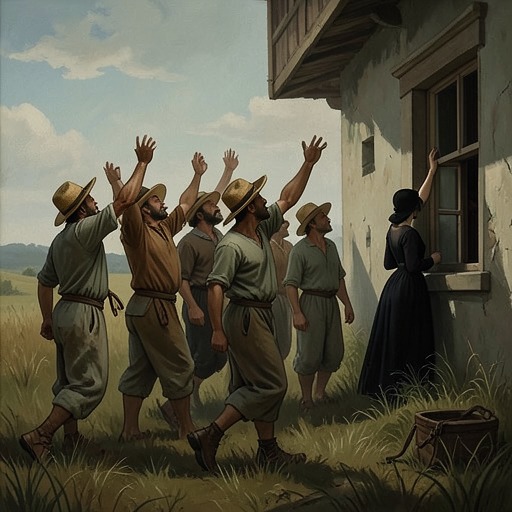
The House of Bernarda AlbaThe Harvesters’ Song is an offstage chorus heard by the women of Bernarda Alba’s household. Its verses connect the reapers’ work with the attention and longing of girls watching them, then invite women in the village to open their doors and windows. The song’s decisive dramatic force lies in that contrast: workers move out toward the fields while the daughters remain indoors, listening and imagining a freedom they do not share.
Appearance and Sound
A distant song is heard approaching. Poncia recognizes the singers and remarks on the beauty of their songs; Amelia identifies them as reapers setting out to work. The sound is accompanied by tambourines and a rough folk instrument, and the stage direction holds the household in silence as the music draws near. The chorus is therefore not a private song performed by one of the characters but a sound from beyond the house, entering the women’s closed world from outside.
The chorus first describes the reapers going out in search of ears of grain. As they leave, it says, they take with them the hearts of the girls who watch. The image binds agricultural labor to attraction: the men have a destination and a place in public life, while the girls are positioned as observers whose feelings are stirred by seeing them pass. Its words make the outdoor world present in the room without bringing the workers themselves onto the stage.
Open Doors and Restricted Lives
In a second verse, the chorus calls to women living in the village to open their doors and windows. It then says that the reaper asks for roses to decorate his hat. The movement of the song—from men going out to work, to women being asked to open their homes—briefly offers an image of exchange between the street and the household. Yet the women listening are living under the restrictions imposed within Bernarda Alba’s home, so the invitation remains an external voice rather than an action they can freely take.
The scene makes that divide explicit through the daughters’ reactions. Amelia says that being born a woman is the greatest punishment, and Magdalena adds that even their eyes do not belong to them. Adela longs to go out to the fields too. Their remarks locate the song within the play’s wider portrayal of women’s limited choices: the chorus may sing of girls watching the reapers and doors opening onto the village, but the daughters’ own words register the cost of being confined and watched.
Dramatic Function
The song brings the rhythms of harvest and village life into the household while exposing how unevenly freedom is distributed. The reapers can leave for the fields; the daughters can hear their music and respond, but cannot simply join them. The chorus’s reference to the hearts of watching girls gives the moment an emotional charge without resolving the women’s situation. Instead, it heightens the distance between desire and permissible action.
Poncia eventually urges the others to be quiet as the chorus continues farther away. The song thus approaches, fills the enclosed space with an alternative social world, and recedes, leaving the women inside. Its repeated appeal to open doors and windows resonates with the play’s concern with confinement and the desire for freedom, but the scene does not show the household opening itself to the life beyond it. The song remains both a communal sound and a measure of the separation the women endure.