Vitality versus repressive order
The House of Bernarda AlbaVitality versus repressive order is a central conflict in The House of Bernarda Alba: the play sets instinct, passion, and the generative force of nature against the social conventions and traditions that restrict them. The opposition is embodied in its characters and stage images, and gives the particular story of a family in a Spanish village a wider meaning as a conflict between life-enhancing and life-denying forces.
Two opposing worlds
The contrast takes visible form in the difference between Bernarda’s household and the world associated with natural vitality. Adela, presented as the embodiment of youth and energy, resists the restrictions imposed on her life. When she refuses to accept being shut inside, she is wearing her green dress. Its color links her to the fertility and vitality of nature, making her resistance legible not only as a personal refusal but as part of the play’s broader opposition between living desire and repressive convention.
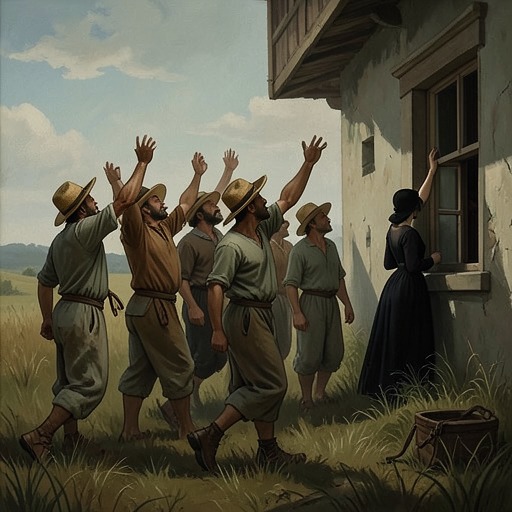
That contrast recurs in the imagery surrounding Adela and the harvesters. The olive grove, predominantly green, is associated with nature’s fertility and provides the setting for Paca la Roseta’s encounter with the young men. Poncia describes one of the strong young harvesters as having green eyes. Adela’s fan, decorated with green and red flowers, similarly carries colors that Bernarda rejects: green suggests natural life, while red evokes passion. When the harvesters pass the house, their song invites the girls to open their doors and windows and refers to roses in a sexual manner. The scene brings the energy of the outside world to the threshold of the closed household.
Nature, desire, and blocked life
The play’s images of fertility and creative power extend beyond color. The harvesters work in cornfields and are described as reaping in tongues of fire, connecting their labor to sunlight and to nature’s capacity to renew life. These images stand against the constrained existence of Bernarda’s daughters and sharpen the difference between the vitality visible beyond the house and the lives restricted within it.
Water and the sea offer another expression of openness and life. In a village described as lacking a river, the dry landscape suggests an absence of emotional and spiritual vitality. By contrast, María Josefa’s image of foam evokes the sea as a source of life and creativity, while her wish to marry a young man on the seashore imagines open space and freedom. Both images point toward possibilities that Bernarda’s household does not allow its women to inhabit.
Conflict and significance
The opposing images gather around the play’s central tension: instinct and passion meet an order sustained by convention and tradition. Adela’s green dress and resistance to confinement give the conflict a human focus, while the harvesters’ song, the olive grove, the cornfields, and the sea extend it into the landscape. Nature becomes more than a setting; it supplies a vocabulary for what the household suppresses.
Lorca’s use of particular characters, actions, and images allows the story to reach beyond one family and one house. The opposition between forces that enhance life and forces that deny it is presented as fundamental and universal. The play’s symbolic world makes that large conflict concrete: open doors and fertile land suggest movement and renewal, while the restricted household stands for the conventions that contain them.